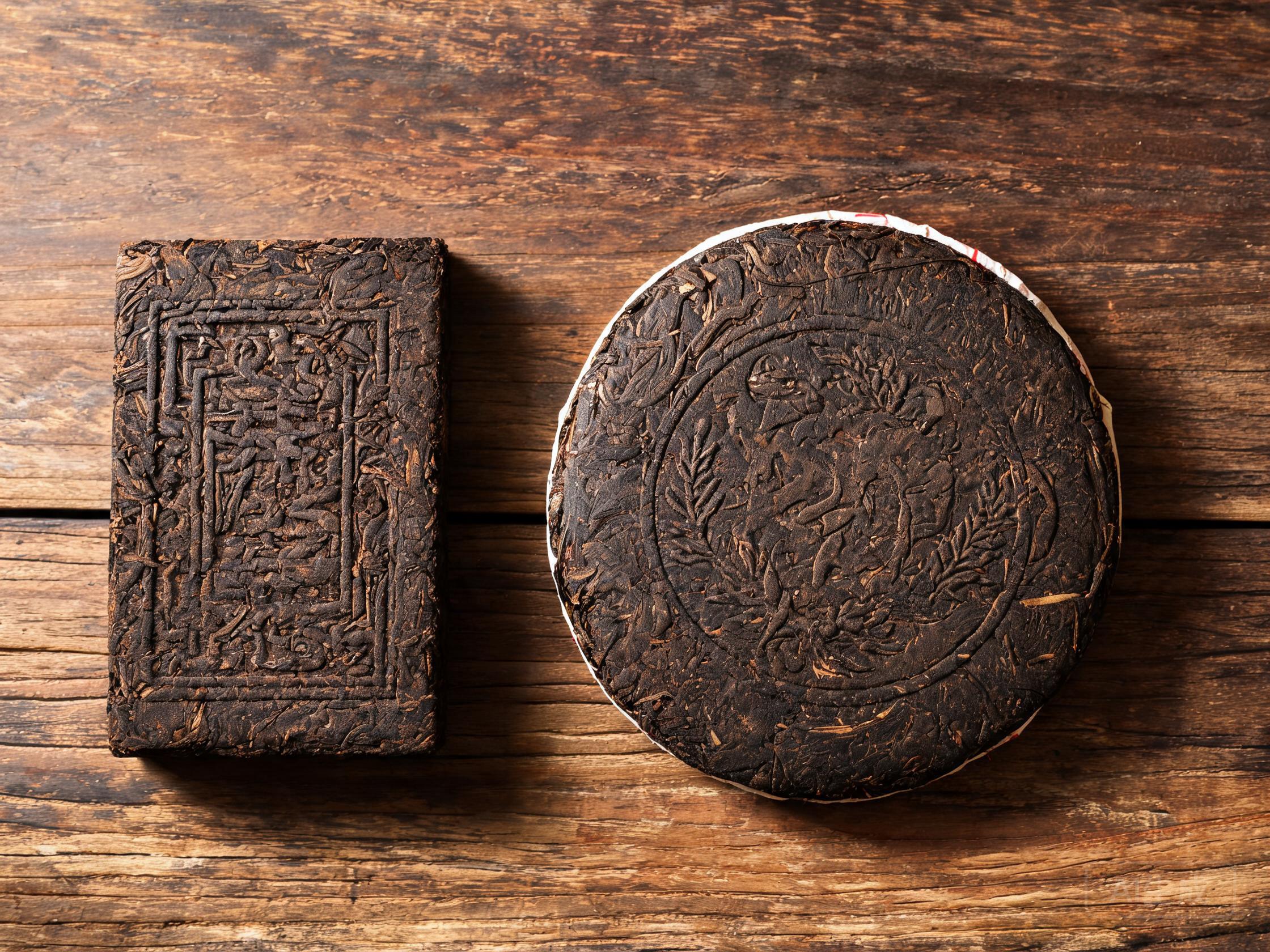
Wild and ancient trees
Reprocessed tea starts from a base leaf, so the word wild can only describe the base.
In practice that base is a cultivated green or a cultivated white, and not forest leaf.
Jasmine base is a clean green from Hengxian or from Fuding.
The flowers are cultivated too, and they are bred rather than gathered.
Hengxian plants jasmine over a wide area, and the harvest runs from late spring into autumn, so one batch of base leaf can be scented several times across a season.
So the craft here is a supply chain rather than a single origin.
Good base leaf plus fresh flowers is what makes the tea, and neither part is wild.
That is worth saying plainly, because wild does appear on these labels.
When it does, it usually refers to a compressed cake sitting under the scent.
A scented pu-erh can be made from old arbor leaf, and then the claim is inherited, not made.
For everything else in the category the word has no referent at all.
One part of the category can inherit an old tree claim, and the rest cannot.
That is the honest starting point for reading any label in this group.
Why age matters
Tree age matters least here of any category, because scenting covers the base.
The flower supplies the aroma, and it arrives from outside the leaf entirely.
Whatever a deep root contributed to the base gets buried under several rounds of blossom.
What survives is body, and body does come through in a well made tea.
A thicker base holds the scent longer and tastes less hollow after the third infusion.
That is the practical argument for a good base, and it has nothing to do with age.
Round count is the other variable worth knowing, since 3 rounds of blossom cost far more than 1 round, and the label will usually say so when it is true.
The same base bushes are used for white and green tea, where age matters rather more.
Here the flower does the work and the base does the carrying.
Soil, elevation and the maker’s hand matter more than either.
A careless scenting ruins an excellent base, and there is no recovery from that.
If you want the old tree argument to be legible, drink the unscented base instead.
Scented tea is the wrong place to look for it, and the labels know that.
What reaches the cup
What an old tree base contributes to a scented tea is a longer hold and a rounder body.
The scent fades more slowly, and the third infusion still tastes of something.
A thin base tastes hollow by then, because the flower has gone and the leaf had nothing.
Brew two bases at 85 °C with 3 g in 150 ml and run them both to 3 infusions.
The third cup is where the base shows itself, and the difference is obvious there.
The first cup tells you about the flower, and the third tells you about the leaf.
That is the useful way to taste any scented tea, whatever the label claims about it.
Bitterness from old leaf is mostly irrelevant here, since the scent dominates the early pours.
What remains is weight, and weight is what carries the fragrance.
Treat the base as a carrier rather than as a flavour, and the pricing becomes clearer.
It is worth paying for a good base, and not for a tree age you cannot verify.
The rest of the price is flower quality, round count and story, and those are separate.
A caveat on the word wild
Wild is a word that has almost no meaning in this category, and it appears anyway.
The flowers are cultivated, the base is cultivated, and the process is industrial.
Any wild claim here is inherited from a compressed base or invented outright.
Both happen, and only one of them is honest.
Compressed scented cakes are the exception, and those do carry whatever the base cake carried, including a tree claim if the original wrapper made one honestly.
The test is a place and a tree age you could check.
‘Wild jasmine’ is a mood, and ‘Fuding Dabai base from gardens above 600 metres’ is a claim.
One can be argued with, and one is built so that it cannot be.
Ask what the base is, since that question gets a real answer far more often.
Buy 25 g before believing any of it, and smell the dry leaf before brewing it.
A sprayed tea gives itself away immediately, and no tree claim survives that.
A seller with a good base will name the bush rather than reach for the adjective.
That difference in vocabulary is the whole test, and it takes one question.