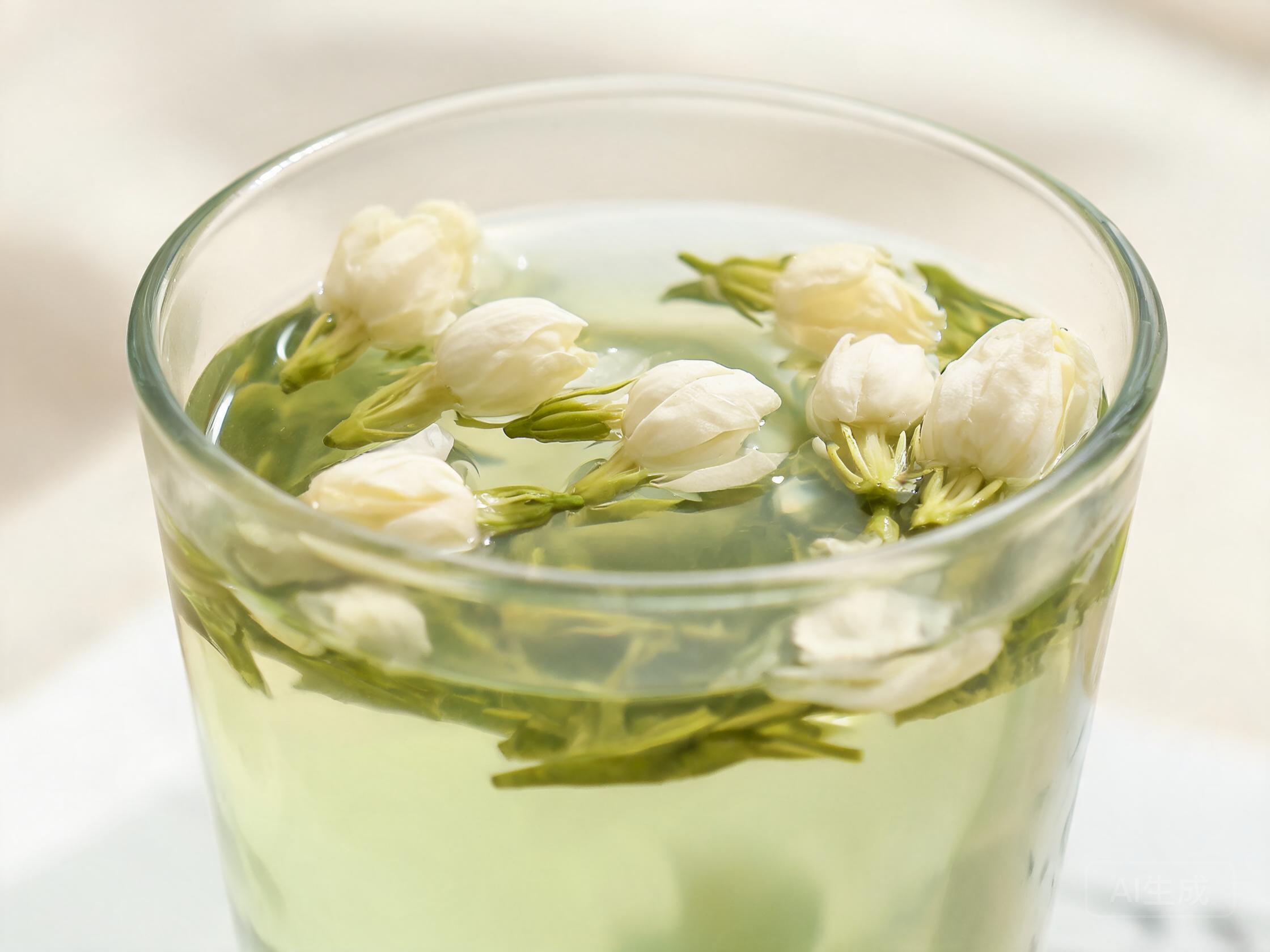
Jasmine tea is the best-known member of the scented tea family and, by volume, the most widely drunk flavored tea in China. What distinguishes it from a flavored or sprayed product is method: real jasmine tea takes its aroma from fresh flowers that are physically mixed with the finished leaf, repeatedly, over several nights. No oil, no essence, no shortcuts.
What Scented Tea Actually Is
Scented tea, or xūn huā chá, literally “smoked flower tea” , is tea that has absorbed volatile aroma compounds from fresh blossoms. Unlike a flavored blend, the flower is removed after scenting; only the aroma transfers. In the highest grades you will find no petal in the finished product at all.
Jasmine dominates the category because the flower’s biology suits the process perfectly. Jasminum sambac does not release its main aroma when it is picked; it releases it over the hours after dusk, as the bud opens. Scenting therefore happens at night, timed to the flower’s own rhythm.
How Scenting Works
The process is a controlled moisture and temperature exercise.
- Base tea preparation. Usually a green tea, sometimes a white or a light oolong. The base is dried lower than normal so it can absorb moisture and aroma without spoiling.
- Flower intake. Buds are picked in the afternoon, held until evening, and only used when they begin to open, the signal that volatile release has started.
- Mixing. Leaf and flowers are layered in troughs or piles, typically at 30–40 % flower by weight for the first round. The pile heats naturally to around 40–45 °C as the flowers respire.
- Holding. Ten to twelve hours overnight, with periodic turning to control temperature. Too hot and the aroma scorches; too cool and uptake stalls.
- Separation and re-drying. The spent flowers are sieved out and the tea is re-dried to restore a safe moisture level, usually below 6 %.
- Repetition. Each cycle is one “scenting.” Standard commercial grades get three; premium grades get seven, nine, or in rare cases twelve.
The economics are stark. Nine scentings can use roughly three kilograms of fresh flowers per kilogram of finished tea. That is why high-scent jasmine tea costs several times more than three-scent material made from the same base.
Choosing the Base Tea
- Green base: the classic. A light, slightly flat base is chosen deliberately so the jasmine reads clearly. Most Fujian jasmine tea uses this.
- White base: buds such as Baihao Yinzhen give a softer, honeyed result. Expensive and delicate.
- Oolong base: less common; produces a rounder cup with more body but less aromatic lift.
- Pellet and shaped bases: rolled into pearls, “silver needles,” or pressed into decorative shapes. These look impressive but often use lower-grade base leaf, because the shape is the selling point.
You can read more about how the base categories differ in our green tea overview, and about scented tea as a whole in our flower tea guide.
How to Judge Quality
Evaluate in this order:
- Dry aroma: should be fresh, sweet and clearly floral, never perfumed or soapy. A chemical sharpness means added essence.
- Liquor aroma: the best jasmine tea smells stronger in the cup than in the bag, because hot water releases the absorbed volatiles. If the cup smells weaker, the aroma was surface-level or synthetic.
- Persistence: good jasmine holds through three infusions; poor jasmine disappears after one.
- Balance: you should still taste tea. If the cup is pure perfume, the base was too weak to carry it.
- Petal count: a high proportion of visible dried petals is usually decoration, not quality. In top grades petals are deliberately removed.
Brewing Jasmine Tea
Brew it like the base tea, not like a tisane. For a green base use water at 80–85 °C (176–185 °F), 3 g per 150 ml, for 2–3 minutes, and re-infuse two or three times. Water that is too hot flattens the jasmine and scalds the green base simultaneously, which is the single most common mistake. A porcelain gaiwan or glass pot is preferable to unglazed clay, which retains aroma between brews.
Where Jasmine Tea Is Made
China’s jasmine tea industry centers on Guangxi, and specifically on Hengxian (now Hengzhou), which handles the overwhelming majority of the country’s jasmine flowers. Fujian remains the historic home of the craft and produces the best-known premium grades, particularly Fuzhou jasmine pearls. Sichuan and Yunnan also produce, generally at lower cost.
Regional differences are real. Fujian producers tend to favor green bases and higher scenting counts, giving a floral-forward cup. Guangxi production is dominated by volume grades with fewer scentings, which is honest but produces a lighter, less persistent aroma. Neither is wrong; they simply sit at different price points, and knowing which you are buying prevents disappointment.
Storage
Jasmine aroma is volatile and fades faster than the base tea degrades. Store sealed, opaque, cool and away from spices; expect noticeable aroma loss after 12–18 months even under good conditions. Buy in quantities you will finish within a year.
Practical Takeaway
- Real jasmine tea is scented with fresh flowers at night, then dried. The flowers are removed, not left in.
- Scenting count is the main quality and price driver: three is standard, seven and nine are premium.
- Judge by cup aroma and persistence across infusions, not by visible petals.
- Brew at 80–85 °C; hotter water destroys the very aromatics you paid for.
- Drink within a year of purchase.