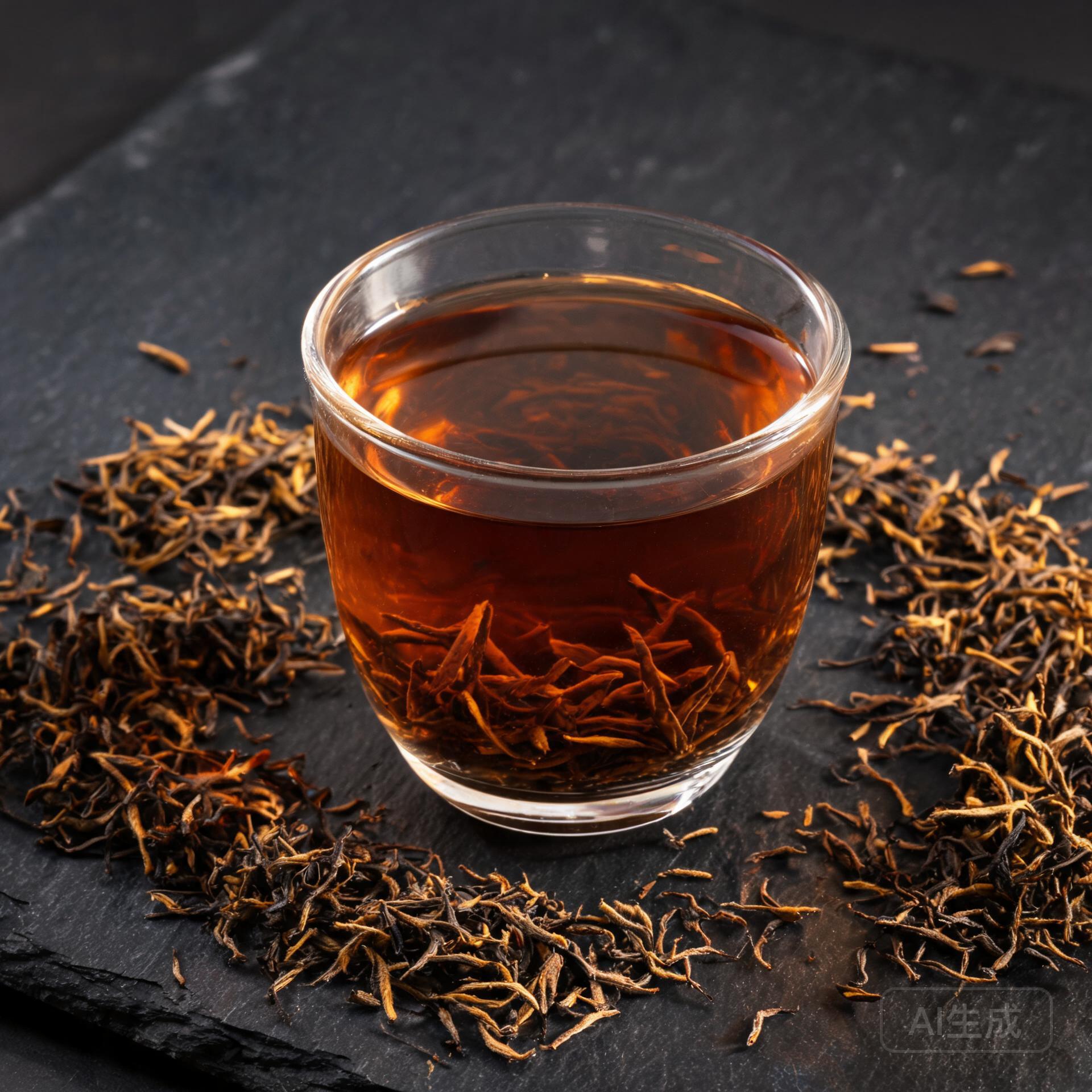
The steps
Red tea is made in five steps: pluck, wither, roll, oxidise, then fire and grade.
Wither brings the leaf down to roughly 60 per cent moisture, soft enough to roll without shredding.
Rolling twists the leaf and breaks cell walls, which is the step that actually starts the chemistry.
A typical roll runs 30 to 90 minutes depending on the style and the size of the leaf.
Oxidation follows, held at about 24 to 28°C with high humidity for 2 to 5 hours.
The leaf turns from green to copper, and the grassy smell becomes something malty or fruity.
Firing stops it, usually in two passes, a first firing to arrest oxidation and a second to finish.
Smoked styles such as Zhengshan Xiaozhong are dried over pine wood, which is a regional variation.
Grading by size comes last, separating leaf grades from the broken grades used in bags.
The whole process runs inside about 24 hours from the leaf arriving at the factory.
Few teas move from leaf to finished product that fast, and the pace is part of the style.
Order matters
The order matters because each step creates the condition that the next one needs.
Fresh leaf is turgid and snaps when rolled, so withering has to soften it first.
Rolling then breaks the cells, and that breakage is what lets enzymes meet polyphenols.
Without rolling there is no oxidation worth speaking of, since the two never come into contact.
Oxidation has to come after rolling and before firing, and there is no way around that.
Fire too early and the tea stays green and grassy, with none of the colour developed.
Fire too late and the tea goes dark and sour, having passed through the window already.
Wither after rolling and you get a paste, because the leaf has already released its juice.
Grade last, because sorting is about size and size is fixed only once the leaf is dry.
Every step is a gate, and the leaf that comes through it differs from the one that entered.
A maker who understands that works backwards from the cup they want, which is how recipes begin.
Where it can go wrong
The failures are all failures of degree, and each one has a recognisable signature in the cup.
Under-withered leaf will not roll properly and comes out of the roller in fragments.
Over-rolled leaf produces too much dust, which over-oxidises and darkens the whole batch.
Under-oxidised tea keeps a raw green note and brews a pale, thin liquor.
Over-oxidised tea turns sour and flat, and the liquor goes dark and muddy.
Firing too gently leaves the tea unstable, and it carries on changing inside the bag.
Firing too hard gives a scorched taste that no amount of blending will cover.
Oxidation rooms that run too hot are the usual culprit, since the window narrows as temperature rises.
A maker judges oxidation by smell and by the colour of the leaf, not by the clock alone.
Get it slightly wrong and the tea is ordinary, and get it very wrong and it is unsellable.
Scale and consistency
Red tea was the first category to be industrialised, and it shows in how consistent it is.
The orthodox method above is one route, and the crush, tear and curl method is the other.
That second route was built for bags, and it gives a strong, fast brewing tea in about an hour.
Oxidation is the step that scales best, because it happens in a room rather than in a pair of hands.
Controlled humidity and temperature let a factory run the same profile every single day.
Rolling is mechanised almost everywhere now, and machines roll more evenly than people do.
Grading is entirely mechanical, done through a stack of meshes that sorts the leaf by size.
Blending is where a large producer earns its money, holding a house style across dozens of lots.
What suffers is the top end, since a machine cannot pick out the best 5 per cent of a batch.
Scale delivers an identical cup all year, which is exactly what most of the market wants.
Worth knowing before paying a premium for a hand-rolled tea that never needed much rolling.