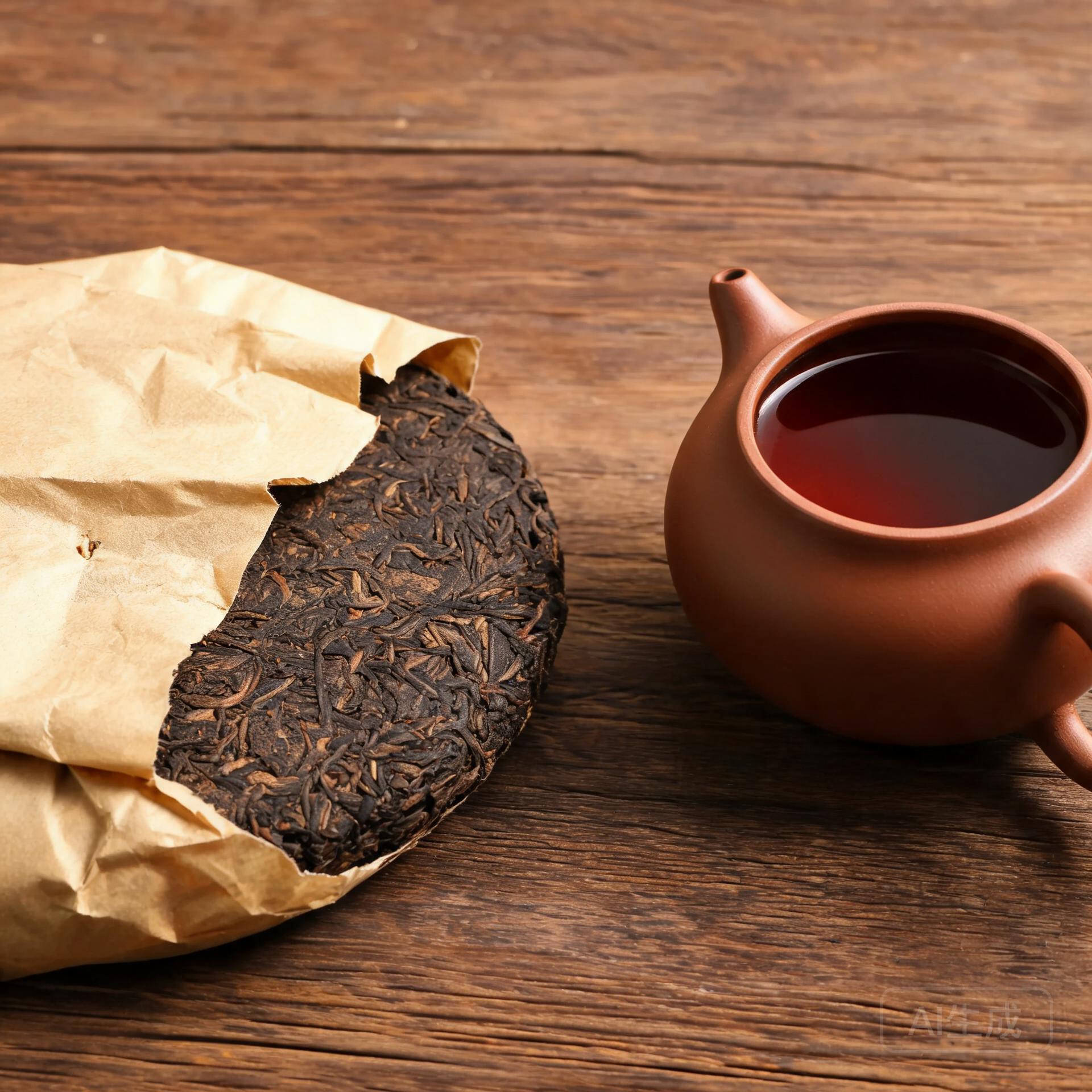
The one step
The defining step for dark tea is piling, wo dui(渥堆), and it turns the category into something alive.
Leaf is wetted to roughly 30 to 40 per cent moisture and heaped in piles of several tonnes.
The heap heats itself as microorganisms begin to work, reaching 50°C to 60°C within days.
It is turned every few days, re-wetted where it has dried, and rebuilt.
The whole run takes 30 to 60 days, and a pile is turned 7 to 10 times across that period.
What makes it unusual is that the transformation is biological rather than enzymatic.
In red tea the leaf’s own enzymes do the work, and in dark tea microbes do it instead.
That is why dark tea is the only category that keeps changing for decades after it is finished.
The organisms survive the compression and the drying, and they go on working slowly in storage.
Fixing, rolling and drying all happen as they do elsewhere, and none of them is the category.
Piling is the step, and everything about dark tea follows from what happens inside the heap.
Why it defines the tea
Piling defines dark tea because it is what separates the category from red tea, which it otherwise resembles.
Both are dark, both are compressed, and both improve with some age.
The difference is that red tea stops changing once it is fired, and dark tea does not.
Piling leaves the tea biologically active in a way that firing does not permit.
That is why a 20 year old red tea is a faded version of what it was, and a 20 year old raw pu-erh is not.
The step also produces the flavour profile the category is known for, which is earthy rather than fruity.
The malty and fruity compounds of red tea are largely absent, and the microbial ones replace them.
Drinkers who expect red tea and get ripe pu-erh are usually reacting to exactly this difference.
Raw pu-erh skips the piling and reaches a similar place over decades instead of weeks.
That is the other half of the category, and it is defined by the absence of this step.
So the presence or absence of piling splits the category in two, which is unusual in tea.
What it takes
What piling takes is attention over weeks, and the cost of inattention is the whole batch.
Moisture is the first requirement, and a heap that dries out below 25 per cent simply stops.
A heap that goes above 45 per cent turns sour, and sour ripe tea never recovers in storage.
Temperature is the second, and it is read with probes pushed into the heap at several depths.
Above 65°C the organisms driving the fermentation are killed, and the pile stops changing.
That produces tea tasting more like weak raw pu-erh than ripe, and it is a specific and common fault.
Turning is the third, and it evens out hot spots that would otherwise cook one part of the heap.
Each turn also resets the temperature and gives the maker another chance to read the leaf.
The end point is judged by the colour of the liquor and by the smell of the heap.
A finished pile smells sweet and earthy, and one that has gone wrong smells of cellar or of acid.
Turning a heap of several tonnes by hand is heavy work, and it is why ripe tea is a factory product.
A caveat
Piling cannot rescue poor leaf, and in dark tea the limitations show up years later rather than immediately.
Coarse material with a high stem content ferments differently, and it produces a hollow sweetness.
That hollowness becomes obvious after 10 years, when better material has developed depth and this has not.
Leaf from young plantation bushes lacks the soluble material that long ageing needs.
It can be piled successfully and sold as ripe tea, and it will never become anything more interesting.
Piling is also used to make weak material drinkable quickly, which is why it was developed in the first place.
That is not a criticism of the technique, but it is the reason cheap ripe tea is so common.
A buyer should be sceptical of a young ripe tea sold with an ageing story attached to it.
Storage is the other limit, and a well piled tea kept badly will fail anyway.
Humidity above 75 per cent brings mould, and below 50 per cent nothing happens at all.
The step is necessary and not sufficient, and the decades afterwards have the final word.