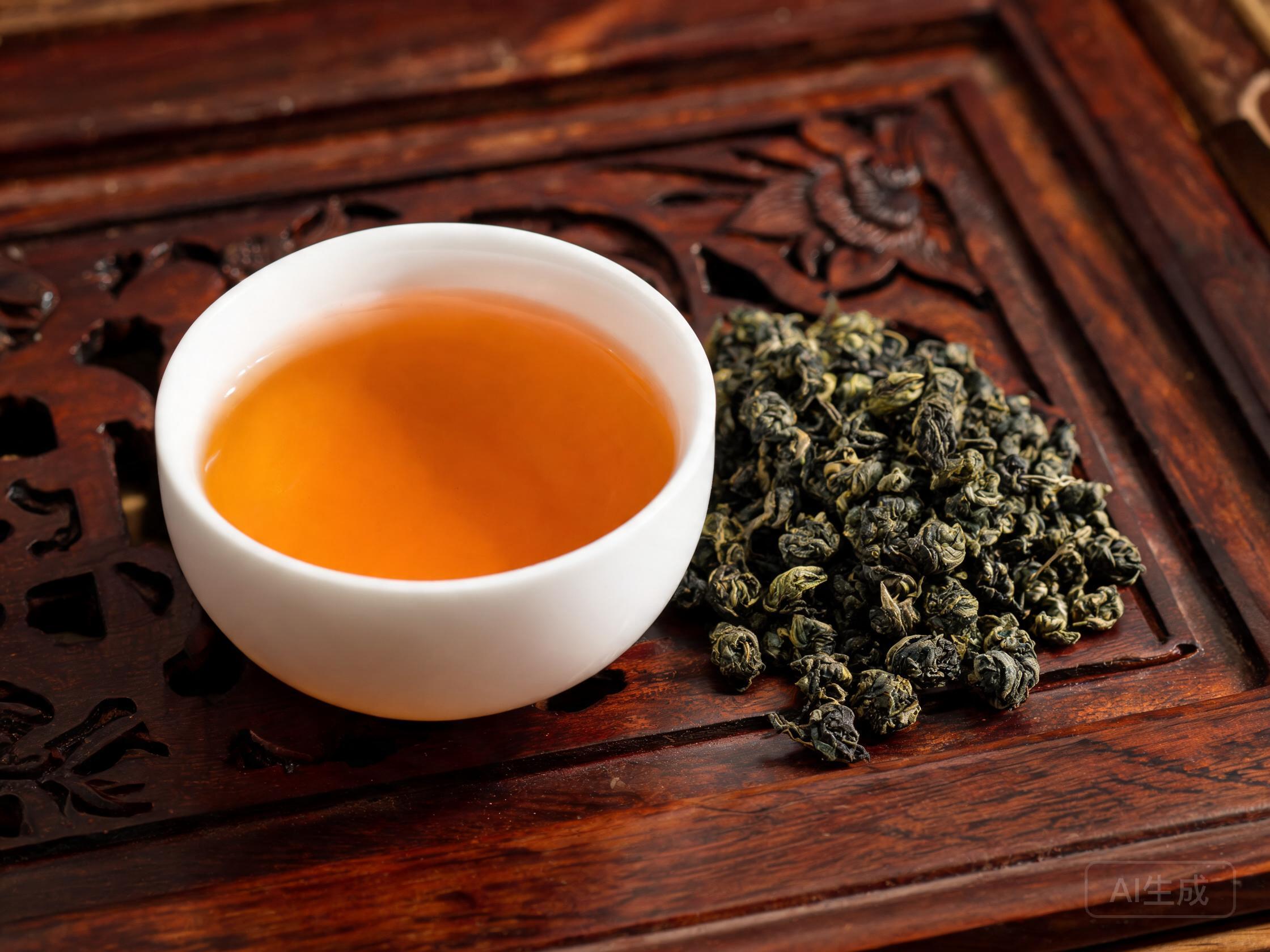
The one step
The defining step for oolong is shake-withering, yao qing(摇青), and no other category has anything like it.
Withered leaf is tumbled in a drum or shaken in a bamboo tray until the edges bruise.
The leaf is then left to rest, and during the rest the bruised edges begin to oxidise.
Then it is shaken again and rested again, and the cycle repeats through the night.
A maker runs 3 to 5 cycles, and each one adds a little more oxidation to the leaf.
What makes the step unusual is that the oxidation is partial and uneven by design.
The edge of the leaf oxidises while the centre stays green, and that difference is the whole point.
Green tea avoids it by fixing straight away, and red tea removes it by rolling the leaf thoroughly.
Oolong lives in the gap between the two, and shaking is how a maker holds a leaf there.
The aroma develops during the rest periods, which is why the timing matters more than the shaking.
Fixing ends it, and everything after that is shaping and drying rather than transformation.
Why it defines the tea
Everything else in oolong is shared with other categories, which is why this step defines it.
Plucking, withering, rolling and drying all happen in green and red tea as well.
Only the shake and rest cycle produces a partly oxidised leaf with an intact centre.
That structure is what gives oolong its particular combination of floral aroma and green freshness.
Take the shaking away and the leaf oxidises evenly, which produces a red tea.
Fix before any shaking happens and the leaf stays green, which produces a green tea.
The category is therefore not defined by a temperature or a machine, but by a decision about when to stop.
That is also why the oxidation percentages quoted for oolong range from 10 to 70 per cent.
The number is not a setting, it is the accumulated result of how many cycles were run.
Two teas both called oolong can sit at opposite ends of that range and share almost nothing.
The step is the definition, and the number only describes where one maker chose to stop.
What it takes
The step looks simple and is easy to spoil, because three conditions have to be held at once.
The first is the state of the leaf going in, which must have withered enough to bruise without tearing.
Leaf that is still too wet bruises unevenly and goes sour where it was damaged too hard.
Leaf on the dry side will not bruise at all, and the oxidation never gets started properly.
The second condition is the rest interval, and it is where most mistakes are made.
Rest too briefly and the aroma never forms, rest too long and the leaf oxidises past its target.
The third is the room temperature, since the reaction runs much faster in a warm workshop.
At 28°C the same cycle may need half the interval that it needs at 20°C.
So the maker reads the leaf rather than the clock, checking colour, smell and the feel of it.
Small errors compound through the night, and by the fourth cycle the leaf cannot be brought back.
This is the skill that separates a maker from a factory, and factories know it.
A caveat
Even done perfectly, shake-withering cannot rescue leaf that was poor to begin with.
A coarse pluck of mature leaf and stem will not produce the floral aroma the step is meant to build.
That aroma comes from compounds in the leaf, and shaking only releases and transforms them.
Leaf picked in the rain, or held too long before withering, has already lost much of what is needed.
Shaking such leaf produces a flat tea, and the fault is usually blamed on the process.
Machine picked material has the same problem, since a machine takes whatever is on the branch.
The step is also unable to correct an error made earlier in the same night.
If leaf went sour during the second rest, the fourth cycle makes it worse rather than better.
Roasting gets used to hide this, and a heavily roasted oolong is often hiding exactly that.
A buyer should treat a very dark roast on a cheap tea as a question rather than a feature.
The step is necessary and not sufficient, which is the honest way to describe any craft.