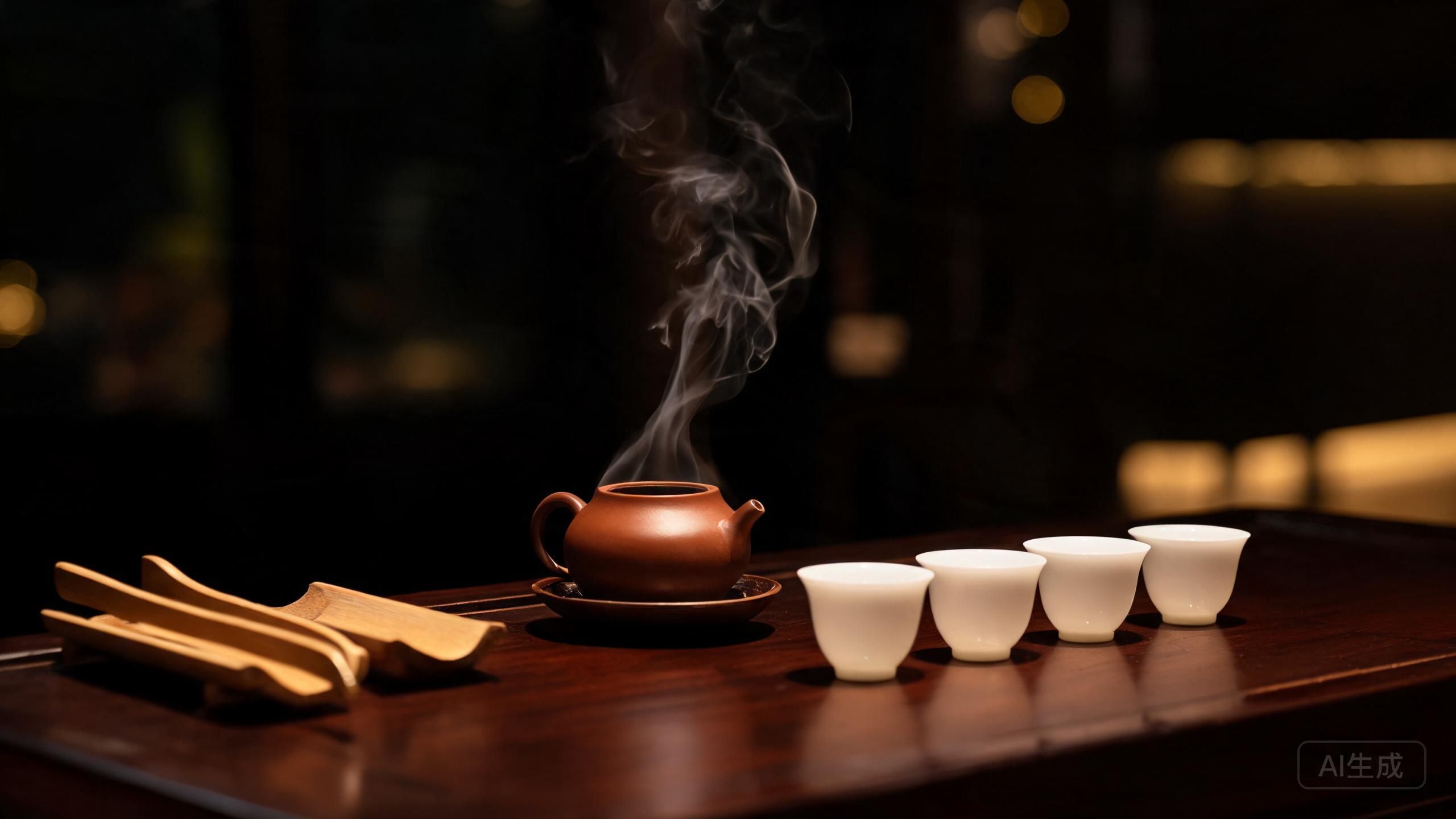
How Oolong tea is served
Oolong is the category the gongfu method was built around, and it shows.
A small vessel, a high dose and short repeated steeps are the standard approach.
The usual setting is 5 g in 100 ml at 95 °C or above.
The first pour runs about 30 seconds, and each later one is extended rather than the dose raised.
That pattern exists because a rolled leaf opens slowly and needs heat to do it.
A gaiwan holding 100 to 150 ml is the standard vessel, and porcelain is the usual choice.
Yixing clay is traditional for oolong, since it holds heat well and seasons with use.
The clay is porous, so a pot used for one style should stay with that style.
Chaozhou practice uses an even higher dose and shorter steeps than the Wuyi habit does.
Both produce a strong cup, and both are correct for their own leaf.
Taiwanese practice sits between the two and generally uses a slightly larger vessel.
Three regions, three settings, and one shared principle of heat and repetition.
The wider picture
Ceremony is not one ritual, and oolong is where the differences become obvious.
Gongfu cha is the Chinese method, and it is a set of controls rather than a rite.
Chaozhou gongfu is the most formal version, with a fixed tray and a fixed sequence.
Wuyi practice is looser, and mostly concerned with heat and with the pour count.
Japan’s chanoyu took powdered tea somewhere else entirely, and sencha-do stayed with leaf.
The western pot and milk habit was built for red tea and suits oolong badly.
Oolong sits at the centre of the Chinese tradition rather than at the edge of it.
If any category can claim the gongfu method as its own, this one can.
What the method gives it is repetition, which is exactly what a rolled leaf needs.
One long steep cannot do to this leaf what six short ones do.
That is the practical argument for the form, and it is not a mystical argument.
Repeatability is the other half, since six pours from one leaf give you six chances to read it, and one long steep gives you a single chance.
The ritual is a brewing technology that happens to look beautiful.
What the ritual protects
What the ritual protects is a set of four controls, and nothing more than that.
Temperature, ratio, vessel and timing, applied deliberately rather than by habit.
For oolong, temperature is the one that separates a good session from a poor one.
Cooler water leaves the aroma in the leaf, and no amount of extra time recovers it.
Ratio is deliberately high here, at 5 g in 100 ml, which is several times a western dose.
Vessel size is what makes that ratio possible, and it is why the cups are so small.
Timing is the last control, and it gets counted in seconds rather than in minutes.
Count out loud for the first few sessions, since the habit forms faster than people expect and it removes the guesswork from every pour that follows.
A fairness pitcher is not decoration, since it stops the last cup being weaker than the first.
Get those four right and the category rewards you across eight pours or more.
Get one of them wrong and the session collapses by the third pour.
The form exists to serve the leaf, and this leaf wants heat, dose and discipline.
Everything else in the ceremony is theatre, and pleasant theatre at that.
A note on authenticity
There is no single correct ceremony, even for the category that owns the method.
Chaozhou, Wuyi and Taiwan all do it differently, and all three are right.
What matters is that the method fits the tea rather than the other way round.
A lightly oxidised oolong wants slightly cooler water than a heavily roasted one.
A rolled leaf wants a longer session than a strip leaf, and gives more pours.
Treat any claim of one true gongfu with scepticism, and ask which region it came from.
The answer tells you which leaf the speaker learned on, which is useful information.
The practical approach is the four controls, set by taste and adjusted for each leaf.
Brew 5 g in 100 ml at 95 °C and run the full session rather than a single cup.
Note where the sweetness arrives, since that marker tells you the dose was right.
If the tea collapses by the fourth pour, raise the dose before changing anything else.
That habit teaches more than any diagram of the correct movements.