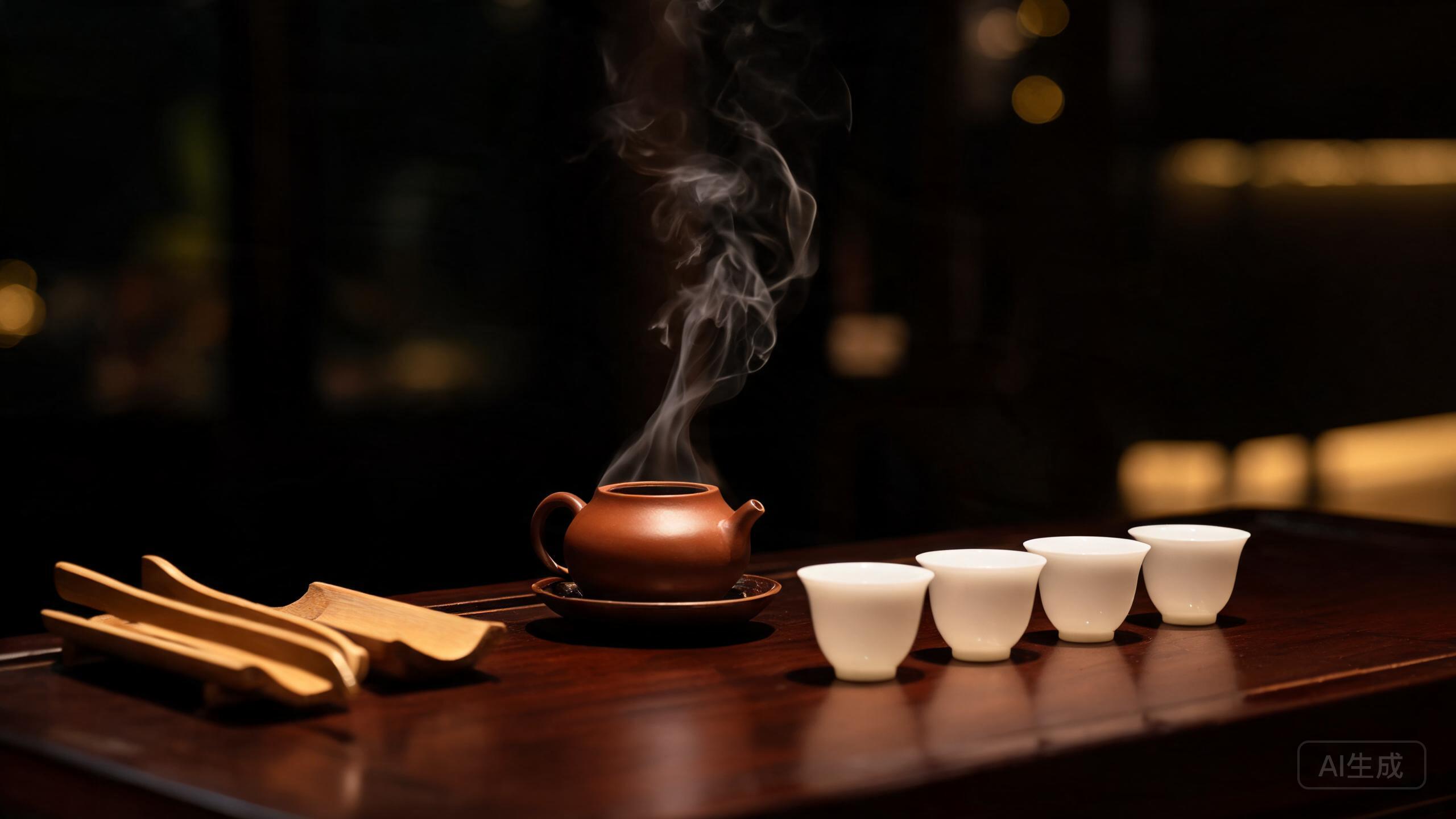
How Dark tea is served
Dark tea is served hot, strong and in a small vessel, and it gets rinsed first.
The rinse wakes a compressed cake and washes off the dust of compression and storage.
After that the method is gongfu like everything else, with a high dose and short steeps.
The usual setting is 5 g in 100 ml at 100 °C, with the first pour around 20 seconds.
Each later infusion is extended rather than the dose being increased.
A gaiwan or a small Yixing pot, plus a fairness pitcher so the cups match each other.
The session runs longer than for any other category, and 10 pours is a normal target.
Boiling water is not optional here, since compressed leaf will not open below it.
Some people boil the leaf outright, which is a traditional preparation in the pastoral regions.
That produces something closer to a soup than an infusion, and it is an acquired taste.
For most buyers the gongfu method is the more useful one to learn.
It shows what the cake is actually made of, which is the whole point of tasting one.
The wider picture
Ceremony is a family of habits, and dark tea sits at the practical end of it.
Gongfu cha is the standard method, and it is used here as a tasting tool rather than a rite.
The compressed shape is the reason, since a cake has to be opened before it can be assessed.
Japanese ceremony never encountered this tea, and western habits never took to it either.
What dark tea has instead is a social habit rather than a formal one.
In Yunnan and in Tibet the tea is shared from a common pot across a long afternoon.
That is a genuine ritual, and it has no fixed movements and no special equipment.
It is closer to a long lunch than it is to chanoyu, and there is nothing wrong with that.
The formal gongfu session and the shared pot are both real, and they serve different purposes.
One is for evaluating a cake, and the other is for drinking it with other people.
Most buyers only need the first, and it is worth learning properly.
The rest of the ceremony literature has very little to say about this category.
What the ritual protects
A ceremony is a control system, and the controls matter more here than the form does.
Temperature, ratio, vessel and timing, and for dark tea the first is settled in advance.
A full boil, every time, because anything cooler leaves the material behind in the leaf.
Ratio is high, at 5 g in 100 ml, and the vessel is small to make that ratio possible.
Timing is counted in seconds for the early pours and in minutes for the late ones.
One rinse before the first counted pour, and a short rest straight after it.
Vessel choice matters for heat retention, and porcelain or Yixing clay both work well.
Get those four right and a cake will keep changing across the whole session.
A good one moves from bitter to sweet somewhere in the middle and holds to the eighth pour.
A poor one tastes the same throughout, and that sameness is the verdict on it.
The form exists to serve the leaf, and here it serves a leaf built for repetition.
Everything else, from the cake knife to the wrapper, is furniture.
A note on authenticity
There is no single correct ceremony for dark tea, and the range runs very wide indeed.
A gongfu session, a shared pot and a boiled preparation are all defensible.
What matters is that the method fits what you are trying to find out.
If you are evaluating a cake, use the gongfu method and count the pours.
Drinking with other people wants a pot and no counting at all.
Treat any claim of one true method with scepticism, and ask what it is meant to reveal.
The answer is usually a sale rather than a cup.
The practical alternative is the four controls, applied deliberately rather than by rote.
Brew 5 g in 100 ml at 100 °C, rinse once, and run the full session.
Note where the sweetness arrives and where the tea starts to fade.
Those two markers tell you more about a cake than any certificate on the wrapper does.
And they cost one afternoon rather than a lifetime of study.