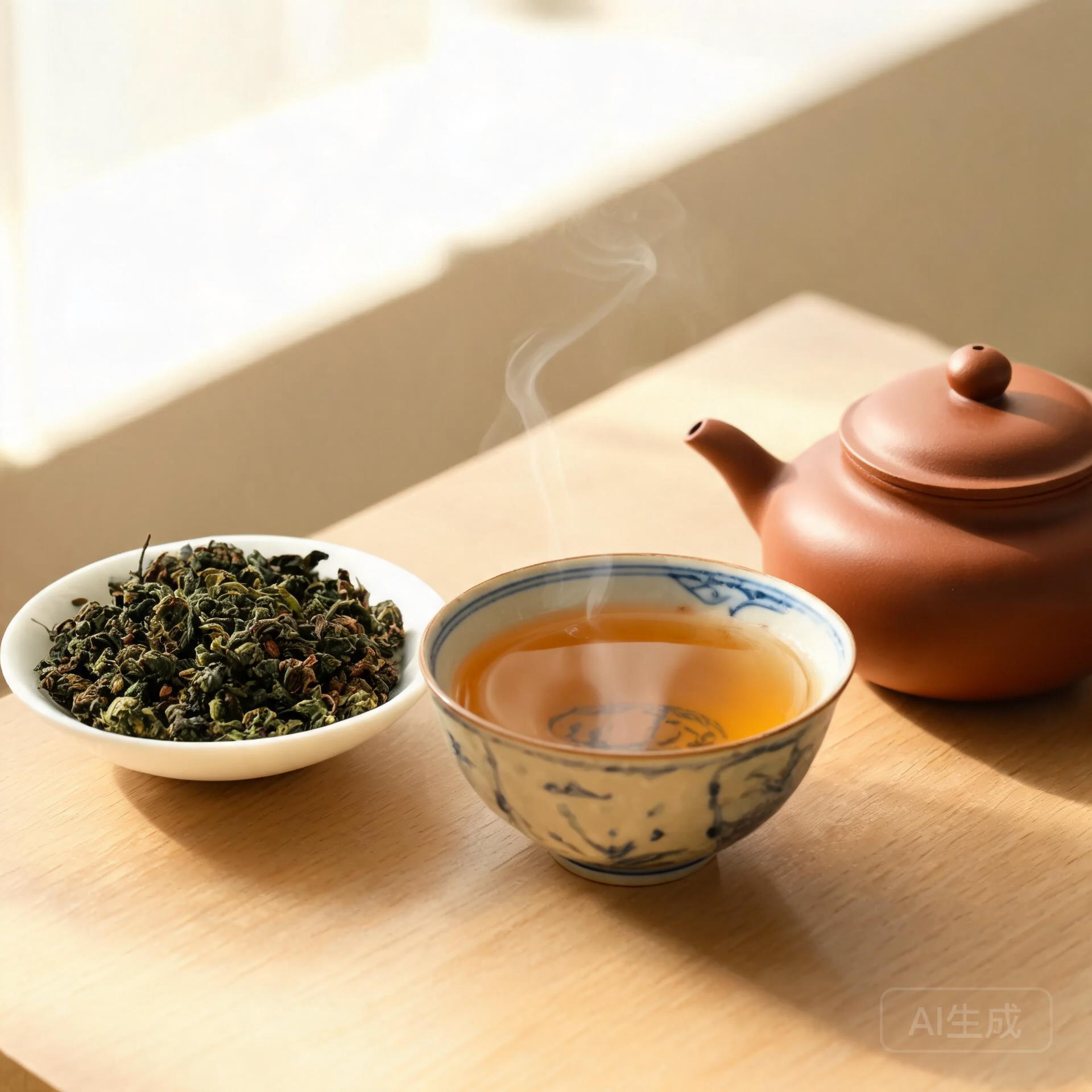
Teas named by place
Oolong splits by region and by geology, and the split is sharper than in any other category.
Wuyi rock tea from northern Fujian is twisted into strips and roasted over charcoal.
It grows in a gravelly cliff soil, and the mineral note people describe comes from there.
Anxi Tieguanyin(铁观音)in southern Fujian is ball rolled and far greener.
One province, roughly 2 hours apart by road, and nothing about the two teas overlaps.
Fenghuang Dancong(凤凰单丛)from Guangdong is the single tree aromatic style.
Old bushes are named individually, and the count of named aromas runs into the hundreds.
Taiwan makes high mountain, Dongding(冻顶)and Oriental Beauty(东方美人).
Oriental Beauty is made from leaf the leafhopper has bitten, and the insect does the work.
The process family is the same across all four, and the results do not resemble each other.
Roast level and region together account for almost everything in an oolong’s flavour.
That is the strongest argument for reading oolong as a set of regions rather than a category.
Four places, one method, and four entirely different drinks.
Why region matters
Region matters in oolong because the process amplifies the leaf instead of covering it.
Roast, rolling and withering all change what the leaf already contains.
They do not add a flavour that was never there, whichever story the seller prefers.
Wuyi’s cliff soil, Anxi’s hills and Taiwan’s altitude each produce a different raw material.
Altitude is the clearest variable, since high mountain leaf grows thicker and slower.
That slower growth is what produces the floral, cooling character buyers pay for.
A region earns its name by setting a standard the others are measured against.
Wuyi did it for roast, Anxi for the ball rolled green, and Taiwan for high mountain.
Regional fame outlasts marketing, and it survives the region losing its best makers.
What a name buys you is a strong prior, and priors get updated by tasting.
The prior is worth a lot, because it tells you where to start looking.
The tasting is what tells you whether to keep buying there.
When regions cross borders
Oolong styles have travelled further than any other tea, and the results are mixed.
Tieguanyin bushes are grown in Vietnam and in Thailand, and the rolling went with them.
That tea can be well made and still be a different thing from Anxi.
Altitude, rainfall and soil arrive with the place, and none of them can be transplanted.
Taiwanese high mountain styles have been copied on the mainland, with variable success.
Some of it is excellent, none of it is Alishan, and both statements are true.
For honest buying, the region should name where the leaf grew and where it was made.
A style inherited from a place is a description, and an origin is a fact.
Only one of those belongs on a label as though it were the other.
Ask which mountain, and then ask what elevation, and the answers get specific quickly.
Vague answers at that point usually mean the leaf was bought in at auction.
That is normal practice, and it should be described honestly rather than hidden.
The mainland high mountain copies are the clearest case, and a few are genuinely good.
How to choose among them
Choosing among oolong regions means choosing a roast level and a body first.
Wuyi if you want roast and mineral, Anxi if you want flowers and a light body.
Dancong if you want single tree aromas, and Taiwan if you want altitude and softness.
Those four preferences map onto four regions almost exactly, which makes choosing easy.
Buy 25 g of each and brew them in a gaiwan(盖碗)at 95 °C with 5 g in 100 ml.
Same water and same time for all four, and then the differences belong to the tea.
Run each to 5 infusions, since an oolong’s character often arrives after the third.
Once a region suits you, sub-regions are next, and this is where it gets expensive.
Wuyi’s named cliffs and Taiwan’s named mountains add cost faster than they add flavour.
Go down one level at a time, and stop when you cannot taste the difference.
A cheap version of a region you like teaches more than an expensive one you do not.
That point differs for every drinker, and finding it is most of the education.
Four regions, one afternoon, five infusions each, and you will know which way to go.