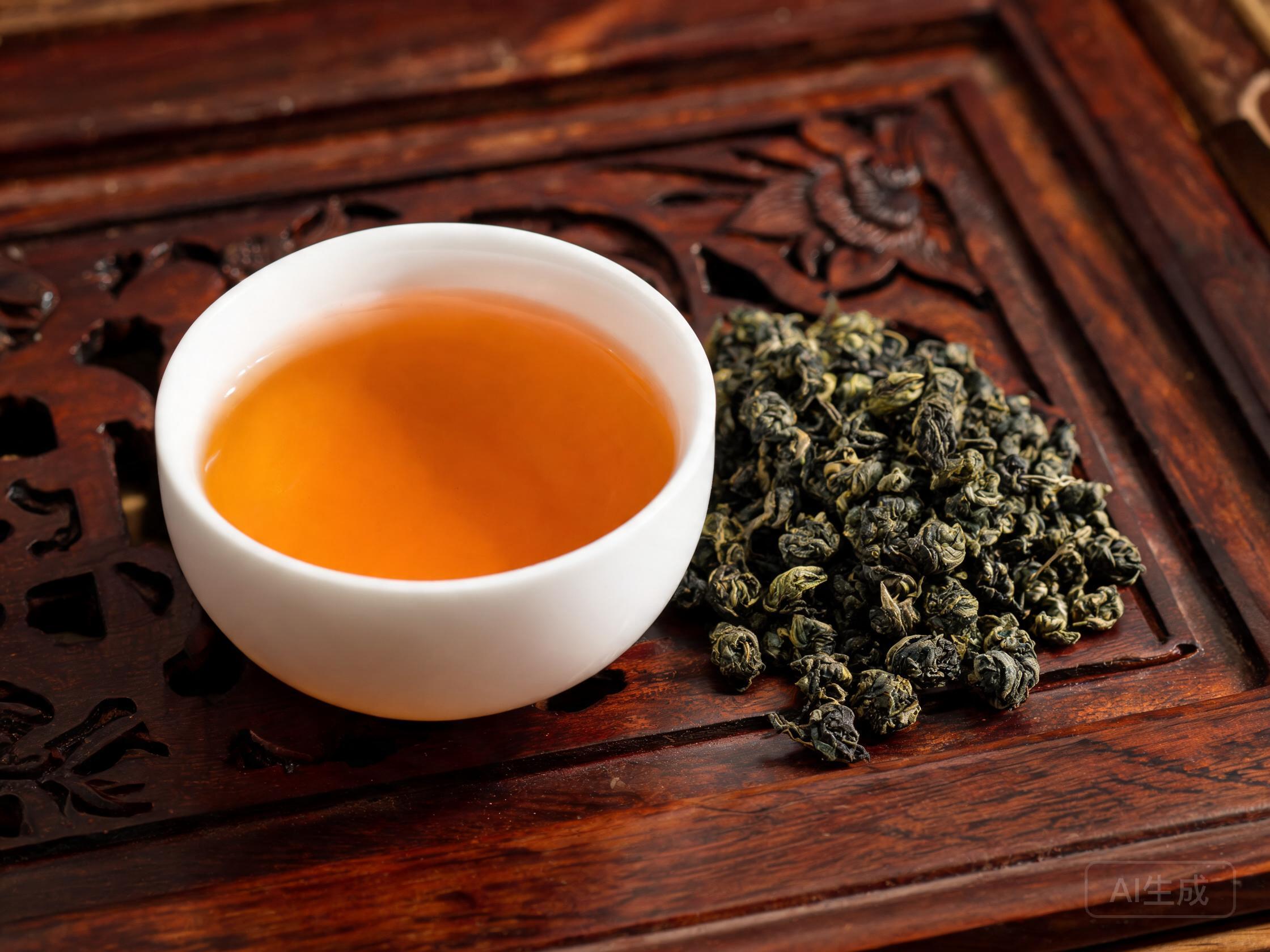
What to eat with it
Oolong covers more ground than any other category, so the first question is which oolong.
A lightly oxidised, unroasted oolong behaves like a green tea and pairs like one.
A heavily roasted one behaves like a dark tea and wants altogether different food.
In between sits most of what people actually drink, and it pairs widely.
Roasted oolongs take nuts well, particularly roasted chestnut and almond.
They also take lightly sweet baked things, since the roast already carries a caramel note.
Tieguanyin(铁观音), at the green end, wants steamed food and plain crackers.
Dancong(单丛)is aromatic enough to pair with almost nothing, and is best drunk alone.
Wuyi rock tea, at the roasted end, stands up to fatty food better than most tea does.
Char siu and roasted goose are the classic Cantonese partners for exactly that reason.
Milk in the cup changes the picture, since it adds body and tolerates more sweetness.
If you remember one thing, remember that roast level sets the pairing, not the name.
A 7 g dose in a 110 ml gaiwan is the standard gongfu measure, and it changes what the tea can carry.
Roast level runs from 0 per cent for a green style oolong to something near 60 for a heavy Wuyi.
That level is printed on almost no packaging, so learn to smell it instead.
What to avoid
Oolong is forgiving, which is precisely why people stop paying attention and get it wrong.
The wrong move is assuming the roast makes it indestructible.
A heavily roasted Wuyi tea will survive a plate of char siu and will not survive chilli oil.
Capsaicin beats roast, and it always does.
Very sweet desserts flatten the finish, which is the best part of a rock tea.
Strong cheese competes with the roast rather than complementing it.
Anything pickled is too acidic for the greener oolongs.
Fried food is fine with a roasted oolong and fatal to a green one.
That split is the single most useful thing to know about this category.
Mint and strong coffee between cups will erase the aftertaste entirely.
Very cold drinks do the same thing, only more slowly.
If the tea has a long finish, protect it, because no food will improve on it.
Two minutes after a chilli dish the palate is still not back.
A dessert at 30 per cent sugar will flatten a rock tea finish in one mouthful.
Sweet or savoury
Sweet or savoury is not a fixed answer for oolong, because the category itself is not fixed.
Green style oolongs go savoury, in the same way green tea does.
Roasted oolongs go sweet, and they are one of the few teas that take sugar well.
Milk oolongs, which are often scented, are closer to a dessert in themselves.
Treat those as the sweet element and put something plain beside them.
Savoury pairing favours roasted nuts, dried meat and anything with a smoky edge.
Salt is less dangerous here than elsewhere, because the roast buffers it.
Sweet pairing favours caramel, toffee, baked apple and anything made with brown sugar.
Dark chocolate finally works at this weight, at around 70 per cent cocoa.
Dried fruit works across the whole category, which makes it the safe default.
Fresh fruit is riskier, since acidity hits the green end hard.
Decide by the roast: darker roast, sweeter plate.
Brown sugar at 5 per cent of a cake reads as caramel, which is exactly the overlap you want.
One cup of milk oolong carries about as much sweetness as a plain biscuit.
A simple rule
Sort by roast first, and everything else follows from it.
A green oolong is a green tea with more aroma and should be treated as one.
A roasted oolong is closer to a dark tea and can carry a plate.
Within that, match the weight and you will rarely be wrong.
Contrast is easiest at the roasted end, where there is more to contrast against.
A sweet baked thing beside a charcoal roasted tea is the clearest example.
Temperature is less critical here, because roast notes survive cooling.
That makes roasted oolong the practical choice for a long meal.
Serve it in small cups throughout rather than in one sitting at the end.
If the tea tastes hollow, the food was too acidic.
When the finish disappears, the food was too fatty or too cold.
If the roast note gets louder after eating, you have it right.
Sort into 3 bands, green, medium and roasted, then pair each as its own category.
A roasted oolong will hold for 8 or 9 steeps, which is longer than any plate lasts.
That is the practical reason Chaozhou serves oolong through a whole meal.