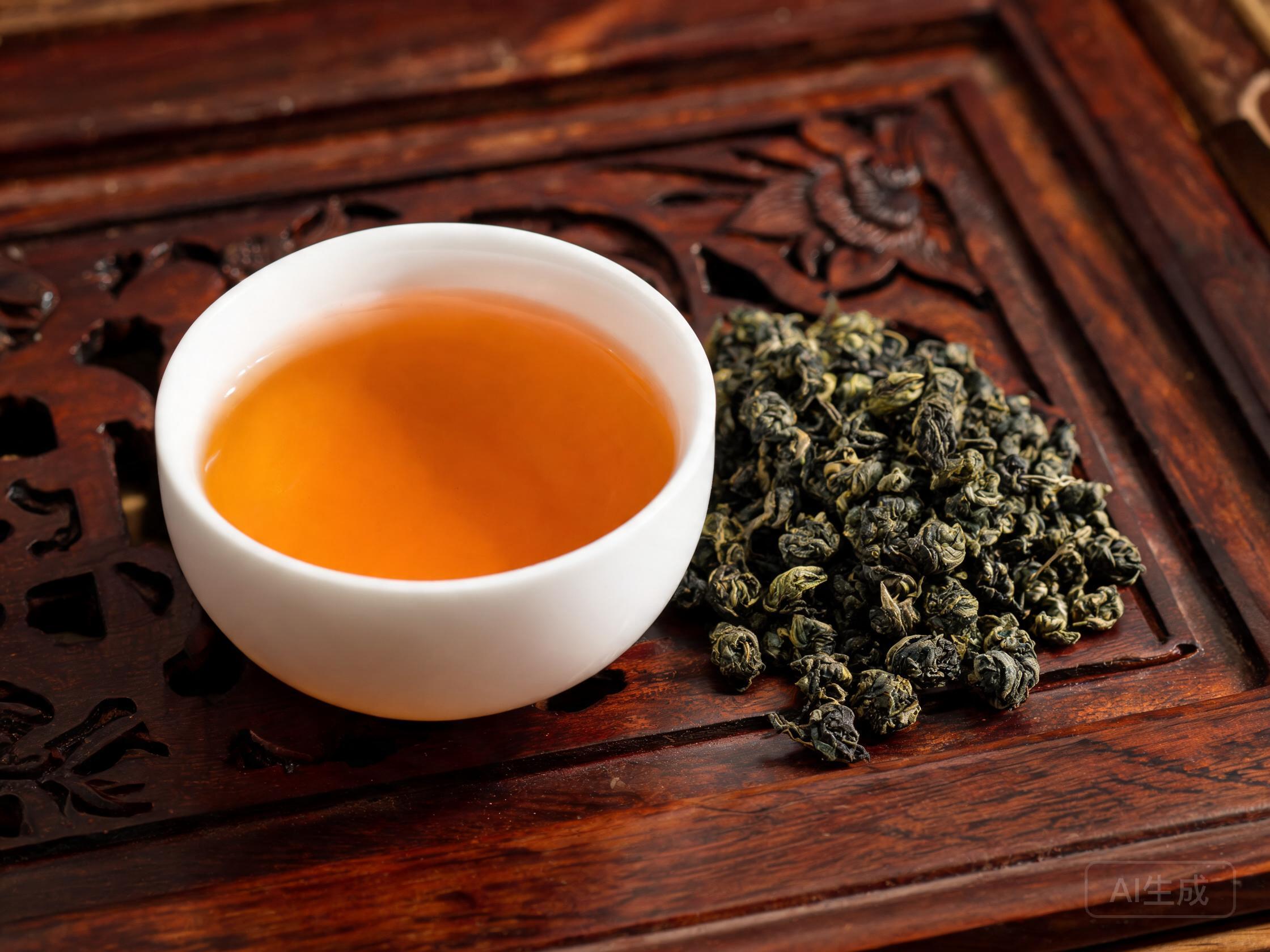
Where it sits among teas
Oolong occupies the middle of the oxidation spectrum, between green and red tea.
It is partially oxidised, which is the whole definition and also the whole difficulty.
Partial covers a wide range, and this category uses all of it.
Oxidation can be stopped anywhere between roughly 20 and 70 per cent.
A light oolong sits near the green end of that range and a heavy roast near the red end.
Both are called oolong, and they taste nothing like each other.
What defines the method is repeated shake-withering, called zuo qing(做青).
The leaf is shaken to bruise its edges, then left to rest while oxidation begins there.
The cycle runs through the evening, and the maker stops it when the aroma is right.
Fixing then halts oxidation at that point, and most oolong is roasted afterwards.
Roast is a second axis, running from none at all to several rounds spaced over years.
Oxidation and roast together account for nearly all the variation in the category.
It is the most culturally elaborated of the six, with named cultivars, competitions and regional styles.
That depth rewards patience, and it is also why the category intimidates beginners.
The family logic
Two axes, oxidation and roast, explain almost every oolong you will meet.
Place a tea on both of them and the names stop mattering quite so much.
Low oxidation with no roast gives a floral, buttery cup that sits close to a green tea.
High oxidation with heavy roast gives something nearer a red tea, with more weight.
Most oolong sits between those, and the middle is where the Cantonese default lives.
The family logic also predicts how to brew a tea you have never met before.
A light oolong wants cooler water, around 90 °C, and a shorter steep.
A heavy roast wants boiling water and will take a longer steep without turning bitter.
Guessing wrong on a light oolong produces a bitter cup within 30 seconds.
With a roast the same error produces a thin cup, which is the less damaging mistake.
Storage follows the same split: light styles go cold, roasted styles stay at room temperature.
Mixing those two rules is the most common way to waste a good purchase.
The taxonomy is doing real work here, and it is worth ten minutes of anyone’s attention.
Neighbours and overlaps
Both boundaries of this category blur, and they blur in different ways.
At the green end, a very lightly oxidised oolong can taste close to a green tea.
The difference is structural, since an oolong is not fixed before oxidation begins.
In the cup that shows up as aroma, which a green tea does not develop in the same way.
Some Taiwan high mountain styles are sold on exactly this ambiguity.
At the red end, a heavily roasted oolong approaches a red tea in weight and in colour.
Roast and oxidation together can darken the liquor without the leaf being fully oxidised.
The tell is the finish, since an oolong keeps a floral or mineral note that a red tea lacks.
Labelling at both edges gets loose, and the names are not policed by anyone.
A tea sold as a light oolong may have been made like a green, and the reverse happens too.
That is not always fraud, because regional practice genuinely varies across the category.
It does mean a label is a starting point rather than an answer.
One infusion at the right temperature settles the question faster than any description.
Why the system helps
Knowing where oolong sits makes the category navigable instead of endless.
Six families, one of which spans half the oxidation range, and two axes to place things on.
From there, region narrows it further: Anxi, Wuyi, Chaozhou and Taiwan, China.
Each region has a default shape, a default roast habit and a set of named cultivars.
Learn one tea from each region and you hold a working map of the whole category.
Buy 50 g of three roasts rather than 150 g of one, and taste them together.
Brew 7 g in a 110 ml gaiwan at 95 °C, with steeps around 20 seconds.
Three sessions is enough to find out where on the two axes you prefer to be.
Most people discover they like one end rather than the middle, and that simplifies everything.
The regional guides here take each area separately, and they assume this framework.
The brewing pages cover the gongfu method in more detail than fits on this page.
What the system cannot do is tell you which tea to like.
That part is up to the cup, and it takes about three of them.