- Two Steps, Both of Them Slow
- The Four Grades
- White, Green and Light Oolong Compared
- Fuding, Zhenghe, and the Yunnan Alternative
- The Caffeine Question
- Brewing by Grade
- Aging White Tea
- Storage in Practice
- What the Health Claims Are Worth
- Buying Without Wasting Money
- Where to Go Next
- Practical Takeaway
White tea is defined by how little is done to it — the leaf is picked, withered, and dried — and everything distinctive about it follows from that. No rolling. No kill-green. No controlled oxidation step. The leaf is picked, left to wither until it has lost most of its water, and then dried. That is the entire process, and it is why white tea is so often described as the most natural of the six categories.
The description is true and slightly misleading. Removing every other step means the one remaining step carries all of the craft. Withering is not simply letting leaves sit; it is a slow, partly uncontrolled chemical change that decides whether the finished tea tastes like melon and hay or like wet grass. Everything distinctive about white tea happens in those two days.
Two Steps, Both of Them Slow
Withering runs anywhere from 36 to 72 hours, and some producers take longer. The leaf is spread thin on bamboo trays, on racks, or in long troughs with air moving underneath. Ambient temperature is usually kept in the 20 to 30 °C band. During this time the leaf loses water steadily while its enzymes stay active, which means a slow, mild oxidation happens as a side effect.
That side effect is worth understanding, because the marketing often goes wrong here. White tea is frequently sold as "unoxidised." It is not. It is lightly oxidised, just enough to take the raw green edge off, and the amount varies with how long and how warm the wither ran. This is also why some white teas taste closer to a light oolong than to a green tea.
Three approaches exist, and they produce different teas:
- Sun withering (ri shai, 日晒). Trays go outside in thin layers. Considered the traditional ideal and the hardest to do well, because a sudden shift in weather can ruin a batch. Sun-withered whites tend to be sweeter and more open.
- Indoor withering (shi nei wei diao). Racks in a ventilated room, more controllable, used heavily when the spring rains arrive. Slightly greener and less rounded as a rule.
- Combined. The most common commercial approach: some sun when the weather allows, finished indoors, sometimes with heated air to rescue a slow batch.
Drying then takes the moisture down to around 6 to 7%, which is where the Chinese national standard for white tea sits. Firing is gentle compared with green tea, often in the 60 to 80 °C range, because the aim is to stop the enzymes without adding a roasted character.
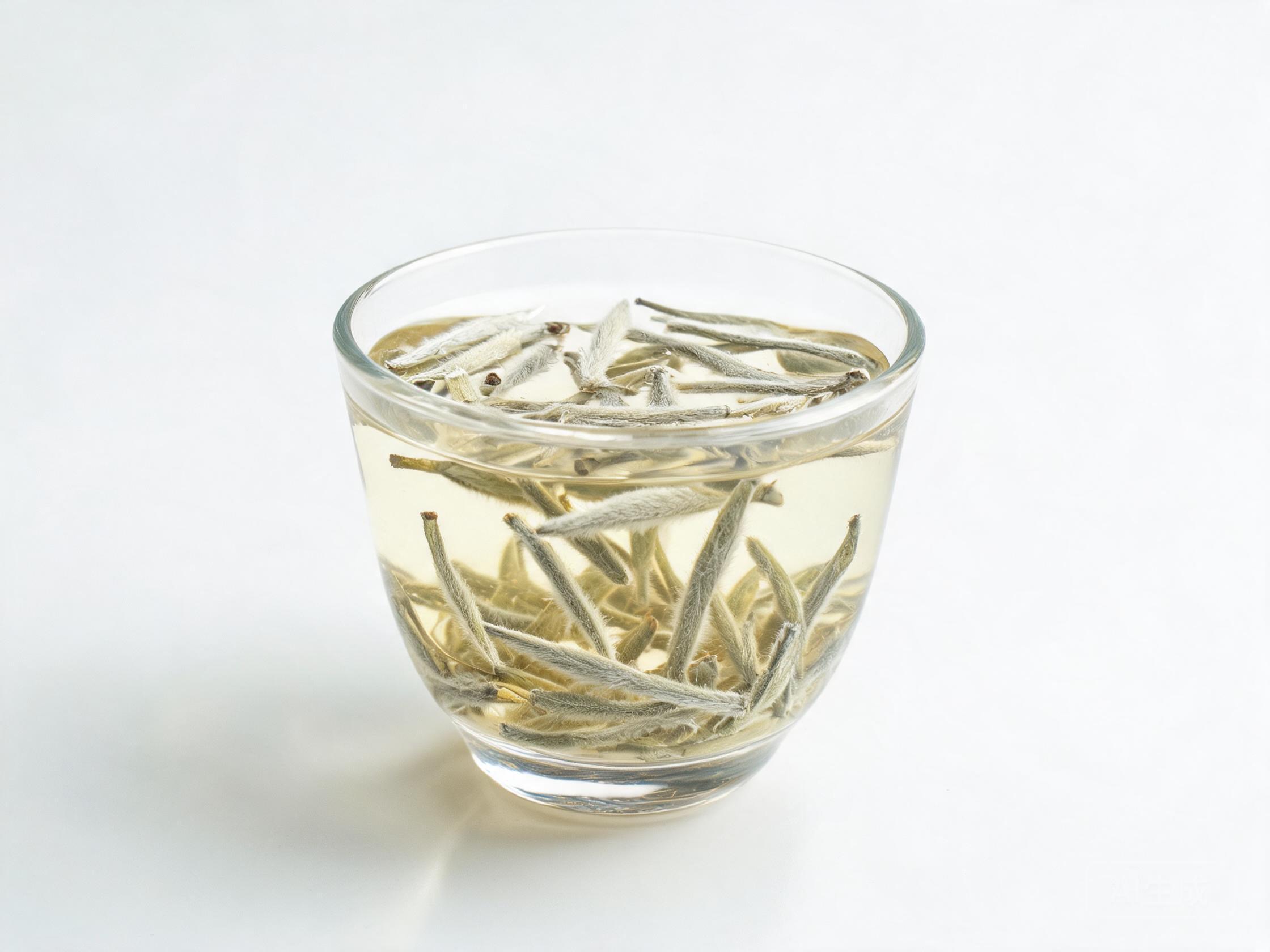
One visible consequence of skipping the rolling step: the leaf keeps its shape and its down. That fine silver fuzz, bai hao (白毫), is where the category gets its name and much of its aroma.
The Four Grades
| Grade | What is picked | Character | Notes |
|---|---|---|---|
| Baihao Yinzhen (白毫银针) | Buds only | Delicate, sweet, melon and hay, thick down | The harvest window is only a few days. Fuding needles are fatter and more downy; Zhenghe needles are slimmer and greyer. |
| Bai Mudan (白牡丹) | Bud plus one or two young leaves | Rounder, more floral, more body than Yinzhen | The workhorse grade and, for many people, the best balance of price and character. |
| Gongmei (贡眉) | Leaf from native small-leaf bushes (cai cha, 菜茶) | More herbaceous, less sweet, good body | Often confused with Shoumei. Defined by the plant rather than by picking date. |
| Shoumei (寿眉) | Later, larger leaves and stems | Coarse when young, excellent when aged or boiled | The least expensive fresh and often the most interesting after five or ten years. |
White, Green and Light Oolong Compared
These three sit next to each other on the processing spectrum and are confused constantly, not least because a heavily withered white tea can taste closer to a light oolong than to a green. The distinction is mechanical, not sensory.
| White | Green | Light oolong | |
|---|---|---|---|
| Enzymes stopped by | Drying, slowly, at the end | Heat, within hours of picking | Heat, after a short oxidation |
| Rolled? | No | Usually | Yes |
| Oxidation | Light and incidental | None intended | Roughly 10 to 30% |
| Typical brew temperature | 85 to 95 °C | 75 to 85 °C | 90 to 95 °C |
| Fresh character | Hay, melon, flower, faint sweetness | Grass, chestnut, seaweed, toast | Floral, creamy, green |
| Best within | Two years fresh, or five and beyond if aged | 6 to 18 months | 18 to 36 months |
| Improves with age? | Yes, if kept dry | No | Sometimes, if periodically re-roasted |
The practical version: white tea is what you get when you let the enzymes run out of water instead of killing them with heat. That is why it is more tolerant of high water temperatures than green tea, despite tasting delicate, and why it is the only one of the three that rewards being forgotten in a cupboard for a decade.
Fuding, Zhenghe, and the Yunnan Alternative
Two neighbouring counties in Fujian make almost all of China's classic white tea, and they do it differently enough that the difference is worth learning.
Fuding sits on the northeast coast. Its main cultivars, Fuding Dabai (福鼎大白) and Fuding Dahao (福鼎大毫), produce fat, densely downy buds. Fuding whites tend to be sweeter, rounder and more obviously hay-and-melon.
Zhenghe is inland and higher, and its Zhenghe Dabai (政和大白) cultivar gives slimmer buds with greyer down. Zhenghe relies more on sun withering, and the resulting tea is often more floral and slightly drier in the finish.
Yunnan white tea, sold as Yueguangbai (月光白) or moonlight white, is a different animal: made from the large-leaf variety Camellia sinensis var. assamica, with big dark buds and a pale underside. It is thicker, more honeyed and fruit-forward, and it ages noticeably faster than Fujian white. Guangdong and Sichuan also produce small amounts.
The Caffeine Question
White tea is routinely marketed as gentle and low in caffeine, and the second half of that claim is often wrong. Caffeine in the tea plant is concentrated in the growing tip. Buds contain more of it than mature leaves, which means Silver Needle, made entirely of buds, can carry as much caffeine as a green tea, while a leafy Shoumei may carry appreciably less.
A 240 ml cup typically lands somewhere between 15 and 40 mg, but the spread is wide and it is driven far more by grade, leaf ratio and steeping time than by the word "white" on the packet. If caffeine is a real concern for you, brew cooler and shorter, and pour the first infusion off after 30 seconds. That does remove a meaningful share of it.
Brewing by Grade
| Tea | Water | Leaf per 150 ml | Time | Notes |
|---|---|---|---|---|
| Silver Needle | 85 to 90 °C | 3 g | 2 to 3 min | Brew in glass and watch the needles stand upright. Gongfu: 5 g per 100 ml, 20 to 30 s, eight or more infusions. |
| Bai Mudan | 90 °C | 3 g | 2 min | The most forgiving grade. Rounds out further after a year or two of storage. |
| Young Shoumei | 95 °C | 3 to 4 g | 2 to 3 min | Coarse and a little thin when very fresh. |
| Aged white (loose or cake) | 95 to 100 °C | 4 to 5 g | 1 to 2 min | Rinse once and discard the rinse; it wakes compressed tea up. |
| Aged Shoumei, boiled | Boil | 5 to 8 g per litre | 3 to 5 min simmer | Boil after a rinse rather than from dry. Produces a thick, date-sweet liquor. |
Water at roughly 50 to 150 mg/L total dissolved solids suits white tea. Very hard water flattens the delicate aromatics faster here than in any other category. Details in water quality and temperature standards and tea-to-water ratio and steeping times.
Aging White Tea
White tea is one of the few teas where age genuinely changes the drink rather than merely degrading it. A fresh white smells of hay, melon, flowers and a faint green edge. After several years in dry, dark, sealed storage it moves toward dried date, honey, dried herbs and sometimes a faint camphor note, and the liquor darkens from pale yellow to amber.
You will see the saying 一年茶,三年药,七年宝: one year a tea, three years a medicine, seven years a treasure. It is a folk saying with commercial value attached, not a laboratory finding. What can be said plainly is that the change is real, slow, and not guaranteed. It depends on the starting material and entirely on storage conditions.
The conditions are not negotiable: below about 25 °C, relative humidity under 60 to 65%, dark, sealed, and away from anything with a smell. Loose leaf ages faster than compressed cakes; compressed material, being denser and less exposed to air, changes more slowly and ends up somewhere different. Both are legitimate.
The failure mode is easy to recognise. Aged means sweet, dry and clean. Spoiled means musty, damp, sour or cardboard-like. If it smells like a cellar, it has gone, and no amount of rinsing or re-roasting genuinely fixes it. See the aging tea storage guide and practical home storage.
Storage in Practice
White tea is hygroscopic and picks up both moisture and neighbouring smells readily. For tea you plan to drink soon, a sealed tin in a cool dark cupboard is enough, and the fresh floral character will be at its best within 18 to 24 months of harvest. For tea you intend to age, seal it properly, keep it dry, and leave it alone; checking it every month does nothing but let air in. Refrigeration is possible but risky, because the seal has to be genuinely airtight and the package has to return to room temperature before opening.
What the Health Claims Are Worth
The claim that white tea has the highest antioxidant content of any tea traces largely to a small number of laboratory studies and a widely reported press release in the mid-2000s. It has been repeated ever since. The honest version is this: white tea is minimally processed, so its polyphenol profile resembles fresh leaf more closely than a heavily processed tea does. But the measured differences between a brewed cup of white tea and a brewed cup of green tea are modest, and they depend more on how you brew than on which leaf you started with.
The cautions that apply to other teas apply here too. Tea polyphenols can reduce absorption of non-heme iron when drunk with meals, which matters if you are iron deficient. And if you are pregnant or on medication affected by caffeine, treat white tea as a caffeinated drink, because it is one.
Buying Without Wasting Money
- Check that the grade matches the leaf. Silver Needle should be buds and nothing else. If the bag has obvious open leaves in it, you have been sold Bai Mudan at Yinzhen prices.
- Look for the county, not just the province. "Fujian white tea" is nearly meaningless; Fuding or Zhenghe tells you what to expect.
- Ask for a date. For fresh whites, the spring picking year. For aged whites, both the production year and how it has been stored.
- Be sceptical of cheap old cake. Genuine aged white tea has years of storage cost built into the price. A very cheap "ten year" cake is usually young tea that has been stored badly or treated to look older.
- Try Shoumei before Silver Needle. It costs a fraction as much, it is more forgiving to brew, and it is the grade that rewards age most.
Where to Go Next
The full process, including where most batches go wrong, is in the step-by-step processing breakdown and the critical quality-determining process points. For origin, read the producing regions overview and the effect of altitude and microclimate. To judge what you have, use the national standard grade classification and new tea versus aged tea. And if you want the single most useful next article, read the complete guide to Bai Mudan.
White tea does the least to the leaf, which makes it a useful baseline for the rest. Green tea adds a kill-green step, yellow tea adds a sweating step on top of that, oolong adds rolling and partial oxidation, black tea oxidises completely, and pu-erh ferments.
Practical Takeaway
White tea rewards patience more than technique. Buy a named grade from a named county, brew it a little cooler and a little longer than you would a green tea, and if you want to experiment with age, start with Shoumei rather than expensive Silver Needle. Keep it dry, dark and sealed, and give it years rather than months. If the tea smells sweet and dry after that, it worked.