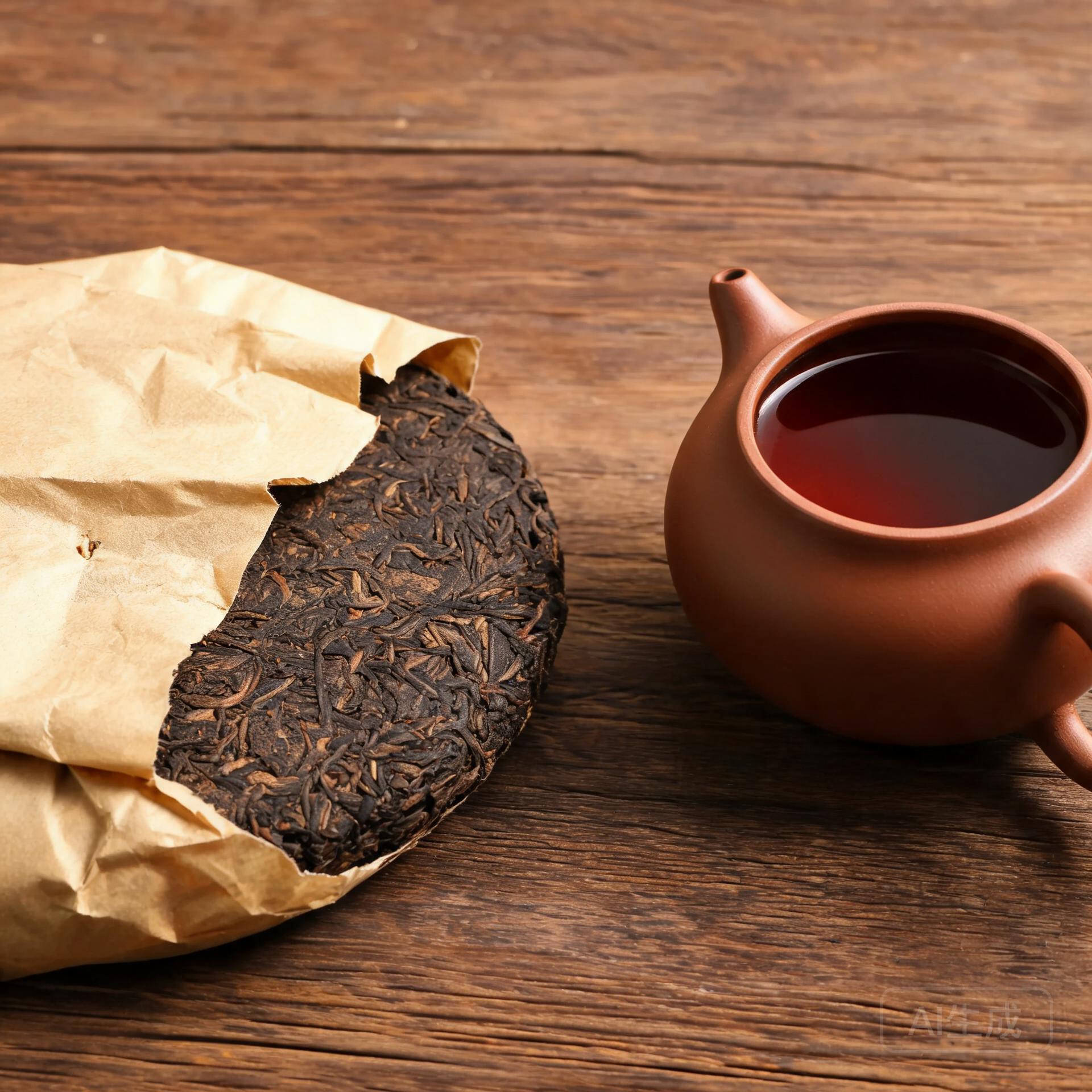
The steps
Dark tea starts like a green tea and then diverges, which is what makes the category confusing.
Leaf is plucked, fixed at a relatively low temperature, and rolled while still warm.
Then it is dried in sun rather than by fire, producing what is called sun-dried raw material.
That material, known as shai qing mao cha(晒青毛茶), is the base for everything that follows.
For raw tea it is steamed, pressed into cakes, and left to age for years or decades.
For ripe tea it is piled, wetted, and turned repeatedly over weeks in a process called wo dui.
A pile runs at perhaps 50 to 60°C inside, and it is turned 7 to 10 times across the cycle.
The whole fermentation takes 45 to 60 days before the leaf is dried and sorted.
Compressed ripe tea is pressed after piling, while raw tea is pressed before ageing.
Two routes, one shared beginning, and results that taste nothing alike.
One name covers both routes, and that is the source of most confusion about the category.
Order matters
The order is set by what has to stay alive, which is unusual in tea making.
Fixing comes first but is kept light, because a hard fix would remove what the later steps need.
Sun drying rather than firing matters for the same reason, since high heat would finish the leaf.
The result is a base that still has something left in it for microbes to work on.
Piling can only work on that kind of base, which is why it is not done to an ordinary green tea.
Water is added before piling, because microbes need moisture to move through the heap.
Turning comes during piling and not after, since the heap is cooled and re-wetted in stages.
Drying ends the pile fermentation, and it has to happen before the leaf is pressed or stored.
For raw tea the order is simpler: press after drying, then wait, since time does the work.
Either way, what happens first decides whether anything can happen last.
That is why two cakes pressed in the same year can be nothing alike a decade later.
Where it can go wrong
The classic failure is fixing too hard, which kills the material for anything that follows.
Over-fixed leaf will not pile properly and will not age, and it simply stays flat for years.
Sun drying in rain is the second, and fire-dried leaf never develops in the same way.
Piling too hot burns the heap, giving a tea that tastes sour and smells like a wet cellar.
Turning too late lets the centre of the heap overheat, and those patches turn to carbon.
Under-piled tea keeps a green harshness, and it never becomes the smooth tea it was meant to be.
Over-piled tea loses everything, and the result is thin, dark and without character.
Pressing a cake while it is still wet traps moisture, and the mould shows up a year later.
Storing raw cakes in a damp room does the same thing more slowly, and just as finally.
Most of these faults cannot be seen by looking, which is why this category is risky.
Scale and consistency
Piling is a bulk operation by nature, and a small pile simply does not heat properly.
Commercial piles run to several tonnes, and some producers work at 10 or 20 times that.
That is one reason ripe tea is mostly a factory product rather than a workshop one.
Turning is mechanised at scale, with machines built to break the heap apart and rebuild it.
Temperature is logged rather than felt, which makes the outcome far more predictable.
Raw tea scales differently, since pressing is easy and ageing only needs space.
A large producer can hold thousands of cakes for a decade, which no small maker can afford.
Consistency in ripe tea is now quite good, and that is a change from thirty years ago.
Consistency in raw tea is not really achievable, because every year and every warehouse differs.
Scale gives you a reliable ripe tea and a raw tea that is still a gamble.
Neither route is better, and the argument about which one ages well has no settled answer.