- Claims and their evidence
- The bud as evidence
- The colour curve as evidence
- What the mark actually guarantees
- The paper trail
- A routine that fits in a shop visit
- Frequently asked questions
- What is the fastest check?
- Which counties have a geographic mark?
- How reliable is liquor colour for age?
- Can I verify a wild claim?
- What makes a tea traceable?
- Does a paper trail prove the tin?
Four kinds of evidence bear on a white tea claim: a geographical indication mark, the anatomy of the bud and leaf, the colour curve of the liquor across ages, and a paper trail of producer and batch. The first proves entitlement to a name, the second and third are strong indications, and the fourth is only as good as the database behind it.
The structure of the problem differs from other classes because white tea’s claims are layered. A tin may claim a grade, a county, a bush condition and a year, and each of those needs a different kind of evidence. Treating them as one question is why buyers end up either credulous or paralysed.
Sorting the claims and matching evidence to each is the whole method, and it takes about five minutes to learn.
Claims and their evidence
| Claim | Best evidence | Strength |
|---|---|---|
| Grade | Bud and leaf anatomy | Very strong, at a glance |
| County | Geographic indication mark | Strong for Fuding only |
| Bush condition | Leaf size, uniformity, insect marks | Weak to moderate |
| Year | Liquor colour curve, leaf colour | Moderate, needs comparison |
| Cultivar | Bud size and shape | Moderate |
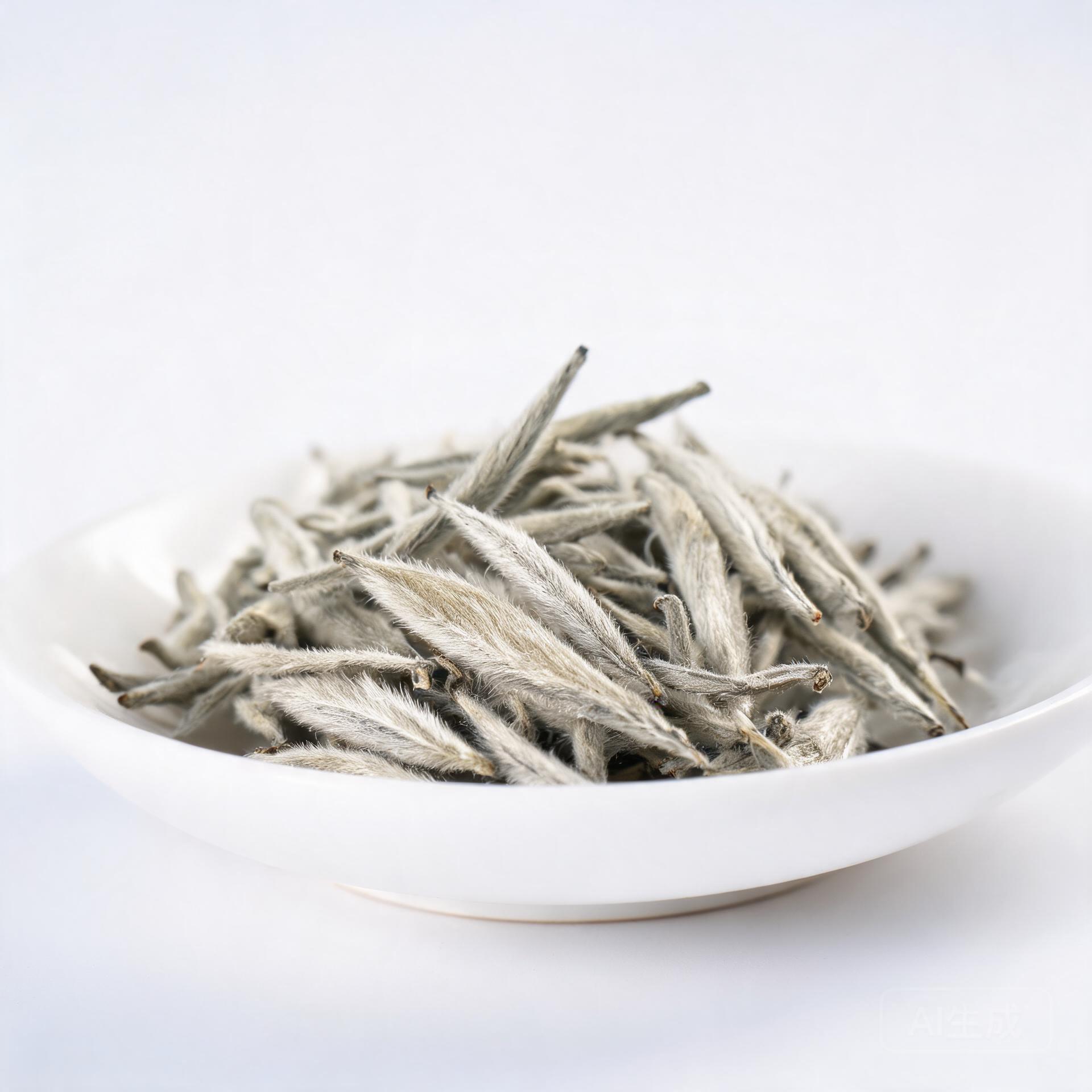
Grade is the easiest claim to check and the only one that can be settled in seconds. A Silver Needle is buds; a White Peony is a bud and two leaves; a Shoumei is leaf and stem. Tip the dry tea onto white paper and look.
County is checkable only where a mark exists. Fuding holds a geographical indication and its mark can be looked up; Zhenghe, Jianyang and Yunnan do not hold equivalent protection, so a county claim for those places rests on the seller.
Bush condition is the weakest claim. A small, uneven, insect-marked leaf suggests an unmanaged garden, and a large uniform leaf suggests a terrace, and neither proves anything because a terrace can be badly managed and an old garden can be well kept.
Year is checkable in a comparative way. The liquor colour moves from pale apricot to gold to amber over roughly seven years, and the leaf darkens from green-grey to brown, and both are consistent enough to catch a false claim of great age.
The bud as evidence
The anatomy of the bud is the most reliable evidence in the category and the most neglected. A Silver Needle bud is fat, covered in fine white down, and has a faint seam where the two leaf primordia are folded.
Size is diagnostic of cultivar. A Fuding Da Bai bud is large and plump; a Zhenghe Da Bai bud is smaller and darker; a Yunnan assamica bud is very large and its down is coarser. A tin of small dark buds sold as Fuding Silver Needle is not what it says.
Down coverage is diagnostic of quality. A bud picked in dry weather and withered gently keeps its down; a bud picked wet or handled roughly loses it, and a bald bud is a poorly made one.
Colour is diagnostic of age. Fresh buds are green-grey with silver down; a year old they are duller; three years they are brownish; seven they are dark brown. The progression is visible in the dry leaf and does not require brewing.
The colour curve as evidence
Liquor colour is the only age evidence available to a drinker without a laboratory, and it is better than most buyers realise. A fresh Silver Needle gives a liquor so pale it is almost colourless; three years gives a clear gold; seven gives amber with an orange edge.
The curve is not linear and it flattens after about ten years, so colour distinguishes fresh from three-year from seven-year reliably and distinguishes seven-year from ten-year poorly. A claim of twenty years cannot be checked by colour at all.
The colour also depends on grade. A Shoumei brews darker than a Silver Needle at every age, so the curve has to be read against the grade. A dark liquor from a claimed fresh Silver Needle is a contradiction.
Brewing method affects colour too. A long infusion darkens any tea, so the comparison has to be made at a fixed ratio and time, which is why the check is comparative rather than absolute.
- The bud settles the grade claim at a glance.
- Bud size identifies the cultivar within limits.
- A geographic mark exists for Fuding and not for the other counties.
- Liquor colour tracks age up to about ten years.
- Colour must be read against the grade and the brewing.
What the mark actually guarantees
The Fuding geographical indication restricts the name to tea grown within a defined boundary and produced according to set rules. It gives registered producers the right to use a mark, and the mark carries a number that can be checked against a registry.
What it guarantees is entitlement, which is not the same as content. A packer entitled to the mark can put leaf from outside the boundary into a tin bearing it, and enforcement depends on inspection rather than on the mark itself.
What it does not guarantee is grade. A Fuding mark says nothing about whether the tea is Silver Needle or Shoumei, and both can carry it.
The mark is therefore most useful as a filter at the top of the market. A tin claiming Fuding Silver Needle with no mark and no producer is making two unverified claims at once, and the absence of the mark is a cheap reason to look elsewhere.
| Evidence | Proves | Does not prove |
|---|---|---|
| Geographic mark | Producer may use the Fuding name | Contents or grade |
| Bud anatomy | The grade | The county or the year |
| Liquor colour | Approximate age band | Exact vintage |
| Producer and batch | A traceable source | The tin in your hand |
The paper trail
A producer name, a batch number and a date are the three items that make a tea traceable, and most retail white tea has none of them. A tin that gives all three is making a claim that can be checked against a producer’s records.
The check is whether the trail leads anywhere. A batch number that resolves to a page showing a producer, a date and a quantity is a real chain; a number printed for decoration is not, and the difference is whether the page tells you something you did not already know.
The trail is weakest exactly where the money is. A claimed twenty-year-old tea from an unnamed source has no paper behind it, and the age premium is being paid on reputation alone.
What the trail cannot do is prove the tea in the tin is the tea in the batch. That gap is the same in every class and no document closes it.
A routine that fits in a shop visit
Start with the leaf. Tip a pinch onto white paper and look at whether it is bud, bud and leaf, or leaf and stem. That settles the grade before anything else is discussed, and it also shows the colour, which gives a first estimate of age.
Then read the front of the pack for three items: a grade word, a county and a year. A pack with all three has made three claims and can be questioned on each; a pack with one has told you very little.
Then look for a mark. If it claims Fuding and shows no mark, ask why. The answer is usually that the tea is not from Fuding, packaged by a merchant who buys on the open market, which is legitimate and worth knowing.
Then ask for a brew and watch the colour. A claimed fresh Silver Needle that brews gold has a problem, and so does a claimed seven-year-old that brews pale.
Then ask for the producer and the batch. If the answer comes easily, the shop knows its stock; if it does not, the shop knows its prices.
One point about proportion is worth adding. The four kinds of evidence cost different amounts to obtain, and a buyer should spend effort where the money is at stake. On an everyday Shoumei a glance at the leaf is enough; on a claimed ten-year-old wild Silver Needle the colour check and the paper trail are both worth insisting on.
The second point is that none of the four proves a cup. They establish that the tea is what it says; whether it is any good is a separate question answered by brewing it and paying attention.
The habit worth keeping is to check the grade first every time, because it is free, instantaneous and settles the claim the label leads with.
Everything else is a refinement of that first glance, and a buyer who has trained the glance has most of what the category offers.
Frequently asked questions
What is the fastest check?
The bud and leaf anatomy, which settles the grade in seconds.
Which counties have a geographic mark?
Fuding holds one. The other white tea counties do not.
How reliable is liquor colour for age?
Good up to about ten years, poor beyond that.
Can I verify a wild claim?
Only weakly, from leaf size and unevenness.
What makes a tea traceable?
A producer, a batch number and a date that resolve to records.
Does a paper trail prove the tin?
No. It proves a batch existed, not what is in the tin.