- Grade changes the number more than age does
- What happens as the tea ages
- The flavonoid question
- Caffeine and theanine across grades
- What the numbers mean for brewing
- The limits of all this
- Why white tea sits so close to green
- What the aging figures do not mean
- Frequently asked questions
- Does white tea have more catechins than green tea?
- Does aging reduce the catechins?
- Is silver needle the richest grade?
- Is aged white tea more medicinal?
- How much caffeine is in white tea?
- Why is white tea so easy to overbrew?
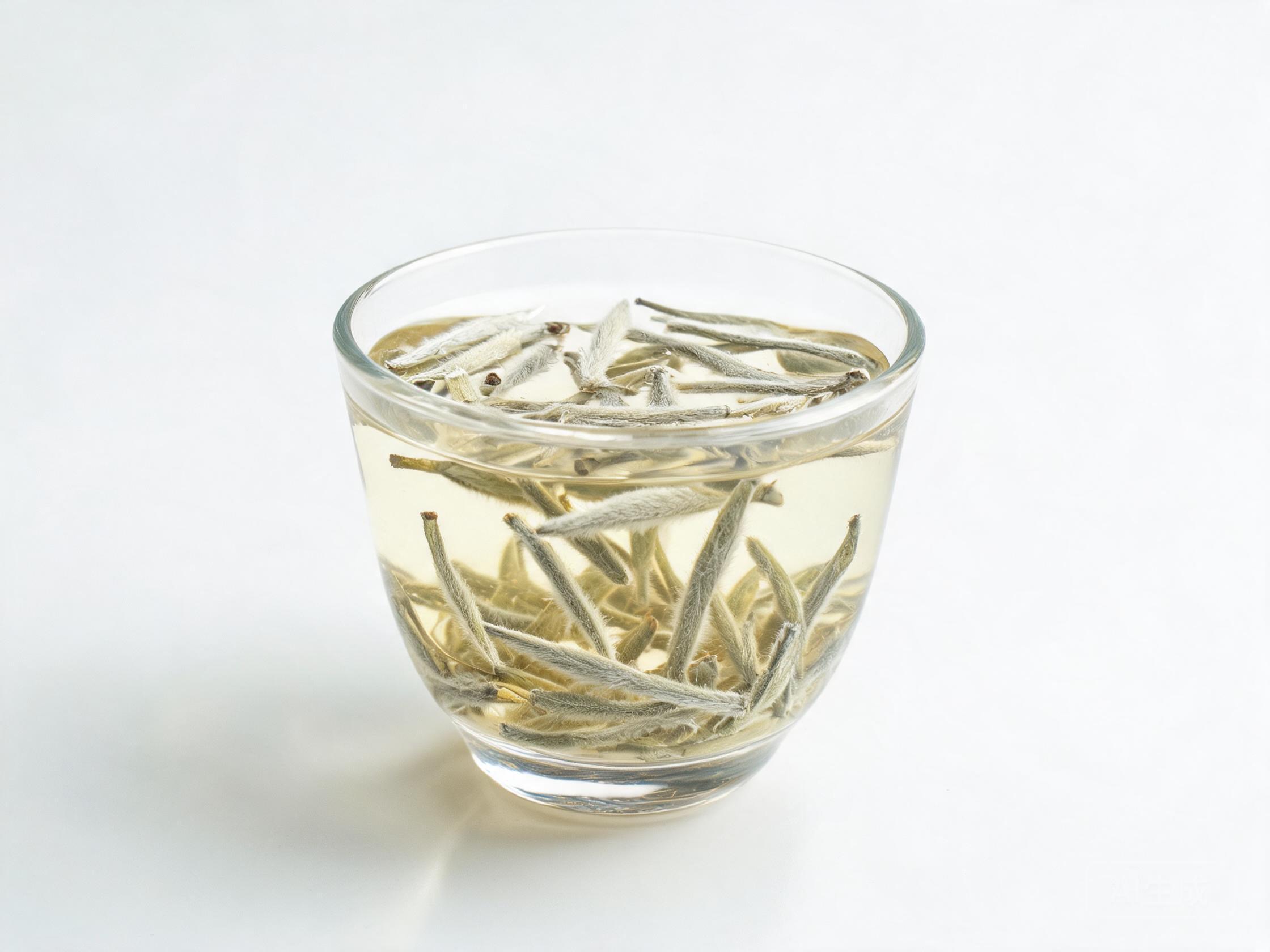
White tea contains 110 to 160 mg of catechins per gram of dry leaf, which puts it just below green tea and well above oolong, red and dark. The reason is processing: white tea is only withered and dried, with no kill-green step and no rolling, so the leaf keeps its original polyphenol load almost intact. What makes it distinct is not the fresh figure but how that figure moves as the tea ages.
The catechins are the highest of any category after green tea, and the reason is the same for both: neither is oxidized to any meaningful degree. White tea undergoes perhaps five to ten percent oxidation during a long wither, which is far less than oolong’s twenty minimum. The dry leaf is close to a snapshot of what was in the bush.
Grade changes the number more than age does
| Grade | Leaf composition | Catechins per gram | Caffeine per cup |
|---|---|---|---|
| Silver needle | Buds only | 110 to 140 mg | 15 to 25 mg |
| White peony | One bud, two leaves | 130 to 160 mg | 20 to 30 mg |
| Gongmei | Bud and three leaves | 120 to 150 mg | 25 to 35 mg |
| Shou mei | Mostly mature leaf | 100 to 130 mg | 25 to 35 mg |
The common assumption that the bud-only silver needle is the richest is wrong. Buds carry more caffeine and more theanine, and mature leaves carry more catechins, so white peony, which combines both, often measures highest. A tea sold at a premium for being all bud is paying for rarity and sweetness, not for polyphenol content.
This is worth knowing because the price gradient runs opposite to the catechin gradient. Silver needle can cost three times what white peony costs from the same producer, and delivers less of the compound most health writing focuses on.
What happens as the tea ages
Aged white tea is a real category in Fujian, sold at three, five and seven years with rising prices. The chemical change is measurable and consistent: total catechins fall, simple catechins fall faster than the gallated ones, and the flavonoid glycosides rise in relative terms.
A commonly reported pattern is that after three years, total catechins have dropped by twenty to thirty percent from the fresh figure. After seven years the drop can be forty percent or more. The tea gets darker in the cup, softer in taste, and loses the fresh grassy edge that defines a new white tea.
What rises is gallic acid, freed as the gallated catechins break down, and the flavonol glycosides that give aged white tea its medicinal, dried-fruit character. This is why the traditional claim that aged white tea is more medicinal is not pure invention: the compound profile genuinely changes, even though the health consequences of that change have not been tested.
The flavonoid question
A frequent claim is that aged white tea has more flavonoids than fresh. Whether that is true depends on which flavonoids are meant. Total flavonoid content measured by the standard colorimetric assay tends to fall with age along with the catechins, because catechins are themselves flavonoids and they dominate the total.
The flavonol glycosides, a narrower class, do rise in relative terms. So the claim is true for the specific compounds that give aged tea its character and false for the aggregate number. Most writing that repeats the claim does not distinguish the two, which makes it impossible to check.
Caffeine and theanine across grades
Caffeine in white tea runs 15 to 25 mg per cup for silver needle and up to 35 mg for the leaf-heavy grades, which is the lowest range of any tea category. This is not because white tea lacks caffeine but because the buds and young leaves used are lower in it than the coarse leaves used for oolong and dark tea.
Theanine is the opposite story. Buds are rich in theanine, so silver needle delivers more of it than any other white tea grade and more than most green teas. A cup of silver needle is therefore low in caffeine and high in the amino acid that softens caffeine’s edge, which is a genuinely unusual combination and the chemical basis for its reputation as a gentle tea.
| Compound | Fresh white tea | Aged white tea |
|---|---|---|
| Total catechins | 110 to 160 mg per g | 70 to 110 mg per g |
| EGCG | 30 to 60 mg per g | 10 to 30 mg per g |
| Gallic acid | low | rising |
| Flavonol glycosides | moderate | higher share |
| Caffeine | 15 to 35 mg per cup | largely unchanged |
| Theanine | 10 to 25 mg per g | gradually falls |
What the numbers mean for brewing
- New white tea: 85 to 90 Celsius, three grams per 150 ml, two to three minutes.
- Aged white tea: 95 to 100 Celsius, or simmered, to extract the softened compounds.
- Silver needle: cooler water, because the buds are delicate and bitterness comes fast.
- Shou mei: boiling water is fine, the leaf is tough.
- Gongfu style works with five grams per 120 ml and short steeps.
- Do not judge a white tea by its first infusion alone.
The temperature rule matters more for white tea than for most categories because the leaf is unrolled. An unrolled leaf gives up its compounds more slowly at first and then all at once if the water is too hot, which is why white tea is easy to overbrew and hard to underbrew.
The limits of all this
The catechin figures are solid. The health inferences from them are not. White tea has almost no human trials, and the aged tea claims rest on chemical reasoning rather than on outcomes. A higher catechin number in the leaf does not translate into a measured effect in the body, because absorption across all tea catechins is low.
The honest summary is that white tea is a low-processed leaf with a high polyphenol content, that its chemistry shifts predictably with age, and that the shift has been measured but its consequences have not. That is a more interesting story than a health claim, and it happens to be true.
Why white tea sits so close to green
The catechin content of a tea is set mainly by two decisions: how much oxidation the leaf undergoes, and whether it is heated early. White tea takes the second path. The leaf is spread and withered, which lets a small amount of oxidation happen, and then it is dried at low heat rather than being cooked.
What this preserves is the intact catechin pool. Green tea preserves it by stopping the enzyme with heat. White tea preserves most of it by never giving the enzyme enough time and moisture to do much. Two different routes to a similar result, which is why the two categories measure in the same range.
The difference is in the edges. Green tea’s brief but intense heat creates some epimerization, converting a portion of EGCG into GCG. White tea’s slow wither does less of that and instead allows a little theaflavin formation. Neither change is large, and both are detectable in a careful analysis, which is why the two teas taste different despite similar totals.
What the aging figures do not mean
A falling catechin number is easy to read as a loss of value. In the aged white tea market it is read as an improvement, because the compounds that replace the catechins are the ones valued for taste and for the traditional medicinal reputation.
Both readings are partial. The tea does lose antioxidant capacity as measured by catechin content, and it does gain a different profile that may have its own properties. No one has compared the two forms on any health outcome, so the market’s preference is a matter of taste and tradition rather than of measured superiority.
One more figure worth knowing is the extraction rate. White tea’s unrolled leaf releases its compounds slowly, so a two-minute steep extracts perhaps a third of the soluble catechins and a five-minute steep closer to half. The rest stays in the leaf, which is why white tea rewards a second infusion more than a fine green tea does.
That has a practical consequence for anyone trying to compare a white tea with a green tea by tasting. A short steep makes white tea seem weaker than its catechin content suggests, and the impression of mildness is partly an extraction artifact rather than a chemical fact about the leaf.
The aged tea figures carry the same caveat in reverse. A seven-year cake brewed for five minutes gives up more of what remains than a fresh leaf brewed for two, so the gap between fresh and aged in the cup is smaller than the gap in the dry leaf. Comparing the two at the same brew time is not comparing them fairly.
Frequently asked questions
Does white tea have more catechins than green tea?
Slightly less. Green tea measures 100 to 200 mg per gram and white 110 to 160, with white peony near the top of the white range.
Does aging reduce the catechins?
Yes. Three years drops the total by 20 to 30 percent, seven years by 40 percent or more.
Is silver needle the richest grade?
No. White peony usually measures higher, because mature leaf carries more catechins than bud.
Is aged white tea more medicinal?
The compound profile changes, but no trial has tested whether that produces a health benefit.
How much caffeine is in white tea?
15 to 35 mg per cup, the lowest range of any tea category.
Why is white tea so easy to overbrew?
The leaf is unrolled, so it releases compounds slowly then suddenly in water that is too hot.