- What menhuang actually does
- The numbers in a cup
- Why the category is so small
- How the leaf grade moves the figure
- Brewing to keep what is there
- What the numbers do not tell you
- The moist heat, in more detail
- Frequently asked questions
- Does yellow tea have fewer catechins than green tea?
- What is menhuang?
- Is yellow tea a kind of green tea?
- Which yellow tea has the most catechins?
- Does yellow tea have caffeine?
- Why is yellow tea so expensive?
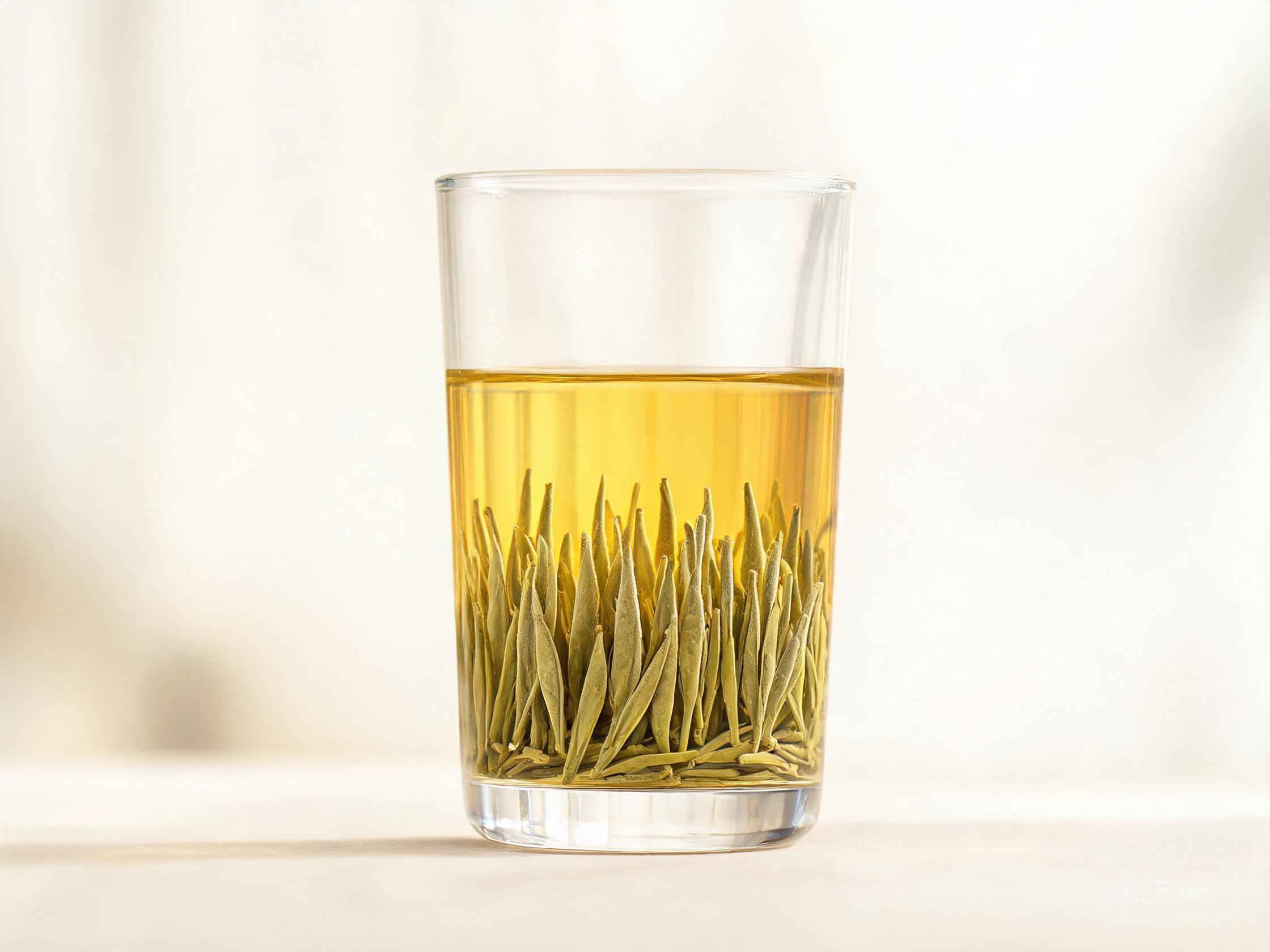
Yellow tea contains 90 to 140 mg of catechins per gram of dry leaf, below green tea’s 100 to 200 and close to white tea’s range. The figure is set by a single step that no other category has: menhuang, a warm moist pile that the leaf rests in for a day or more after kill-green. That step oxidizes a portion of the catechins non-enzymatically, which is why yellow tea is milder than the green leaf it started as.
The category is small enough that its chemistry is often described by analogy. Yellow tea is not green tea with a different color and it is not a lightly oxidized oolong. It is a separate process, and the process is the whole story.
What menhuang actually does
After the leaf is kill-green, it is rolled or not, then gathered into a warm pile while still moist. The pile sits at 60 to 70 Celsius and high humidity for 24 to 72 hours, wrapped or covered to hold the heat and moisture in.
In that environment two things happen at once. Residual enzymes that survived the kill-green continue a slow oxidation. And the heat and moisture drive non-enzymatic reactions, including the breakdown of the larger ester-type catechins into simpler ones and the release of free amino acids from proteins.
The result is measurable: total catechins fall by fifteen to thirty percent against the same leaf processed as green tea, esterified catechins fall further, and free amino acids rise. Bitterness falls with the esterified catechins, which is why yellow tea tastes sweeter and softer than the green tea made from the same pick.
The numbers in a cup
| Compound | Per gram dry leaf | Per 150 ml cup |
|---|---|---|
| Total catechins | 90 to 140 mg | 30 to 55 mg |
| EGCG | 25 to 55 mg | 10 to 25 mg |
| Free amino acids | 30 to 50 mg | 10 to 18 mg |
| Caffeine | 25 to 35 mg | 30 to 45 mg |
| Theanine | 8 to 20 mg | 4 to 9 mg |
The amino acid figure is where yellow tea differs most from green. A green tea from the same pick measures 20 to 35 mg of free amino acids per gram; the menhuang step releases more from bound protein, and the rise shows up as sweetness and as a rounder mouthfeel. That is the chemical basis for the category’s reputation as the gentlest of the lightly processed teas.
The caffeine is unchanged by menhuang. It is not destroyed by heat at these temperatures and it is not consumed by the reactions in the pile, so a yellow tea carries the same caffeine as the green tea it came from.
Why the category is so small
Yellow tea is under one percent of Chinese tea production. The menhuang step is slow, hard to control and easy to get wrong: a pile that is too cool does not transform, and one that is too hot or too wet spoils. It also adds days to a process that green tea finishes in hours, with no way to sell the time back at a premium large enough to justify it at scale.
That scarcity shapes the market. Most yellow tea is sold domestically at prices that reflect hand work, and the grades most often discussed outside China, Junshan Yinzhen and Mengding Huangya, are produced in quantities measured in hundreds of kilograms rather than tons.
How the leaf grade moves the figure
The three yellow tea grades are bud tea, small leaf tea and large leaf tea. Junshan Yinzhen and Mengding Huangya are bud teas, picked before the leaf opens, and their catechin content is at the low end because buds carry fewer catechins than mature leaves.
The small leaf teas, such as Huoshan Huangya, use one bud and one or two leaves and measure higher. The large leaf teas from Anhui, which are coarse and pan-fired, measure higher still but are rarely exported and rarely discussed in English.
This means the expensive yellow teas are the least rich in catechins, the same inversion that applies to white tea’s silver needle. Price tracks picking labor and rarity, not compound content.
Brewing to keep what is there
- Use 85 Celsius water, not boiling, because the buds are tender and bitterness comes fast.
- Three grams per 150 ml for bud tea, four for leaf tea.
- Steep two minutes for the first infusion, add thirty seconds for the second.
- Expect two good infusions from bud tea and three from leaf tea.
- Do not brew it like green tea and assume it is weaker, the extraction is slower.
- Store it cool and sealed, the moist process makes it less shelf stable than green tea.
The storage point is worth taking seriously. Yellow tea has been through a moist warm process, and its moisture content at the end is close to the limit for stability. A bag left open in a humid kitchen goes flat faster than green tea does.
What the numbers do not tell you
The catechin figures are sound and reproducible. The health inferences drawn from them are not, because yellow tea has essentially no human trials. Any claim that yellow tea does what green tea does, but more gently, is a guess built on a chemistry that is genuinely similar and a research base that is entirely absent.
The honest summary is that yellow tea is a lightly oxidized leaf with slightly fewer catechins and slightly more free amino acids than green tea, produced in tiny quantities by a process that is hard to scale. That is an interesting set of facts and it does not need a health claim to be worth knowing.
The moist heat, in more detail
Menhuang is not a simple rest. The leaf is piled while it is still warm from the kill-green, covered with cloth or paper to hold the heat in, and turned periodically so the outer and inner layers exchange. The target is a pile temperature of 60 to 70 Celsius and a moisture level high enough that the leaf feels damp but not wet.
Getting that right is the difficult part of the process and the reason the category stayed small. A pile that cools too fast does not transform the leaf and produces a tea that is green tea with a yellow leaf but none of the sweetness. A pile that is too hot or too wet develops off-flavors and can spoil outright.
The traditional skill is in the hand and the nose rather than in an instrument. Producers judge the pile by feel and smell and turn it when the aroma turns from green to sweet. That is not a process that transfers easily to a factory, which is the practical reason yellow tea remains a handmade category.
The consequence for the chemistry is that the amount of transformation varies between producers and between batches far more than in green tea. A quoted range of 90 to 140 mg of catechins per gram is an honest average across a category whose members differ because the process is judged rather than measured.
- Menhuang runs 24 to 72 hours at 60 to 70 Celsius.
- Total catechins fall fifteen to thirty percent against green tea.
- Esterified catechins fall furthest, which cuts bitterness.
- Free amino acids rise, which adds sweetness.
- Caffeine is unaffected by the pile.
- Bud grades measure lowest, leaf grades highest.
One more comparison is worth making because it is often confused. Yellow tea and a lightly roasted oolong both taste softer than green tea, and they arrive there by opposite routes. Yellow tea loses catechins to a warm moist pile before it is dried. Oolong loses them to enzymatic oxidation after rolling. The first produces sweetness with fewer catechins, the second produces new compounds alongside the loss.
That is why the two do not substitute for each other in the cup. A yellow tea tastes of the leaf it came from, softened. An oolong tastes of what the leaf became. Both are legitimate and neither is a milder version of the other.
The chemical marker is the theaflavin content. Yellow tea has trace amounts at most, because the menhuang pile is short and the temperature moderate. A roasted oolong has measurably more, and a red tea more again. If a tea sold as yellow measures like an oolong, the process was not menhuang.
The category’s chemistry is best summarized in one sentence: yellow tea is green tea with a slower, warmer, moister version of the oxidation that oolong performs faster. That single comparison explains the catechin loss, the amino acid rise and the softer taste, and it is more useful than any single number.
A buyer who keeps that sentence in mind will not be surprised by anything on the label, and will not be persuaded that the tea is either a rare green tea or a kind of white.
Frequently asked questions
Does yellow tea have fewer catechins than green tea?
Yes, by fifteen to thirty percent, because the menhuang pile oxidizes a portion of them.
What is menhuang?
A warm moist pile the leaf rests in for 24 to 72 hours after kill-green, which softens bitterness and raises free amino acids.
Is yellow tea a kind of green tea?
No. It starts as green tea and then undergoes an extra step that changes its chemistry.
Which yellow tea has the most catechins?
The leaf grades, not the famous bud teas. Buds carry fewer catechins than mature leaves.
Does yellow tea have caffeine?
Yes, 25 to 35 mg per gram of leaf, about 30 to 45 mg per cup, unchanged by the menhuang step.
Why is yellow tea so expensive?
It is under one percent of Chinese production, the process takes days, and the famous grades are made in hundreds of kilograms.