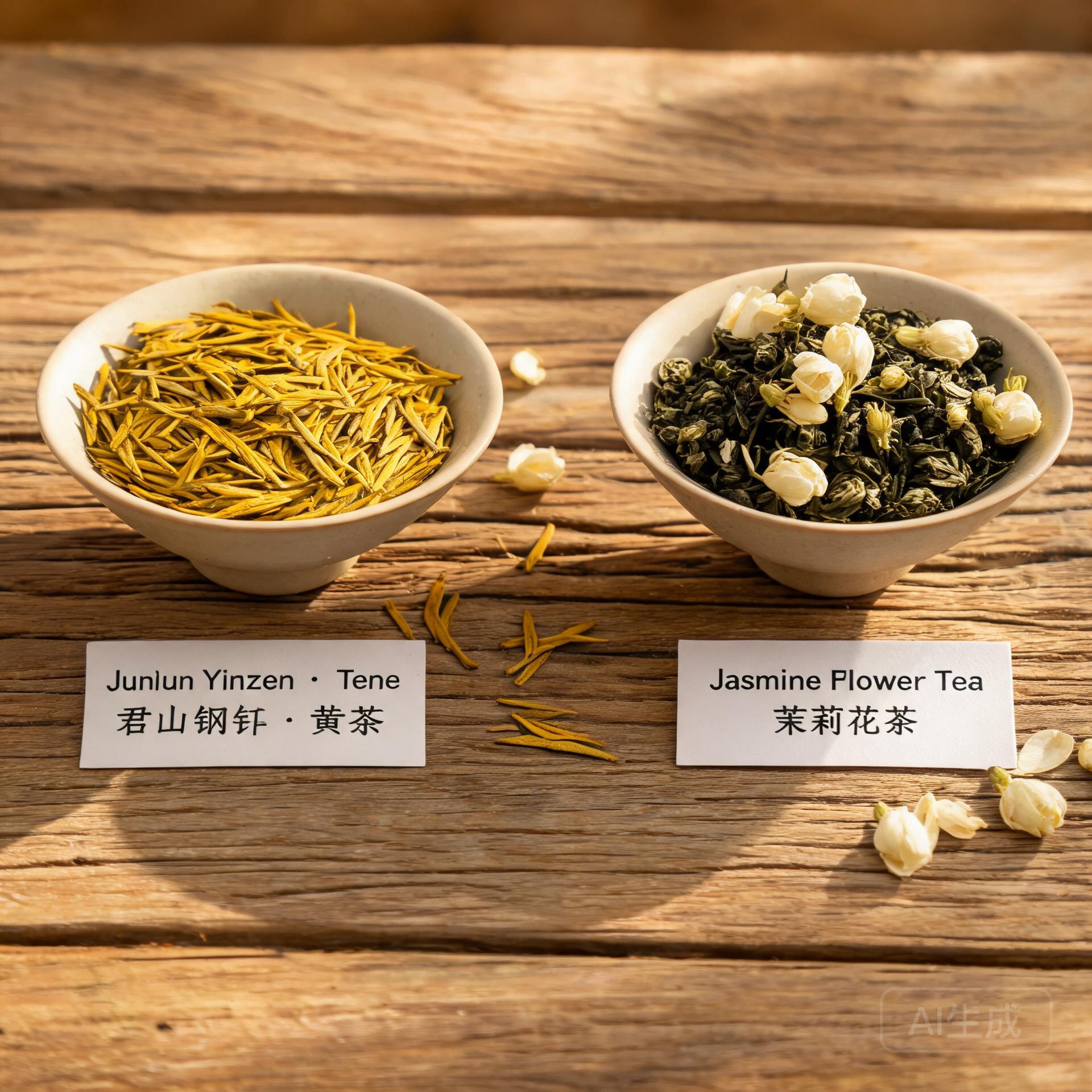
Does Yellow tea age?
Yellow tea is not an ageing category, and this is the clearest answer in the whole set. The step that defines it, men huang, is a damp-heat smothering that softens the grassy edge of a green tea without oxidizing it. What that produces is a delicate, sweet, corn-like softness, and that character fades rather than deepens.
Treat yellow tea the way you treat a fresh green tea, because in storage terms that is what it is. A year to eighteen months is a realistic window. A well-stored cake will not turn into something better in year five. It will just be older.
The reason is the same reason green tea does not age. Men huang is not a fermentation step in the dark tea sense. It is a controlled, brief sweating of the leaf, and it does not leave behind the microbial population that drives long-term change in dark tea.
It is also a step that happens while the leaf is still damp and warm, which is precisely the condition that invites mould if it goes wrong. Yellow tea is therefore both unlikely to improve with age and slightly more vulnerable than green tea while it is being made.
If it ages: store for the long run
You will occasionally see old yellow tea for sale, and there is a thriving market in aged tea generally, so it is worth being specific. Yellow tea has no established ageing tradition comparable to white or dark tea. Junshan Yinzhen and Mengding Huangya are both bought and drunk young.
That does not make aged yellow tea worthless, but it does mean there is no accumulated knowledge about how it develops, and no reason to expect the transformation that white tea shows. If you want to experiment, do it with one cake and no expectations.
It also makes old yellow tea an easy thing to fake. Because almost nobody knows what a genuinely aged yellow tea should taste like, an age claim on a yellow tea cake is close to unfalsifiable. Pay for the tea in the cup, not for the year on the wrapper.
If it does not: drink it
If you do put any aside, the conditions are the same as for green tea: dry, sealed, dark, and cool. Around 50 percent relative humidity or below, in a gasket-sealed tin, away from the kettle and away from anything aromatic.
Because yellow tea is lightly oxidized, it is marginally more stable than a green tea. Marginally. That buys you a few extra months, not years, and it is not a reason to change how you store it.
Refrigeration helps here in the same way it helps green tea, and with the same caveat. The container has to be moisture-proof and it has to come back to room temperature before it is opened. A tin opened cold will pull water out of the air onto the leaf.
A simple smell test
Smell the dry leaf. Clean and faintly sweet is right. Damp, flat, or cellar-like means it is already going, and no amount of time will improve it.
The more common failure with yellow tea is not storage at all. It is buying something labelled yellow tea that is actually a green tea or a lightly oxidized oolong. If what you have does not taste soft and sweet, check what you actually bought before you worry about how to keep it.
Real yellow tea is also expensive and produced in small quantities, which is worth knowing before you buy a kilo of it to put away. The two best known, Junshan Yinzhen from Hunan and Mengding Huangya from Sichuan, come from single growing areas with limited output.
A starter timeline
A realistic timeline for yellow tea is short. Buy it, drink it over the next six to twelve months, and buy again next season.
If you insist on an experiment, seal one small lot, date it, and open it after two years. Compare it against a fresh sample of the same tea if you can still find one. That is the only way to find out whether you like what it became, and for yellow tea the answer is usually no.
The better use of the money is to spend it on fresh yellow tea twice a year. Yellow tea at its best is a delicate, sweet, faintly savoury drink, and that only exists in the first year.