- The classical description
- Why processing decides the nature
- How it was actually used
- The warnings in the classical texts
- Reading the system honestly
- The nine body types and what they imply
- Two source texts, two meridian lists
- Frequently asked questions
- Why is green tea called cold in Chinese medicine?
- Which meridians does green tea enter?
- What did Li Shizhen write about tea?
- Does cold nature mean I should not drink it cold?
- Is any of this medically proven?
- What should I drink if green tea disagrees with me?
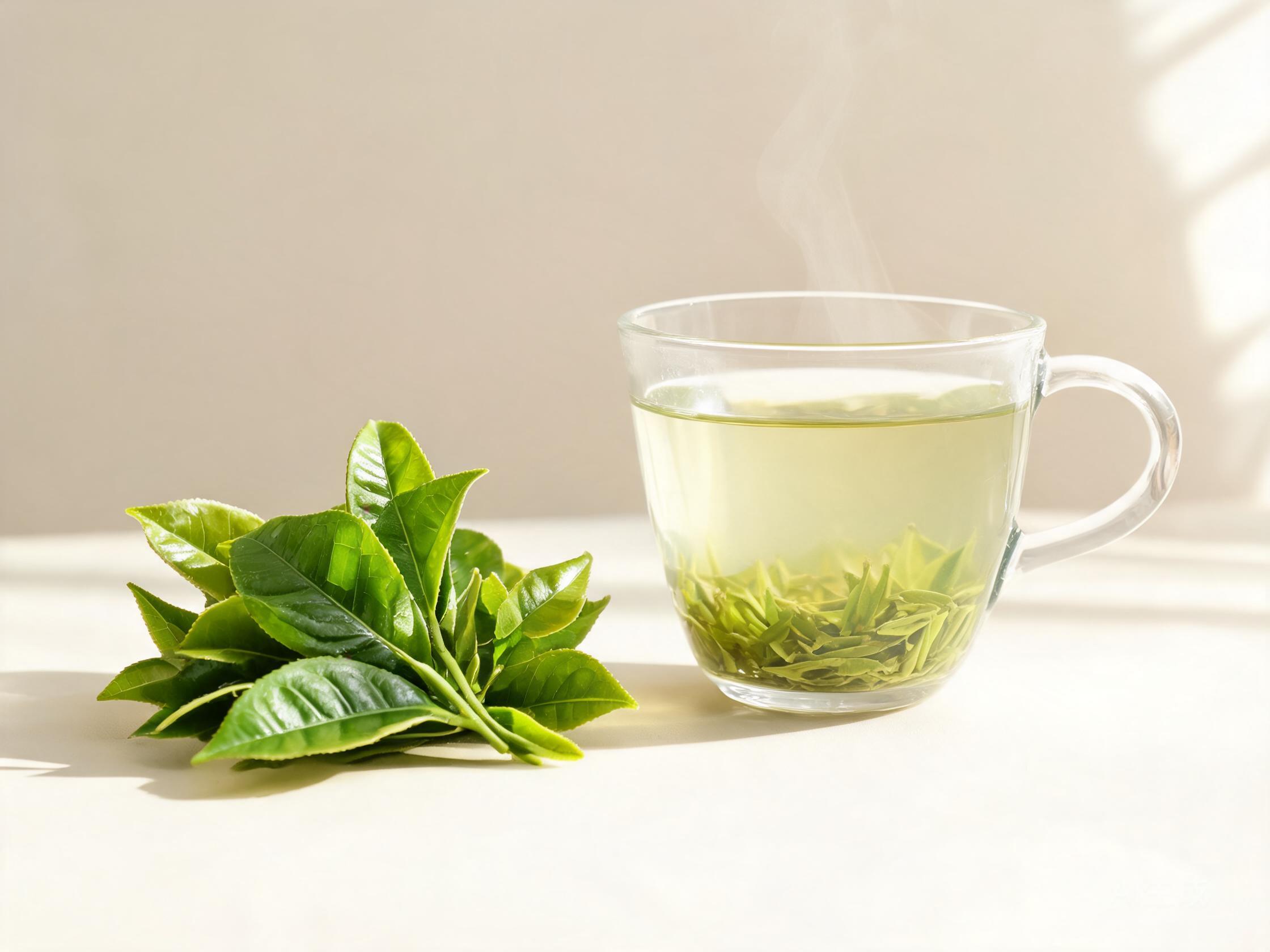
Chinese medicine classifies green tea as bitter and sweet in flavor and cold in nature, entering the heart, lung, liver and stomach meridians. The cold classification is not a comment on the drink’s temperature; it describes what the leaf does in the body’s system of correspondences, and it is why green tea is used for heat-type conditions and why the same tea is considered unsuitable for someone with a cold, weak digestion.
The classical description
The most cited line comes from Li Shizhen’s Bencao Gangmu, completed in 1578: tea is bitter and sweet, slightly cold, and non-toxic. Li added that it is the most effective thing for lowering fire, that fire is the root of a hundred illnesses, and that when fire descends the body clears. He also described it as the yin within yin, sinking and descending in direction.
That is a technical statement, not poetry. In the four-nature system, cold herbs clear heat and drain fire. In the five-flavor system, bitter drains and dries while sweet tonifies and moderates. A herb that is both bitter and sweet, and cold in nature, is understood to clear heat without injuring the fluids too badly, which is precisely the role green tea plays in classical formulas.
The meridian attribution is where sources diverge. The Leigong Paozhi Yaoxing Jie, a Ming text on processing and drug nature, gives all five organs: heart, liver, spleen, lung and kidney. A widely used modern clinical summary of green tea gives heart, lung, liver and stomach. The difference reflects how the tea is being used rather than a contradiction; classical authors assigned meridians according to the conditions the tea was prescribed for.
| Attribute | Attribution | What it means in practice |
|---|---|---|
| Flavor | Bitter and sweet | Bitter drains and dries; sweet protects the fluids |
| Nature | Cold | Clears heat, drains fire, cools the blood |
| Direction | Sinking, descending | Moves downward, diuretic, clears the head |
| Meridians | Heart, lung, liver, stomach | Affects spirit, respiration, liver qi and digestion |
| Classical action | Clears heat, resolves toxicity | Used for heat-type patterns, not cold ones |
Why processing decides the nature
The plant is the same for all six categories. What changes the nature is the process. Green tea is kill-greened immediately, which preserves the leaf’s cold character intact. Red tea is fully oxidized, which the tradition reads as a transformation from cold to warm, and dark tea goes further through microbial fermentation into warmth.
This is not a purely symbolic system. The same processing that the tradition calls warming also destroys most of the catechins and creates the larger theaflavins and thearubigins. A modern reader can treat the cold-warm axis as a traditional index that happens to correlate with real chemical differences, without having to accept the metaphysical framework that produced it.
The practical consequence is the one that matters most. If green tea is cold, then it is the wrong drink for someone whose digestion already runs cold, and the right drink for someone with heat signs: thirst, a red face, a bitter taste in the mouth, constipation, or a feeling of irritability in hot weather.
How it was actually used
Three classical applications recur. The first is clearing the head and eyes: tea was prescribed for headache and heaviness in the head attributed to heat rising, often in a formula with other herbs. The second is cutting through grease and food stagnation, where tea was taken after rich meals. The third is as a vehicle, a liquid used to wash down other medicines, which appears throughout Song and Ming formularies.
The Bencao Shiyi, a Tang text, contains the memorable claim that while each medicine treats its own disease, tea treats the diseases of all of them. That line is usually quoted approvingly, but it sits in a text that also lists contraindications. The tradition was never as uncritical as the quotation suggests.
Li Shizhen himself is the clearest example. He wrote warmly about tea in his youth and then reported that in middle age, with weaker digestion, the same habit caused chest tightness and loose stools. He recorded that change against himself, and the passage has been used ever since to argue that the dose and the constitution matter more than the substance.
The warnings in the classical texts
The same Bencao Gangmu passage that praises tea for lowering fire also warns that people who are deficient and cold, or whose blood is weak, will after long use find their digestion turning colder, their original qi quietly depleted, and their essence and blood affected. It lists the consequences as phlegm retention, distension, weakness, emaciation, and vomiting.
There is also a specific instruction about timing: tea should be drunk warm, because cold tea causes dampness to coalesce into phlegm, and it should not be taken on an empty stomach. The text describes drinking tea when very thirsty or after wine as drawing it directly into the kidney channel, with cold pain in the lower back, legs and bladder to follow.
These are the passages a modern reader should weigh most heavily, because they are the ones the tradition itself emphasised. The praise is general; the cautions are specific and personal, drawn from the author’s own experience of getting it wrong.
Reading the system honestly
- The cold classification is a traditional category, not a measured physiological temperature.
- It is consistent with the chemistry: unoxidised leaf retains the catechins that the tradition links to cooling.
- The meridian attributions vary between texts; there is no single canonical list.
- The classical cautions about weak digestion and empty-stomach drinking are more specific than the classical praise.
- A traditional classification describes what the tea does in a system of correspondences; it is not evidence that the tea treats a disease.
What the tradition does not provide is a clinical trial. Nothing in the Bencai Gangmu establishes that green tea lowers blood pressure or prevents cancer. What it provides is a coherent account of when a cold, bitter drink is appropriate and when it is not, built from centuries of observation, and a set of warnings that a modern drinker can test against their own experience.
That is the honest way to use it. If green tea reliably gives you a stomach ache, the tradition has a name for why and a suggestion about what to drink instead. If it suits you, the tradition explains that too. Neither conclusion requires accepting the underlying cosmology.
The nine body types and what they imply
Modern Chinese medicine sorts people into nine constitutional types, of which one is balanced and eight are tendencies. The framework is used to decide which tea suits which person, and green tea’s cold nature makes it a poor match for two of the eight: the yang-deficient type, who feels cold and tires easily, and the qi-deficient type, who has weak digestion and low energy.
It is a better match for the damp-heat type, who tends toward oiliness, irritability and a bitter taste in the mouth, and for the yin-deficient type, who runs dry and hot. Both are described as having heat, and a cold bitter drink is the classical response to heat.
Whether the framework is predictive in any modern sense is a separate question, and the honest answer is that it has not been tested that way. What it does provide is a vocabulary for the observation that the same drink affects different people differently, which is something anyone who has watched a friend get a stomach ache from a cup of green tea already knows.
- Balanced type: green tea is fine in moderation.
- Yang-deficient: prefers warm, oxidized tea.
- Qi-deficient: green tea may cause loose stools.
- Damp-heat: the classical indication for green tea.
- Yin-deficient with heat: suits green tea.
- Blood-stasis, phlegm-damp, qi-stagnation: depends on the accompanying pattern.
One more distinction is worth drawing. The classical texts describe tea as a whole, not as green tea specifically, because the six-category system is a modern classification. When Li Shizhen writes about tea being cold, he is writing about the unoxidized leaf that most people in his region were drinking, which happens to be what we now call green tea. The application of his words to a modern category is an inference, a reasonable one, but an inference nonetheless.
That matters for anyone reading the tradition carefully. The general statements about tea being cold, bitter and descending apply most directly to the green leaf. The specific claims about warming and digesting apply to the oxidized and fermented teas that developed later and in different regions. The system is consistent; it was simply written about a narrower set of products than the one it is now used to describe.
Two source texts, two meridian lists
The disagreement between sources is specific enough to be useful. The Leigong Paozhi Yaoxing Jie, a Ming dynasty text on processing and drug nature, states that tea enters all five organs: heart, liver, spleen, lung and kidney. A widely cited modern clinical summary gives four: heart, lung, liver and stomach.
The difference is not sloppiness. The five-organ list is a statement about tea in general and reflects its broad use across many formulas. The four-organ list is a statement about green tea in particular and reflects the conditions it is actually prescribed for. A modern reader should treat the four-organ list as the more specific claim and the five-organ list as the older, broader one.
Neither list is testable in any modern sense. What can be said is that the four-organ attribution matches the traditional uses: heart for the spirit and alertness, lung for the head and throat, liver for the eyes and irritable heat, stomach for digestion and grease. Each organ maps onto a set of symptoms the tea was given for.
Frequently asked questions
Why is green tea called cold in Chinese medicine?
Because it is unoxidised. The tradition holds that processing determines nature, and the kill-green step preserves the leaf’s cold character intact, while oxidation and fermentation shift it toward warmth.
Which meridians does green tea enter?
Commonly given as heart, lung, liver and stomach. The Ming text Leigong Paozhi Yaoxing Jie gives all five organs including spleen and kidney.
What did Li Shizhen write about tea?
That it is bitter and sweet, slightly cold and non-toxic, and the most effective thing for lowering fire. He also warned that cold, deficient constitutions suffer from long-term use.
Does cold nature mean I should not drink it cold?
The tradition does advise against cold tea, saying it causes dampness to coalesce into phlegm. The recommendation is to drink it warm.
Is any of this medically proven?
No. The classification is a traditional system of correspondences. It is a framework for choosing what to drink, not evidence that green tea treats disease.
What should I drink if green tea disagrees with me?
The tradition points to oxidized or fermented teas, red tea and dark tea, which it classifies as warm. That is also the practical advice many drinkers arrive at on their own.