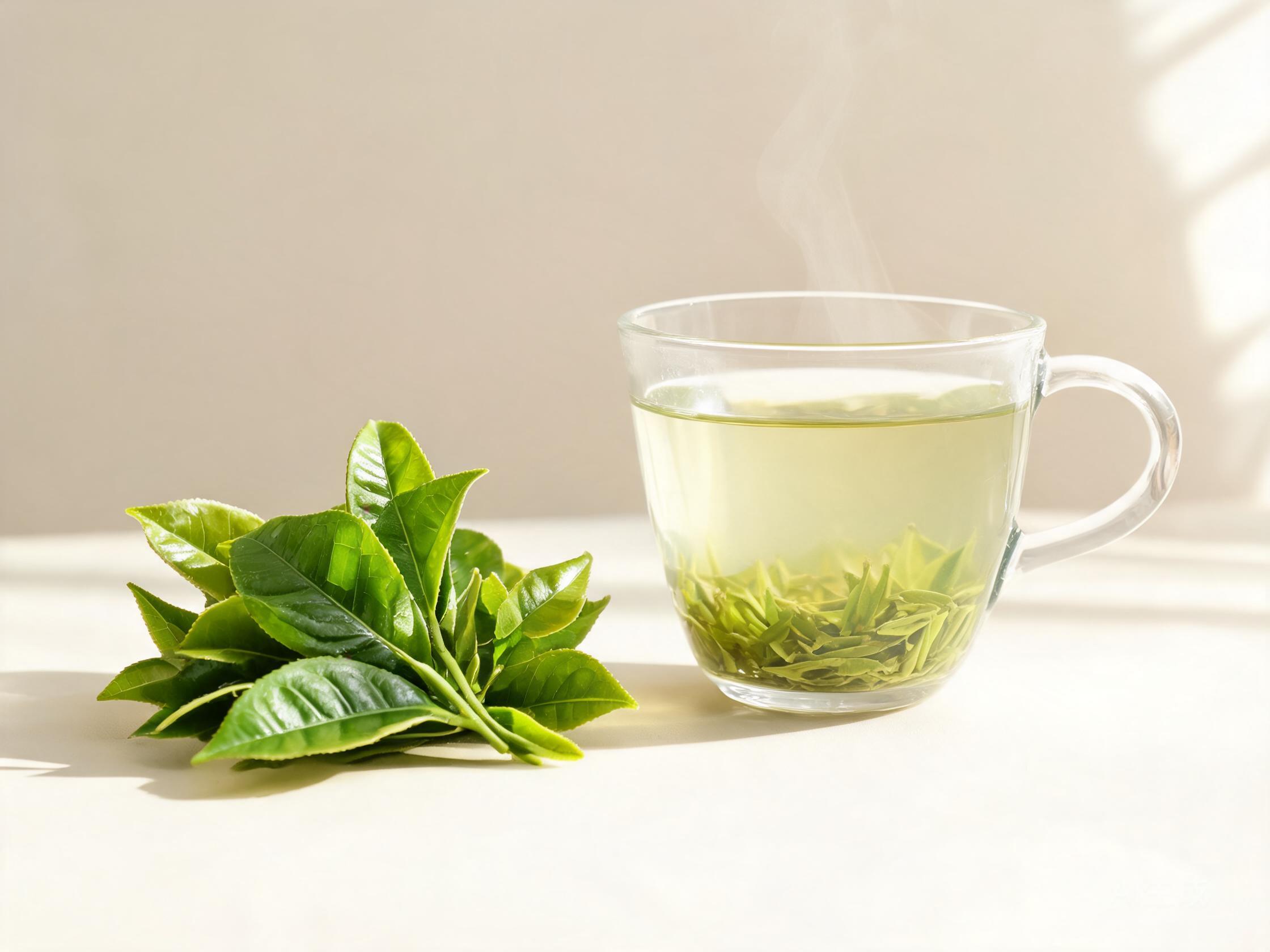
- Why the timing question has a real answer
- Morning: good, but not on an empty stomach
- With meals: the iron problem
- Afternoon: the second window
- Evening: why the answer is usually no
- A simple schedule
- The three-cup pattern
- Does the time of day change what you absorb
- Shift work and travel
- The traditional three-cup quantities
- Frequently asked questions
- Is it better to drink green tea in the morning or at night?
- Can I drink green tea on an empty stomach?
- Why should I avoid tea with meals?
- How long before bed should I stop?
- Does green tea keep you awake?
- Is 4 pm too late?
The best time to drink green tea is mid-morning to early afternoon, ideally an hour after a meal rather than with it. Two cups between 9 am and 2 pm gives the caffeine and theanine benefit without touching iron absorption or sleep. The last cup should be six to eight hours before bed, and the empty-stomach rule matters less than the internet suggests, provided the tea is not strong.
Why the timing question has a real answer
Three separate mechanisms make time of day matter, and they point in slightly different directions. Caffeine is a stimulant with a long tail, which argues for earlier. Tannins block iron absorption, which argues for separating tea from meals. And theanine promotes a calm alertness that some people find useful in the afternoon and others find disruptive at night.
The caffeine tail is the dominant one, because it is measurable. Population-average half-life is about 5.7 hours, and the decay is exponential. A 28 mg cup drunk at 8 am leaves roughly 13 mg at 2 pm and 7 mg at 8 pm. The same cup at 4 pm leaves about 13 mg at 10 pm, which is enough to affect sensitive sleepers.
That is why the six-to-eight-hour rule exists. It is not a prohibition; it is a way of ensuring the residue at bedtime is under the roughly 50 mg threshold that most sleep research treats as the point where latency and deep sleep start to suffer. For a single cup of green tea you are already well under that at six hours.
| Time | Caffeine at bedtime if drunk then | Iron effect | Verdict |
|---|---|---|---|
| 7 am, empty stomach | Under 5 mg | None | Only if it does not upset your stomach |
| 9 to 11 am | Under 5 mg | None | Best window |
| With lunch | Under 5 mg | Up to 26 percent less iron absorbed | Move it an hour later |
| 2 to 3 pm | About 10 mg | None | Fine for most people |
| 5 pm | About 15 mg | None | Borderline for sensitive sleepers |
| 8 pm or later | Over 20 mg | None | Skip if sleep matters |
Morning: good, but not on an empty stomach
The traditional Chinese advice is explicit: tea should not be taken on an empty stomach. The Bencao Gangmu describes drinking tea when very thirsty or after wine as drawing it straight into the kidney channel, with cold pain in the lower back and legs to follow, and it calls the empty stomach the thing most to be avoided.
The modern explanation is simpler. Green tea stimulates gastric acid secretion, and the tannins are mildly irritating to the stomach lining. A strong cup before breakfast causes nausea or discomfort in a meaningful minority of people, and brewing with boiling water makes it worse because more tannins are extracted.
So the practical morning rule is: after breakfast, not before. Two hundred millilitres of water at 80 C over three grams of leaf, taken between 9 and 11 am, is the pattern most people settle into. It is also the pattern that a traditional Chinese three-cup schedule describes, with the first cup placed after the morning meal rather than before it.
With meals: the iron problem
Drinking tea with a meal is the one timing habit with a measurable cost. Tannins and polyphenols bind non-heme iron in the gut and prevent its absorption. In a controlled study, adding green tea extract to a meal reduced iron absorption from 12.1 percent to 8.9 percent, about a 26 percent drop.
For most people that is unimportant. It matters for anyone with low iron stores, for vegetarians and vegans whose iron is entirely non-heme, and for pregnant women with higher requirements. For those groups, moving the tea an hour or two after the meal recovers most of the loss.
There is a related point about timing and supplements. Iron tablets should not be taken with tea. Take them with water or a vitamin C source, which actually improves absorption, and drink the tea later. The same applies to folic acid, which green tea also reduces absorption of.
Afternoon: the second window
The early afternoon is the second natural slot. A cup at 2 or 3 pm delivers enough caffeine to carry the end of the working day, and still leaves under 10 mg in the body by 10 pm. For most people that is not enough to disturb sleep.
This is also where the theanine matters. A cup in the afternoon produces a calmer alertness than a coffee would, without the jitteriness that some people get from a second coffee. Whether that is worth a cup is a personal judgement, but the pharmacology is friendly to the idea.
One caveat: the classic Chinese three-cup schedule places a stronger cup in the early afternoon, four grams in 180 ml, described as useful for lipids and blood vessels. That is a stronger brew than most Western drinkers make, and it is also more caffeine. Anyone sensitive should keep the afternoon cup light.
Evening: why the answer is usually no
One study comparing standard green tea with a low-caffeine version found no significant difference in sleep onset time, which suggests a couple of cups during the day will not wreck most people’s sleep. That is a more forgiving result than the folklore.
But the same study’s authors note that large quantities later in the day are a different matter. Caffeine blocks adenosine receptors, and even when you fall asleep, the blockade reduces deep slow-wave sleep. People who sleep through the night after an evening cup often report feeling less restored.
The practical rule is to stop by mid-afternoon if sleep is fragile, and by early evening if it is not. Anyone who is a slow metaboliser, and the range of half-lives runs from about two to twelve hours, should treat the later cut-off as earlier still. Pregnancy, oral contraceptives and some medications all lengthen the half-life substantially.
A simple schedule
- 9 to 11 am: first cup, after breakfast, 3 g in 200 ml at 80 C.
- Wait an hour after lunch before the second cup, particularly if iron matters to you.
- 2 to 3 pm: optional second or third cup, kept light.
- Stop by 4 pm if you are sensitive to caffeine.
- No tea after 8 pm, and none at all in the two hours before bed.
- If you take iron or folic acid, keep tea at least an hour away from the dose.
The three-cup pattern
Traditional Chinese practice describes three cups a day at set times: one after breakfast, one in the early afternoon, and one in the early evening, with the last kept weak. That pattern is worth examining because it independently arrives at the timing a caffeine-aware schedule would recommend.
The morning cup is placed after food, which avoids the empty-stomach problem. The afternoon cup is strong and taken between two and three, which leaves enough clearance before bed. The evening cup is deliberately light, two grams rather than four, which keeps the caffeine dose small enough that it does not disturb sleep.
The one adjustment a modern drinker should make is the evening cup. The traditional schedule places it at six or seven, which is workable if the tea is weak, but anyone who sleeps badly should move it to late afternoon or drop it. The principle survives; the specific hour does not need to.
Does the time of day change what you absorb
Absorption of the catechins does vary with the state of the stomach, though the research on this is thinner than the research on caffeine. Taking a green tea extract on an empty stomach produces a much higher peak in the blood than taking it with food, which is one reason USP-verified products carry a label advising against the fasting dose.
For brewed tea the effect is smaller, because the drink itself is mostly water and the catechin load is low. What matters more is the iron interaction: a cup with a meal costs you iron, and a cup an hour later does not. That single timing decision is worth more than any refinement of the morning window.
Shift work and travel
The schedule above assumes a conventional day. Shift workers and frequent flyers need a different rule, because the anchor is not the clock but the sleep period. The workable version is to place the last cup six to eight hours before the planned sleep, whenever that falls, and to keep the interval constant rather than the hour.
After a long-haul flight the body clock lags, and caffeine is a blunt tool for shifting it. A cup at the local morning helps a little, but the bigger variable is light exposure. Tea is a pleasant accompaniment to adjusting, not the mechanism.
| Habit | Problem | Fix |
|---|---|---|
| Tea with breakfast | Iron absorption falls about 26 percent | Move it an hour after eating |
| Strong cup before food | Nausea from tannins and gastric acid | Eat first, then brew weaker |
| Cup at 5 pm | About 15 mg caffeine at 10 pm | Move to 2 pm |
| Cup at 9 pm | Over 20 mg at midnight | Skip it |
| Tea with iron tablets | Reduced supplement absorption | Space by two hours |
The traditional three-cup quantities
Classical Chinese practice specifies not just the hours but the quantities, and the numbers are more precise than most modern advice. The morning cup is three grams of leaf in 200 ml of water, taken between 8:30 and 9:30 after breakfast. The afternoon cup is four grams in 180 ml, taken between 2 and 3 pm. The evening cup is two grams in 150 ml, taken between 6 and 7 pm, and nothing after 9 pm.
That schedule deliberately scales the dose down through the day, which is exactly what a caffeine-aware modern plan would do. Three grams in the morning gives a full cup for alertness. Two grams in the evening keeps the ritual without the stimulant load. The ratio between the first and last cup is 1.5 to 1 in leaf weight, and about 1.6 to 1 in caffeine.
It also solves a problem the modern advice usually ignores. Most people who drink tea in the evening do so for the ritual and the warmth rather than for the caffeine, and a weak cup delivers both. If the ritual is what you want, two grams is enough.
Frequently asked questions
Is it better to drink green tea in the morning or at night?
Morning and early afternoon. Caffeine has a half-life of about 5.7 hours, so an evening cup still leaves measurable amounts at bedtime.
Can I drink green tea on an empty stomach?
It causes nausea and discomfort in some people because it stimulates gastric acid and the tannins irritate the lining. Take it after food, especially if the brew is strong.
Why should I avoid tea with meals?
Tannins bind non-heme iron. One study found absorption fell from 12.1 to 8.9 percent, about 26 percent. Wait an hour or two if iron matters.
How long before bed should I stop?
Six to eight hours for most people, longer if you are a slow metaboliser. Half-lives range from about two to twelve hours.
Does green tea keep you awake?
Less than coffee, and one study found no difference in sleep onset with normal intake. Large amounts late in the day still reduce deep sleep.
Is 4 pm too late?
For most people it leaves around 13 mg at 10 pm, which is below the threshold that usually affects sleep. If you are sensitive, treat 2 pm as the cut-off.