- Why the large-leaf variety matters
- The main growing regions
- Ancient tea forests and the "ancient tree" claim
- From one leaf to two very different teas
- Frequently asked questions
- Kunming versus coastal storage
- What Yunnan tea is not
- How to buy Yunnan tea without overpaying
- Why Yunnan tea tastes the way it does
- Frequently asked questions
- Is all pu-erh from Yunnan?
- What does Yunnan black tea taste like?
- Are ancient tea trees real?
- Which Yunnan region makes the best tea?
- Why does Yunnan tea often look larger?
- Does Yunnan produce green tea too?
- Why does storage location matter so much for pu-erh?
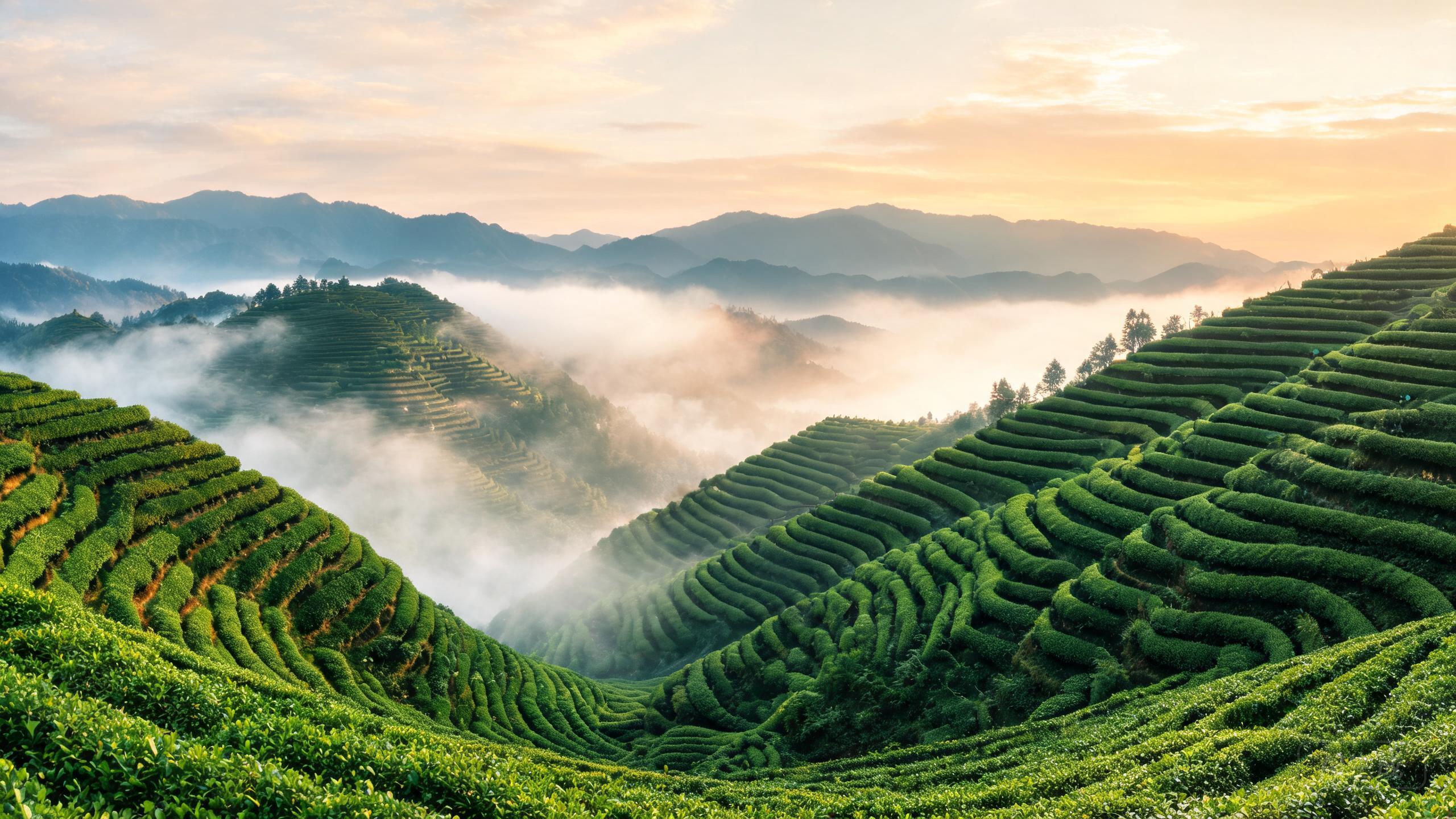
Yunnan is the southwestern Chinese province where pu-erh originates and where much of the world’s large-leaf tea grows. It sits in the eastern Himalayas, with the Mekong, Salween and Yangtze rivers cutting through it, and that geography produces an unusual combination of altitude, latitude and humidity. Three areas dominate production: Xishuangbanna in the far south, Simao (now Pu’er City) in the centre, and Lincang to the north. Yunnan is the only province that makes both substantial black tea and substantial post-fermented tea from the same leaf, which is why pu-erh and Yunnan black tea are more closely related than their very different tastes suggest.
Why the large-leaf variety matters
Yunnan tea comes predominantly from Camellia sinensis var. assamica, the large-leaf variety. The leaves are bigger and contain higher levels of polyphenols, which makes them suitable for both strong black tea and the fermentation that produces pu-erh.
This is the single most important fact about Yunnan tea. The same leaf material, processed differently, becomes either a malty black tea or a pu-erh cake. The variety sets the ceiling on what the processing can achieve, and Yunnan’s variety is unusually high in the compounds that both styles depend on.
Yunnan also has related wild species. Camellia taliensis is used occasionally, and some tea sold as white tea from Yunnan is made from it rather than from standard tea leaf.
The main growing regions
| Region | Location | Known for |
|---|---|---|
| Xishuangbanna | Far south, borders Laos and Myanmar | Historic pu-erh centre, Menghai and Yiwu |
| Simao / Pu’er City | Central | Named for the tea, broad pu-erh production |
| Lincang | North | High altitude, strong raw materials |
| Baoshan | West | Green tea and black tea |
| Dali | Northwest | Traditional green tea, Tuo cha |
Xishuangbanna is the most historically significant. Menghai and Yiwu — two of its sub-regions — are names that appear repeatedly on old pu-erh wrappers, and the tea factories there shaped how the modern pu-erh market is structured. Menghai is associated with bold, strong raw material; Yiwu is associated with softer, sweeter character.
Ancient tea forests and the “ancient tree” claim
Yunnan has genuine old tea forests — areas where tea bushes have been tended for centuries and grown into trees, particularly in Xishuangbanna and Lincang. These are real, culturally important and produce distinctive tea.
The problem is the marketing. “Ancient tree” (gushu) has become a price multiplier, and the claim is essentially unverifiable on a label. The quantity of genuine old-tree tea is small compared with the volume sold as such. If you are paying a premium for age, you need specific provenance — a village name, a producer you can check — rather than the adjective.
From one leaf to two very different teas
Yunnan black tea is made by withering, rolling, oxidising fully and drying. The result is malty, sweet and often honeyed, with a smooth body that makes it one of the more accessible black tea styles.
Pu-erh is made by pan-firing, rolling and sun-drying to maocha, then either pressing it to age slowly (raw) or pile-fermenting it before pressing (ripe). The difference in taste is total, and yet the starting leaf may be from the same bushes.
Frequently asked questions
Kunming versus coastal storage
Once a Yunnan cake leaves the province, storage becomes the dominant variable. Kunming, at altitude with a dry climate and cool nights, ages tea slowly: cakes change gradually, retain more of the original bitterness for longer, and tend to keep a clearer, more defined structure. Guangzhou and Hong Kong, hot and humid, age tea fast: cakes darken quickly, soften, and develop the sweet, woody notes collectors associate with old tea — but also a higher risk of damp if the environment is not controlled.
This is why two cakes from the same production, made on the same day, can diverge so far in ten years that they no longer taste related. It is also why a seller who can describe storage in specific terms — city, conditions, how open the storage is — is giving you far more useful information than one who simply quotes a vintage.
For the processing side of the same question, our guide to raw versus ripe pu-erh covers how the two styles age differently, and the storage guide takes the practical view of humidity and temperature.
What Yunnan tea is not
Two corrections are worth making because they come up constantly.
Yunnan is not the only place that makes post-fermented tea. Hunan produces Anhua dark tea, Guangxi produces Liubao, Hubei produces qingzhuan bricks, and Sichuan has its own tradition. These are all heicha — dark tea — and none of them is pu-erh, which is a protected Yunnan designation. If a seller offers Yunnan-style dark tea from another province, the wording is doing useful work for a reason.
Yunnan is also not where most of the world’s tea comes from. In volume terms, China overall, India and Kenya lead global production, and Yunnan is a specialty region rather than a bulk supplier. Its importance in tea culture is out of proportion to its tonnage, which is exactly what you would expect of a place whose teas are valued for character over yield.
How to buy Yunnan tea without overpaying
Yunnan produces more styles than most buyers realise, and the price range within each style is enormous. A few practical rules cut through it.
- For black tea, the value is generally better than for pu-erh. Yunnan black tea is produced in volume and a good everyday example costs little, so there is no reason to pay premium prices without a specific reason.
- For raw pu-erh, match the price to the age and the storage, not to the wrapper. A five-year cake from a known garden is a better buy than a twenty-year claim with no storage history.
- For ripe pu-erh, the differences between producers are smaller than the marketing suggests. Buy a mid-range cake, learn what you like, and upgrade later.
- Treat single-village and ancient-tree claims as unverifiable unless the seller gives a name you can check and a plausible reason for the premium.
- Buy small first. Yunnan tea is produced in quantities that make sample sizes easy to find.
Why Yunnan tea tastes the way it does
The province’s character comes from a combination of factors that are hard to replicate elsewhere. High altitude slows leaf growth and concentrates flavour compounds. A long rainy season and significant day-to-night temperature swings affect how the leaf develops. And the dominant large-leaf variety carries more polyphenols than the small-leaf varieties used across most of eastern China, which is what makes both strong black tea and long-aged pu-erh possible from the same material.
That combination is why Yunnan tea often tastes fuller and more assertive than tea from the coastal provinces, and why the same leaf can become either a malty black tea or a cake intended to mature for twenty years. The variety sets the ceiling; the processing decides which direction it goes.
Frequently asked questions
Is all pu-erh from Yunnan?
Traditionally and legally, yes — pu-erh is defined by its Yunnan origin. Other provinces produce post-fermented teas, but they are sold as dark tea rather than as pu-erh.
What does Yunnan black tea taste like?
Typically malty, sweet and smooth, sometimes with honey or cocoa notes. It is generally rounder and less astringent than an Assam, which makes it a good introduction to black tea.
Are ancient tea trees real?
The old tea forests are real and significant. The commercial use of the claim is not reliably verifiable, and most tea sold as ancient-tree is not from old trees.
Which Yunnan region makes the best tea?
There is no reliable answer. Regions produce different characters rather than better or worse tea, and within every region quality depends heavily on the specific garden, the producer and the year.
Why does Yunnan tea often look larger?
Because the dominant variety is C. sinensis var. assamica, the large-leaf type. The bigger leaf and higher polyphenol content shape both the flavour and the processing choices.
Does Yunnan produce green tea too?
Yes. Yunnan produces green tea, often from the same large-leaf material, and its fuller, slightly more bittersweet character is distinct from the coastal Chinese green tea styles covered in our green tea guide.
Why does storage location matter so much for pu-erh?
Because the tea keeps changing after it is pressed, and the rate of that change depends on humidity and temperature. A dry, cool city ages tea slowly and preserves structure; a hot, humid one ages it fast and produces softer, sweeter notes.