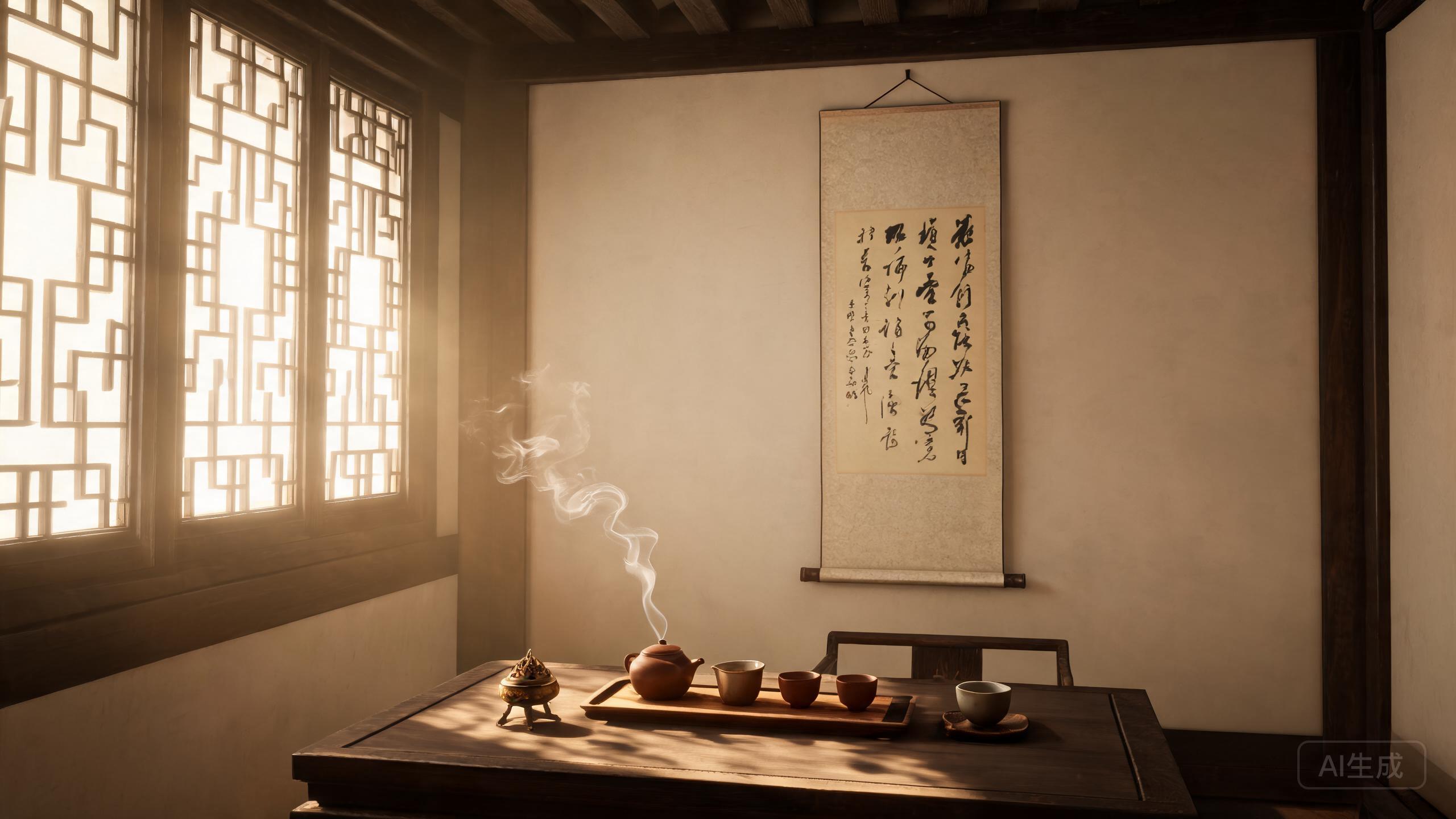
Lu Tong and the Seven Bowls
Green tea sits at the root of Chinese tea writing, and almost every classical text describes it.
Lu Yu’s Chajing(茶经)was written between 760 and 762 CE, and it set the grammar for everything after.
Its second and third chapters cover picking, steaming, pressing and drying, which is how green tea was made then.
There is nothing in it about ageing or about dark tea, and that silence is fact rather than omission.
A generation later the Tang poet Lu Tong wrote his Song of Seven Bowls(走笔谢孟谏议寄新茶).
It runs from the first bowl to the seventh and ends with a light wind rising under both sleeves.
That image of lift is still the most quoted line in Chinese tea poetry.
Neither text is about green tea as we classify it, since the categories came much later.
They are about tea, and tea in the Tang meant compressed green cake.
So green inherits them by default rather than by being named.
Song dynasty writers then added the Fujian tribute teas to the same body of work.
Su Shi(苏轼)wrote that fine tea is like a fair woman, and the comparison still circulates.
The shared foundation
Every Chinese tea category stands on the same two classical texts, and neither of them names a category.
Lu Yu’s Chajing(茶经)made tea a written subject for the first time between 760 and 762 CE.
It is short, it is practical, and it reads like a manual by someone who made the tea himself.
Lu Tong’s Song of Seven Bowls gave the literature its most quoted image about 50 years later.
Between them they set the vocabulary that every later writer borrowed.
Both describe compressed green cake, which was the tea of their century.
That means green inherits them directly, and every other category inherits them at one remove.
A Tang poem quoted on a pu-erh cake is borrowing a heritage rather than documenting one.
That borrowing is common in marketing, and it is not always dishonest.
It becomes dishonest when the poem is offered as evidence about the leaf in the tin.
The safest reading treats both texts as common property of the whole trade.
Shared property is still worth reading, and it does not need to be exclusive to be useful.
What is type-specific
Green tea’s own literary voice starts where the shared canon ends, and it runs for a thousand years.
Song writers described the Fujian tribute cakes in detail, and those were green.
Song tea was still compressed, but it was paler and finer than Tang cake had been.
The whisking competitions that Fan Zhongyan describes used exactly that leaf.
Ming writers then switched to loose leaf, and the vocabulary changed with the method.
Pan firing appears in Ming sources, which is a recognisably modern green technique.
Longjing(龙井)built its reputation in the Qing, helped by imperial visits in the 17th and 18th centuries.
Those visits are recorded, and they are why the name travelled so far so fast.
Biluochun(碧螺春)owes its name to a legend of roughly the same period.
So green holds both the shared canon and a long type-specific tail of its own.
It is the only category with both, which is why quotations on green tea usually feel natural.
Use them, and put the dynasty on the label rather than a vague word like ancient.
Reading the record honestly
The useful test for any tea quotation is whether the leaf existed when the poem did.
Green tea passes that test for almost the whole classical period.
Compressed cake was green, loose Ming leaf was green, and pan fired Qing leaf was green.
So a Tang line printed on a green tea tin is usually defensible.
It is still worth checking what the poem actually says about the tea.
Many famous lines are about friendship, weather or parting, with tea only as the setting.
Lu Tong’s seven bowls are about a gift from a friend rather than about a purchase.
Reading them as tasting notes is the common and rather silly error.
A second check is translation, since many English versions are loose to the point of invention.
Two sleeves of pure wind is an image, and it is not a claim about aroma.
Ask for the Chinese title and the reign year and you will filter out most bad citations.
That costs one message to a seller, and the reply tells you a great deal.