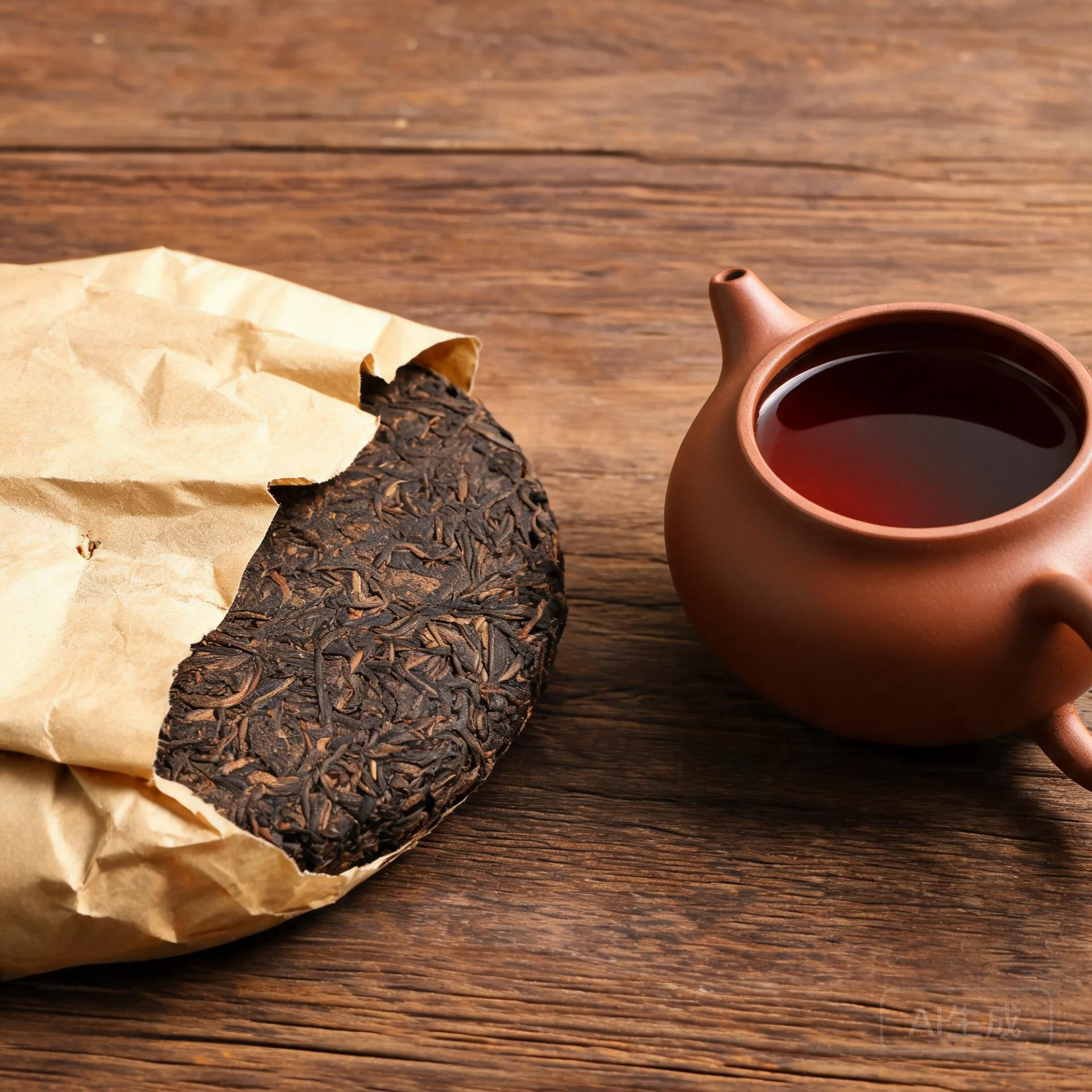
- Why post-fermentation goes further than oxidation
- Spleen, stomach and kidney
- The bitterness and what it does
- What the framework cautions
- Reading the claim at the right level
- Frequently asked questions
- Is dark tea warm or hot in Chinese medicine?
- Which meridians does dark tea enter?
- Why is dark tea warmer than red tea?
- Who should avoid dark tea in this framework?
- Is dark tea good after a heavy meal?
- Does the framework describe microbes?
Chinese medicine classes dark tea as warm in nature, bitter and sweet in flavor, entering the spleen, stomach and kidney meridians. It is the warmest of the six classes, warmer than red tea, because pile fermentation carries the leaf further along the same axis that oxidation began. The kidney attribution is unique to this category and reflects its traditional use for cold and deficiency in the lower body.
The classification is the endpoint of the system’s logic. If unoxidized leaf is cold and fully oxidized leaf is warm, then a leaf that has been through a month of microbial transformation is warmer still. Dark tea is where the axis terminates.
Why post-fermentation goes further than oxidation
Oxidation and pile fermentation are different processes with the same direction. Oxidation is enzymatic: polyphenol oxidase, released when the leaf is rolled, converts catechins into theaflavins and thearubigins. Pile fermentation is microbial: a community of fungi and bacteria metabolizes the leaf over weeks, producing theabrownins and other polymers.
The microbial route goes further because it has more time and more tools. A red tea’s oxidation is finished in hours. A dark tea’s fermentation runs for a month and involves organisms that can break down compounds enzymes cannot touch.
The tradition does not know about the microbes, and it describes the result accurately anyway: a tea that is darker, deeper and warmer than anything oxidation alone produces. The framework’s rule, that processing determines nature, produces the right endpoint from the wrong mechanism.
Spleen, stomach and kidney
The spleen and stomach attribution is shared with most teas and reflects digestive use. The kidney attribution is unique, and it is the most interesting part of the classification.
In the system, the kidney governs the lower body, the bones, the will and the body’s deepest reserves. A tea that enters the kidney meridian is understood to act on cold and deficiency that sit deep rather than on the surface. That is why dark tea is traditionally recommended for lower back coldness, frequent urination and a deep fatigue that warmth at the surface does not reach.
A modern reader can take this as a description of a use pattern rather than a mechanism. The people for whom dark tea is traditionally recommended are those who feel cold deeply and chronically, and the recommendation is consistent across the tradition even though the physiology it assumes is not one a modern reader would accept.
| Tea | Nature | Meridian | Distinctive use |
|---|---|---|---|
| Green | Cold | Heart, lung, stomach | Clear heat |
| White | Cool | Lung, spleen | Dry cough, mild heat |
| Yellow | Cool | Spleen, stomach | Mild heat, sensitive stomach |
| Oolong | Neutral | Spleen, stomach | Food stagnation |
| Red | Warm | Heart, spleen, stomach | Cold constitution, circulation |
| Dark | Warm, warmest | Spleen, stomach, kidney | Deep cold, lower body deficiency |
The bitterness and what it does
Dark tea is bitter as well as sweet, and the bitterness is described as descending and drying. That pair of qualities is why the tradition recommends it after a heavy or greasy meal: a descending bitter is understood to move stagnation downward, and a drying one to cut through richness.
The modern observation that matches this is that dark tea is often drunk with fatty food in the regions that produce it, from Tibet to Mongolia to Hunan. The tradition’s explanation and the practical habit point at the same pairing, which is the kind of consistency that gives the framework its plausibility.
The caution that follows from bitterness is the same one that applies to all strong tea: on an empty stomach, it can irritate. That caution is stronger for dark tea than for most, because the tea is usually brewed strong and often drunk in quantity.
What the framework cautions
A warm tea is cautioned against in heat patterns. A red face, thirst, a bitter taste in the mouth, constipation with heat signs and a sore throat with redness are the signs that a warming drink adds fuel rather than correcting a deficiency.
The second caution is about the stomach. A strong dark tea on an empty stomach is the classic cause of the hollow, slightly nauseated feeling that the tradition calls tea drunkenness, and it is more likely here than with any other category because the tea is brewed at strength.
The third is not traditional but belongs on a page about safety: a badly stored dark tea can be moldy, and the tradition assumes good storage. A musty brick is not an aged medicine.
- Warm and warming, the warmest of the six classes.
- Spleen, stomach and kidney, the only kidney attribution.
- Indicated for deep cold and lower body deficiency.
- Bitterness makes it a post-meal tea, not an empty-stomach one.
- Not suitable in heat patterns.
- Storage quality is part of the medicine.
Reading the claim at the right level
The warm classification is not a comment on the drink’s temperature. A cooled dark tea is still warm in the framework’s sense, and a boiling one is still warm. The word describes a direction of action in a system of correspondences, not a thermometer reading.
This is not clinical trial evidence. No study has tested whether dark tea warms the kidney or corrects deep cold, and the classification was not derived from one. It is a coherent account built from long use, and it is not a substitute for medical evidence about a chronic condition.
Both statements can be held at once. The framework gives a vocabulary for a common experience that many people report with this tea, and it does not establish that the tea treats anything.
The kidney attribution deserves more explanation because it is the most distinctive claim in the category. In the system, the kidney stores the body’s deepest reserves and governs the lower body, the bones and the will. A tea that enters that meridian is understood to reach cold and deficiency that sit below the surface.
That is why dark tea is traditionally recommended for lower back coldness, frequent night urination and a deep fatigue that warmth at the skin does not relieve. The recommendation is consistent across regions and centuries, which is a different kind of evidence from a trial and not nothing.
A modern reader can hold the framework as a description of a use pattern. The people for whom this tea is recommended are those who feel cold deeply and chronically, and the tea is warm by every measure the tradition uses. Whether the meridians exist is a separate question from whether the recommendation is coherent.
The heat-pattern caution follows directly. If a warm tea corrects cold, it aggravates heat, and the signs of heat are specific: a red face, thirst, a bitter taste, constipation with heat. The traditional practitioner would not give dark tea for those.
- Warm, and the warmest of the six classes.
- Bitter and sweet, descending and drying.
- Spleen, stomach and kidney, the only kidney attribution.
- Indicated for deep cold and lower body deficiency.
- Bitterness makes it a post-meal tea.
- Not suitable for heat patterns.
The list is short because the classification is simple. The interesting content of this page is the reasoning behind it, not the number of indications, and the reasoning is that processing intensity maps onto nature. Dark tea is the most processed of the six and therefore the warmest.
The framework’s treatment of dark tea also explains a habit that otherwise looks arbitrary. Dark tea is drunk with milk and butter in Tibet and Mongolia, and with rich food in Hunan. In the system, a warm drying tea is the correct counterweight to a diet of cold damp foods, so the pairing is prescribed as well as enjoyable.
A modern reader can take that as a description of a stable practice rather than a mechanism. The practice has survived centuries because it works as a meal, and the framework supplies a vocabulary for why.
The limit of the vocabulary is the limit of the framework everywhere. It can tell you which tea suits which constitution and it cannot tell you whether the tea changes an outcome. Those are different jobs and the tradition only claims the first.
There is a small historical point worth adding. Dark tea became a mass product through the trade with Tibet and Mongolia, where vegetables were scarce and the diet was heavy in fat and meat. The tea that suited that diet became the tea that was traded for horses, which is why the compressed brick form exists.
That history explains the classification as well as the chemistry does. A warm drying tea that cuts through fat is exactly what a diet of butter and mutton needs, and the tradition’s recommendation follows the conditions in which the tea was used.
A modern reader does not need the framework to see that a strong bitter drink sits well after a rich meal. The framework’s contribution is the vocabulary and the specificity, and the history explains why that vocabulary developed where it did.
Frequently asked questions
Is dark tea warm or hot in Chinese medicine?
Warm, and the warmest of the six classes, because post-fermentation goes further than oxidation.
Which meridians does dark tea enter?
Spleen, stomach and kidney. The kidney attribution is unique to this class.
Why is dark tea warmer than red tea?
Pile fermentation runs longer and further than leaf oxidation, so it moves the leaf further along the axis.
Who should avoid dark tea in this framework?
People with heat patterns, and anyone whose stomach is sensitive to strong tea on an empty stomach.
Is dark tea good after a heavy meal?
In the tradition, yes. Its descending bitterness is understood to cut through richness.
Does the framework describe microbes?
No. It describes the result accurately without knowing the mechanism, which is why the endpoint is right.