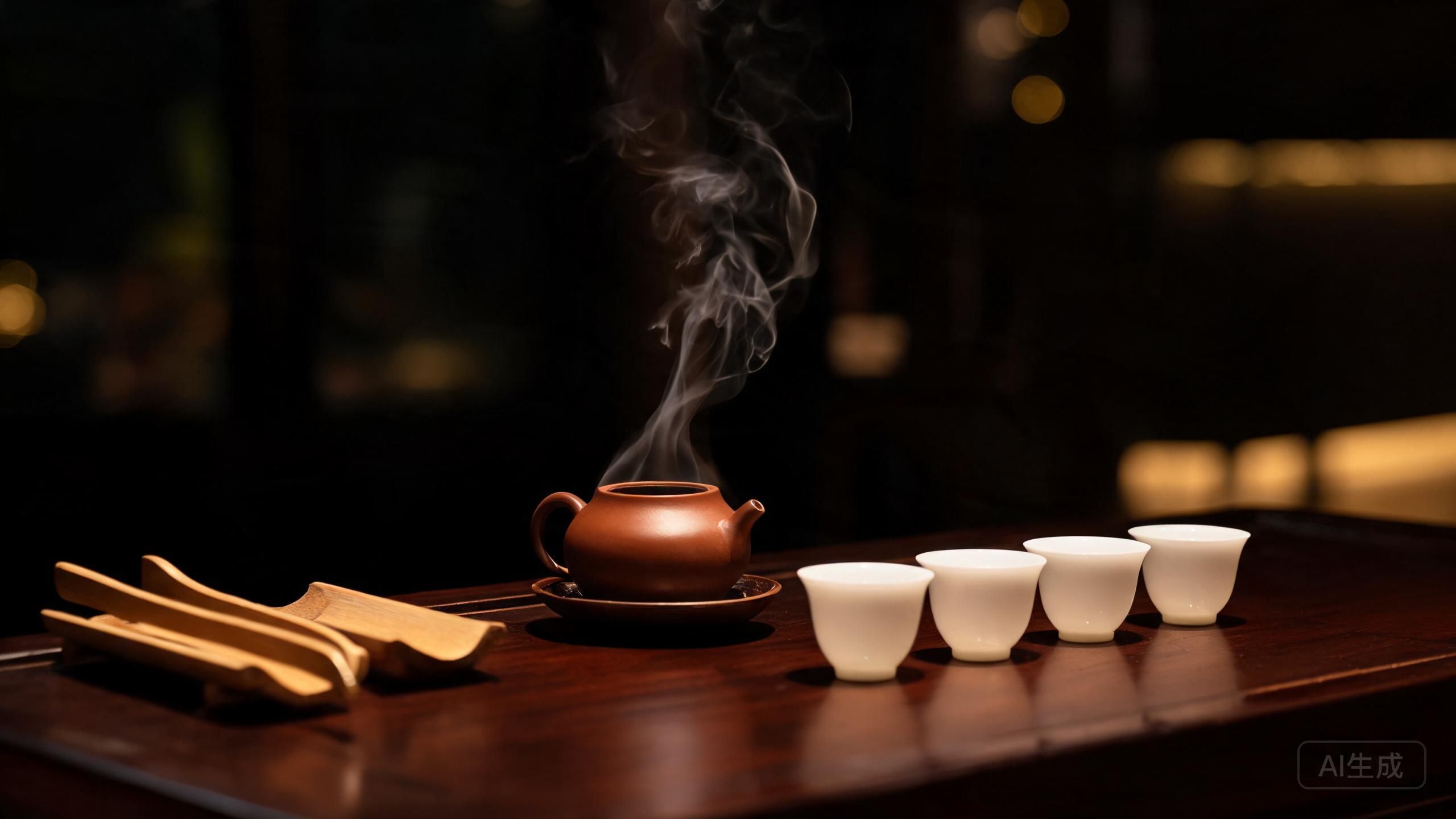
Chinese tea culture is not a single tradition with a single origin. It is the residue of about two millennia of farming, medicine, poetry and etiquette, and the honest way to read it is to separate what can be dated from what cannot.
This page maps that territory: the ideas attached to tea, the customs that still govern how a cup is offered, the method now sold as the Chinese tea ceremony, and the few dates that survive checking.
The Spirit of Tea (Cha Dao)
The Chinese phrase Cha Dao(茶道)is usually rendered as the Way of Tea, which is easy to misread. Dao(道)here is closer to a discipline than to a fixed ceremony with a script.
- he(和, harmony): balance between the drinker, the tea and the setting
- jing(敬, respect): attention paid to the leaf, the maker and the people present
- qing(清, purity): clarity of attention, and a refusal to clutter the process
- jing(静, tranquility): the quiet that comes from repeating the same movements carefully
That four item list is a modern summary rather than a quotation. The Cha Jing(茶经)of Lu Yu(陆羽), written between 760 and 762 CE, sets out no doctrine of this shape.
Tea in Chinese Philosophy
Three traditions get invoked most often, and each claims tea for a different reason.
Confucianism
Tea fits the Confucian emphasis on ordered conduct because serving it has a correct form: a junior pours for a senior, a host pours for a guest, the cup is offered with both hands.
Daoism
Daoist reading values naturalness and wu wei(无为), roughly non forcing, and finds both in a method that mostly consists of not interfering.
Buddhism
Monastic practice supplies the third claim. Tea kept monks awake through long sitting, and that practical use hardened into a symbolic one, summed up far later as Chan Cha Yi Wei(禅茶一味).
The Seven Things of Chinese Life
A common saying lists the seven household necessities as firewood, rice, oil, salt, soy sauce, vinegar and tea. Tea is the only drink on the list and the only item that is neither food nor seasoning.
The point of the list is ordinariness. A second saying groups tea with accomplishment instead, alongside zither, chess, calligraphy, painting, poetry and wine.
Tea and Chinese Arts
- Poetry: Tang and Song poets wrote about tea constantly, among them Li Bai(李白)and Su Shi(苏轼)
- Painting: tea gatherings became a subject in their own right, as in Wen Zhengming(文徵明)'s picture of a gathering at Huishan
The arts matter to a history of tea because they are where it leaves evidence: a painting can be dated and a poem attributed.
Tea in Social Life
- Hospitality: a guest is offered tea at once, and refusing it reads as refusing the welcome
- Weddings: the couple serve tea to both sets of parents, and the order of serving marks the families being joined
- Teahouses: for centuries these were where news travelled, disputes were settled and deals were struck
- Apology and thanks: presenting tea is a recognised way to make either one
None of these customs requires good tea. That is the clearest sign that tea works as a social instrument first and a beverage second.
Gongfu Tea Ceremony
Gongfu Cha(工夫茶)is the method most people now mean by the Chinese tea ceremony, and it is regional before it is national. Its home is Chaozhou and Shantou in Guangdong.
The method is small and fast: a 100 ml gaiwan, 5 to 8 g of leaf, water at or near boiling, and steeps measured in seconds rather than minutes.
Its standing as the national ceremony is recent. The practice is old in its home region, while its spread across China belongs mostly to the tea market revival of the 1990s.
What the Record Supports
Three anchors are worth keeping, because most claims about tea history drift away from them.
- 59 BCE: the Tong Yue(僮约), a household contract by Wang Bao(王褒), tells a servant to buy tea at Wuyang(武阳)
- 141 BCE: tea sealed in the Han Yang Ling(汉阳陵)mausoleum, identified by mass spectrometry and reported in 2016
- 760 to 762 CE: Lu Yu(陆羽)completes the Cha Jing(茶经), the first treatise devoted to tea
Two popular claims are not supported. Shen Nong(神农)is credited in legend with discovering tea, but the Shen Nong Ben Cao Jing(神农本草经)carries no entry for it, and the earliest pharmacopoeia to record tea as a drug is the Xin Xiu Ben Cao(新修本草)of 659 CE.
And the figure of 5,000 years of tea drinking, constant in marketing, has no documentary or archaeological basis behind it.
Tea and Health in TCM
Traditional Chinese medicine sorts foods by perceived thermal character rather than by nutrient content, and tea is sorted the same way. The sorting is a classification rather than a clinical result.
- Spring: green tea, classed as cooling
- Summer: white tea, classed as cooling
- Autumn: oolong tea, classed as neutral
- Winter: red (black) tea and ripe Pu-erh(普洱), classed as warming
This page makes no claim that any tea has a medicinal effect, and nothing above should be read as a dose or a prescription.
Reading Tea Culture Without the Marketing
Tea culture sells things, and it always has. A ceremony, an unbroken lineage and an imperial endorsement all raise the price of a cake.
The defense is to ask what a claim would look like if it were false, then check whether anyone has dated it.