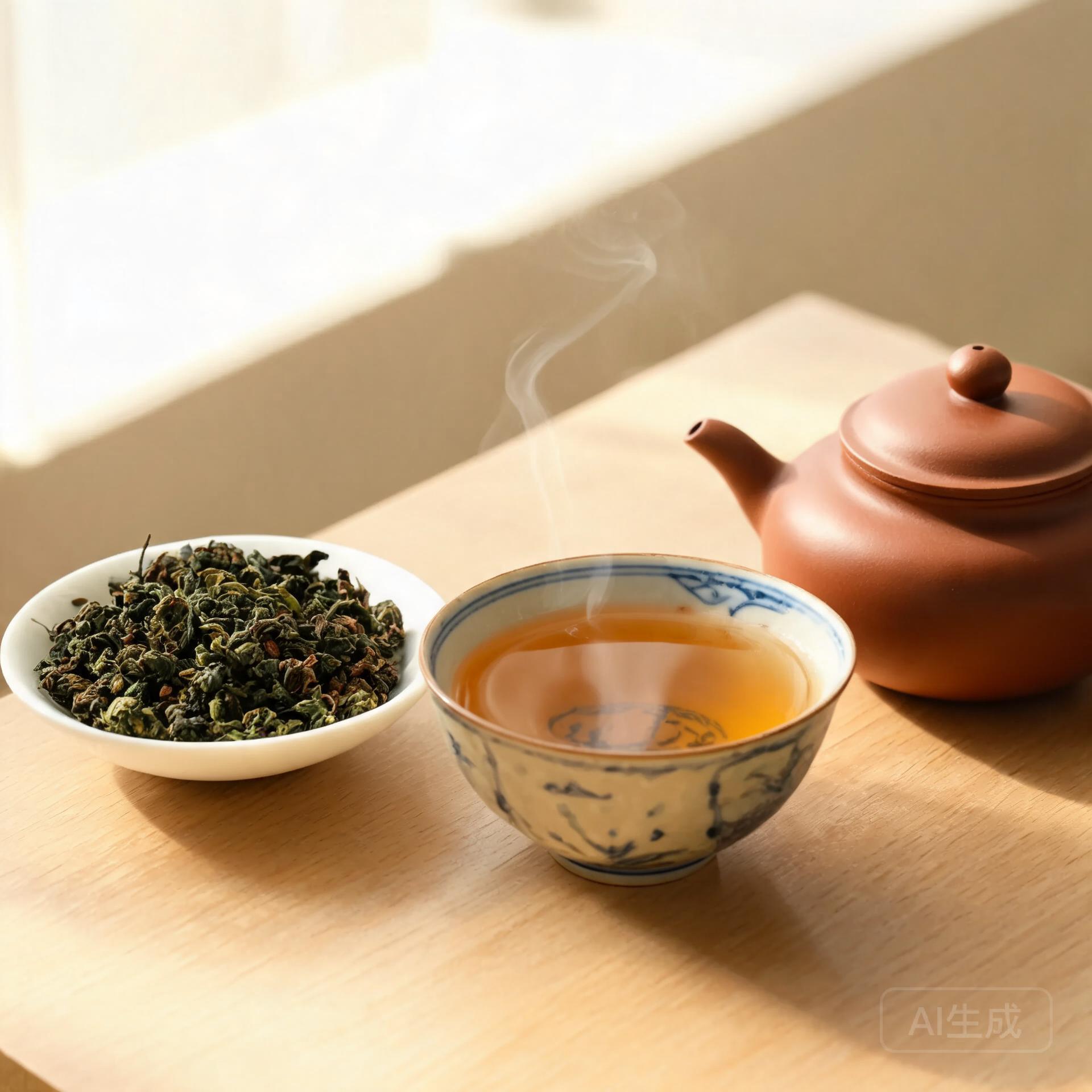
- The logic that produces neutrality
- Spleen and stomach, and why not heart
- Where the classical record is thin
- What neutral nature implies in practice
- The cautions that come with it
- Reading the claim at the right level
- Neutrality as a working category
- The roast as a second variable
- Frequently asked questions
- Is oolong warm or cold in Chinese medicine?
- Which meridians does oolong enter?
- Is a roasted oolong more warming than a light one?
- Does a classical text describe oolong?
- Can I drink oolong with a cold constitution?
- Does neutral mean it has no effect?
Chinese medicine classes oolong tea as neutral in nature, sweet and slightly bitter in flavor, entering the spleen and stomach meridians. Neutrality is not a vague middle: it is a specific category in the system, sitting between the cold of green tea and the warmth of red tea, and it follows directly from the rule that processing determines nature. Half oxidation produces a half-shifted nature.
The classification is useful because it explains a pattern drinkers notice without being told. Green tea unsettles some stomachs. Red tea feels too heating to others in summer. Oolong is the one most people can drink across seasons without either reaction, and the tradition had a word for that before anyone measured a polyphenol.
The logic that produces neutrality
The system’s operating rule is that processing moves a leaf along a temperature axis. Fresh leaf is cold. Heating it, as in green tea production, preserves that cold. Full oxidation, as in red tea, moves it to warm. Oolong stops in between, so it lands in between.
This is not an arbitrary mapping. The tradition observes that the same bush produces leaves of different nature depending on how they are handled, and it builds the classification on that observation rather than on the plant. That is why a lightly oxidized oolong is described as leaning cool and a heavily roasted one as leaning warm, without either leaving the neutral category.
Within the neutral band there is a gradient the tradition acknowledges. A 20 percent Tieguanyin is described as neutral leaning cool. A charcoal-roasted Wuyi yancha at 55 percent is described as neutral leaning warm. The category is a band, not a point, which is exactly what the chemistry predicts.
Spleen and stomach, and why not heart
The meridian attribution is spleen and stomach, which in this system means digestion and transformation. Oolong’s traditional use is for the middle burner: a heavy meal, a sluggish feeling after eating, a stomach that feels cold and slow. The bitterness is read as descending and drying, the sweetness as tonifying, and the pair is understood to move food downward without injuring the center.
Red tea also enters spleen and stomach, but the two are not interchangeable. Red tea is warm and is given when cold is the problem. Oolong is neutral and is given when the problem is stagnation rather than cold: food sitting rather than food failing to warm. A traditional practitioner would not swap one for the other.
The heart meridian attribution that red tea carries is absent here. The tradition assigns it to red tea on the basis of color and a moving, warming action on the blood. Oolong lacks that combination, so it does not inherit the attribution.
Where the classical record is thin
Oolong as a named category is recent. The processing style developed in Fujian during the Ming and early Qing, and the major materia medica were compiled before it existed as a distinct commercial product. There is no classical entry describing oolong by name.
What the tradition supplies instead is derivation. The rule that processing changes nature was already established, and applying it to a half-oxidized leaf is mechanical: if cold is unoxidized and warm is fully oxidized, then partly oxidized is neutral. The classification is inferred rather than recorded, and it is a legitimate inference within the system.
This is worth saying plainly because a lot of English-language writing presents the oolong classification as though a classical text stated it. None does. The honest position is that the tradition’s own logic generates the answer and no primary source names the tea.
| Tea class | Nature | Meridian | Derivation |
|---|---|---|---|
| Green | Cold | Heart, lung, stomach | No oxidation, heat-fixed |
| White | Cool, neutral when aged | Lung, spleen | Minimal processing, withered only |
| Yellow | Cool | Spleen, stomach | Menhuang reduces the cold somewhat |
| Oolong | Neutral | Spleen, stomach | Half oxidation |
| Red | Warm | Heart, spleen, stomach | Full oxidation |
| Dark | Warm | Spleen, stomach, kidney | Post-fermentation |
What neutral nature implies in practice
- Suits most constitutions, which is why it is the safest default when nothing is known about the drinker.
- Appropriate across seasons, where green tea is a summer drink and red a winter one.
- Indicated for food stagnation and heaviness after eating rather than for cold or heat patterns.
- Not a treatment for either cold or heat excess, because a neutral agent does not correct an extreme.
- Roasted oolong leans warm, so a heat-pattern drinker should choose a light one.
The seasonal point is the one most often repeated in Chinese tea writing and the one with the clearest internal logic. A cooling tea in winter and a warming tea in summer both push against the season. A neutral tea does not, so it becomes the year-round choice by default rather than by preference.
The cautions that come with it
Neutral does not mean harmless. The classic caution on oolong is about strength and emptiness: a strong gongfu infusion on an empty stomach can produce the same hollow, jittery feeling that strong green tea does, and the tradition attributes it to bitterness injuring the stomach rather than to caffeine.
There is also a caution specific to heavy roasting. A charcoal-roasted oolong is described as drying, and a drinker with dry mouth, dry throat or constipation is advised to take it weak or choose a lighter roast. This maps onto the modern observation that roasted teas are more astringent and more likely to irritate a sensitive stomach.
The third caution is about the evening. Oolong carries 25 to 45 mg of caffeine per infusion, close to green tea, and the tradition’s warning against late tea applies here without modification.
Reading the claim at the right level
The neutral classification is not a comment on the drink’s temperature. A chilled oolong is still neutral, and a boiling one is still neutral. The word describes where the leaf sits on the tradition’s processing axis, not a thermometer reading.
This is not clinical trial evidence. No trial has tested whether oolong corrects food stagnation, and the classification was not derived from one. What it offers is a coherent vocabulary for a common experience: oolong sits easily for most people, and the system explains that by placing it in the middle of an axis it already uses.
Both statements can be held at once. The framework is internally consistent and often matches experience, and it is not a substitute for medical evidence. A writer can describe it accurately without either dismissing it or overclaiming for it.
Neutrality as a working category
In the Chinese materia medica, neutral is a real classification with its own indications, not a label for something too mild to classify. A neutral substance is used when neither cold nor heat is the dominant pattern, and when the aim is to support rather than to correct. That is a positive role, and it is why oolong appears in household practice as a daily drink rather than as a remedy.
The distinction matters for how the tea is described. A cold tea is prescribed against heat. A warm tea is prescribed against cold. A neutral tea is prescribed when the pattern is mixed, unclear, or absent, which is the ordinary case for most people on most days. Its value is that it does not push a balanced system off balance.
The roast as a second variable
Chinese tea writing treats roast as a separate axis from oxidation, and a drinker can use the two together. A lightly oxidized, unroasted oolong leans cool. A heavily oxidized, heavily roasted one leans warm. The four combinations cover a wider range than the single word neutral suggests.
This is the practical answer to a question the classification raises: which oolong should a particular person drink. The tradition’s answer is to match the roast to the constitution within the neutral band, giving a light tea to someone who runs warm and a roasted one to someone who runs cold. The category stays neutral; the choice inside it does the work.
A reader who wants to use the classification practically can follow a short sequence. Note whether you run hot or cold: cold hands, a preference for warm drinks and loose stools point one way, a red face and thirst point the other. Then choose within the neutral band: light and unroasted for the warm pattern, roasted for the cold one.
The sequence is not a prescription, and the tradition does not present it as one. It is a way of using a vocabulary that already exists rather than inventing one. What it gives a drinker is a reason to prefer one style over another in a given week, which is more than a category label alone provides.
The limit is that the framework cannot tell you whether the tea is doing anything. It can tell you what the tradition says about suitability, and that is a claim about fit rather than about effect. Keeping the two apart is what makes the classification usable by someone who does not accept its metaphysics.
- Neutral is a positive category, not an absence of one.
- Half oxidation produces the neutral placement.
- Roast moves the tea within the neutral band, not outside it.
- Spleen and stomach attribution reflects digestive use.
- No classical text names oolong; the classification is derived.
- Choose light or roasted inside the band to match constitution.
Frequently asked questions
Is oolong warm or cold in Chinese medicine?
Neutral. Half oxidation places it between the cold of green tea and the warmth of red tea.
Which meridians does oolong enter?
Spleen and stomach, according to the standard modern summary, which reads it as acting on digestion.
Is a roasted oolong more warming than a light one?
Yes. Within the neutral band, heavy roasting and higher oxidation both push toward the warm end.
Does a classical text describe oolong?
No. The category postdates the major materia medica; the classification is derived from the processing rule.
Can I drink oolong with a cold constitution?
Generally yes, and a roasted oolong suits better than a light one.
Does neutral mean it has no effect?
No. Neutral means it does not push toward cold or heat, not that it does nothing.