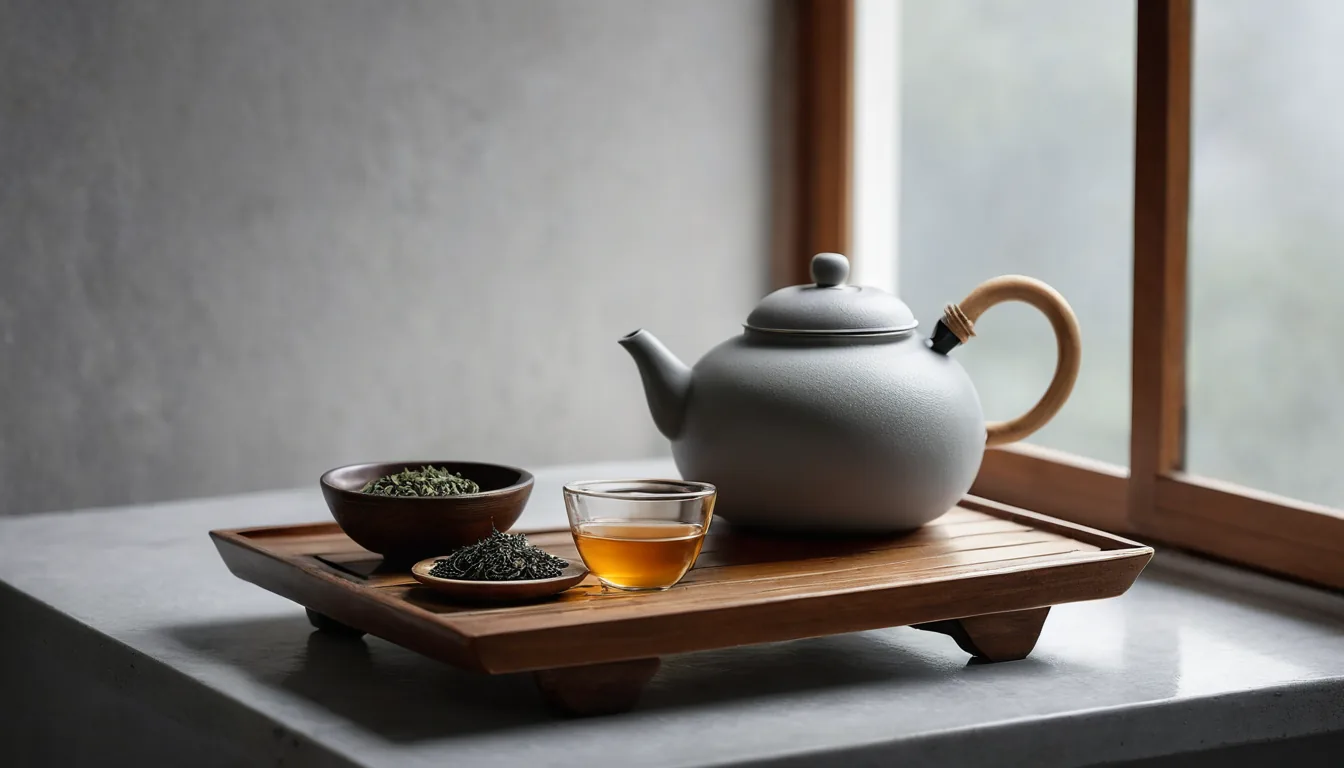
The white ring inside a kettle is not a cleaning failure. It is calcium carbonate that came out of the water when the water was heated. The same minerals that leave a film on the element also change what the water does to tea. The ring is a visible signal, but the taste problem starts before the ring is thick enough to see.
This guide separates three things that are often mixed together: the deposit in the kettle, the hardness of the water, and the effect on the cup. They are related, but they are not the same. A kettle can look clean and still hold hard water. A kettle can look chalky and still make a pleasant cup if the water is otherwise suitable.
The ring is a clue, not a verdict. A clean kettle can still hold hard water.
The white ring is calcium carbonate
Limescale is mainly calcium carbonate, often with some magnesium salts and traces of iron. It is the same material that forms travertine at a spring, but in a kettle it forms on a hot metal surface. The colour ranges from off-white to grey or reddish brown depending on the minerals present. Iron compounds are usually responsible for the brown tint, not dirt from the tap.
The chemistry is simple enough to follow. Rainwater picks up carbon dioxide as it moves through soil, then dissolves calcium and magnesium from limestone and chalk. That water carries bicarbonate ions. Heating drives carbon dioxide out of solution, the equilibrium shifts, and calcium carbonate comes out as a solid. The solid settles on the hottest surface it can find. In a kettle, that is the element or the base plate.
Even a 1 mm layer on the element is enough to change heat transfer. The metal runs hotter while 1 litre of water reaches 100 °C more slowly, and the surface can overheat under the deposit. The same minerals that form the layer are the ones that change the tea. The broader question of hardness is covered in Tea Water: Why Hard Water Flattens the Cup, and the temperature side is covered in Water Temperature: Boiling Point Varies.
Why kettles collect scale faster than cups
A cup of water has a large surface and cools quickly. A kettle concentrates heat in one small area and keeps the water hot for minutes. The element is hotter than the water around it, so the local reaction runs faster there. The result is a deposit that starts on the metal and spreads outward. A stainless steel kettle with an exposed element usually shows the ring first at the element. A flat-base kettle often shows it as a patch in the centre of the base.
Boiling also removes carbon dioxide, which is why temporary hardness is the part that leaves scale. Permanent hardness, usually calcium or magnesium sulfate and chloride, stays dissolved when the water is heated. That distinction matters because a kettle can collect less scale from water that is still hard in the permanent sense. The ring tells you about the temporary fraction, not the whole hardness number.
What scale changes in the cup
Scale on the element slows heat transfer. The water takes longer to reach a boil, and the element runs hotter for the same job. In a badly scaled kettle, the metal can overheat under the deposit while the water around it lags behind. That is a maintenance problem before it is a tea problem. The deposit can also flake into the water, which adds grit and an unpleasant texture to the cup.
The bigger effect on tea comes from the water, not the visible flakes. Water with high calcium and magnesium content can mute aroma and flatten brightness. Bicarbonate alkalinity neutralises some of the acidity that gives a clean finish. The effect is easiest to notice in green tea and light white tea, where the aroma is delicate. Roasted oolong and dark tea have enough roast and body to mask part of it, but they do not escape it completely.
| What you see | What it usually means | First move |
|---|---|---|
| Thin white film on the element | Temporary hardness is leaving calcium carbonate | Descale when it becomes visible or the kettle sounds louder |
| Thick crust that flakes | Scale has built up over weeks or months | Soak with a weak acid, then rinse twice |
| Brown or grey deposit | Iron or other minerals are present | Clean the kettle and check the water source |
| Clean kettle, dull tea | The water can still be hard without visible scale | Check hardness and alkalinity, not only the kettle |
Scale is a symptom, not the water
A clean kettle does not prove the water is soft. If the kettle is emptied and dried after every use, the film may never build up, while the water still carries enough calcium to affect tea. The opposite is also possible: a kettle in daily use can collect a ring from water that is only moderately hard. The ring is a maintenance indicator, not a laboratory result.
For tea, the useful number is total hardness, usually reported as milligrams per litre of calcium carbonate equivalent. A common scale treats water below 60 mg/L as soft, 61 to 120 mg/L as moderately hard, 121 to 180 mg/L as hard, and above 180 mg/L as very hard. Those bands are a starting point, not a rule for taste. Alkalinity and the balance of calcium to magnesium matter as much as the headline number.
How to descale a kettle
Use a weak acid and give it time. Citric acid or white vinegar is enough for normal household scale. Strong acids work faster, but they attack some metals and finishes, and a kettle is not the place to experiment with them. Check the manufacturer’s instructions first, especially for aluminium, enamel, or a coated element.
- Fill the kettle with a 1:3 mix of white vinegar and water, or dissolve one tablespoon of citric acid in 500 ml of water.
- Heat the solution to about 60 °C, switch off, and leave it for 30 minutes. Do not boil it hard.
- Empty the kettle and rinse with fresh water. Repeat the rinse twice so no acid remains.
- Fill with fresh water, boil once, and discard that water before making tea.
Do not descale after every use. A light film is normal in hard-water areas. Clean when the deposit is visible, when boiling takes noticeably longer, or when flakes appear in the water. If the kettle has a hidden element, use less solution and check the manual. If the base is coated, avoid abrasive pads; the acid does the work, not scrubbing.
Filter or soften, and when to leave it alone
A carbon filter is good at chlorine and some odours, but it does not remove calcium hardness. A jug filter with an ion-exchange resin can reduce hardness, though it adds a little sodium and needs regular cartridge changes. Reverse osmosis removes most minerals, which can make the water flat for tea. If the water is very hard, a whole-house softener or a point-of-use reverse osmosis unit is a bigger change than a kettle descaler.
Before buying equipment, test the water. A hardness test strip or a report from the water supplier gives a number you can act on. If the water is moderately hard and the tea tastes clean, a kettle descaler and a rinse may be all you need. If the tea is dull and the kettle scales quickly, treat the water, not just the metal. The goal is not a spotless element. The goal is a cup that tastes the way the leaf was meant to taste.