- The classical basis
- What warm nature implies
- How it was used
- Where the tradition cautions
- Red tea and ginger, and other pairings
- Reading the color symbolism carefully
- What the classification does and does not claim
- Frequently asked questions
- Why is red tea warm and green tea cold?
- Which meridians does red tea enter?
- Does the Bencao Gangmu describe red tea?
- Who should avoid red tea in this framework?
- Is red tea good for digestion?
- Is any of this clinically proven?
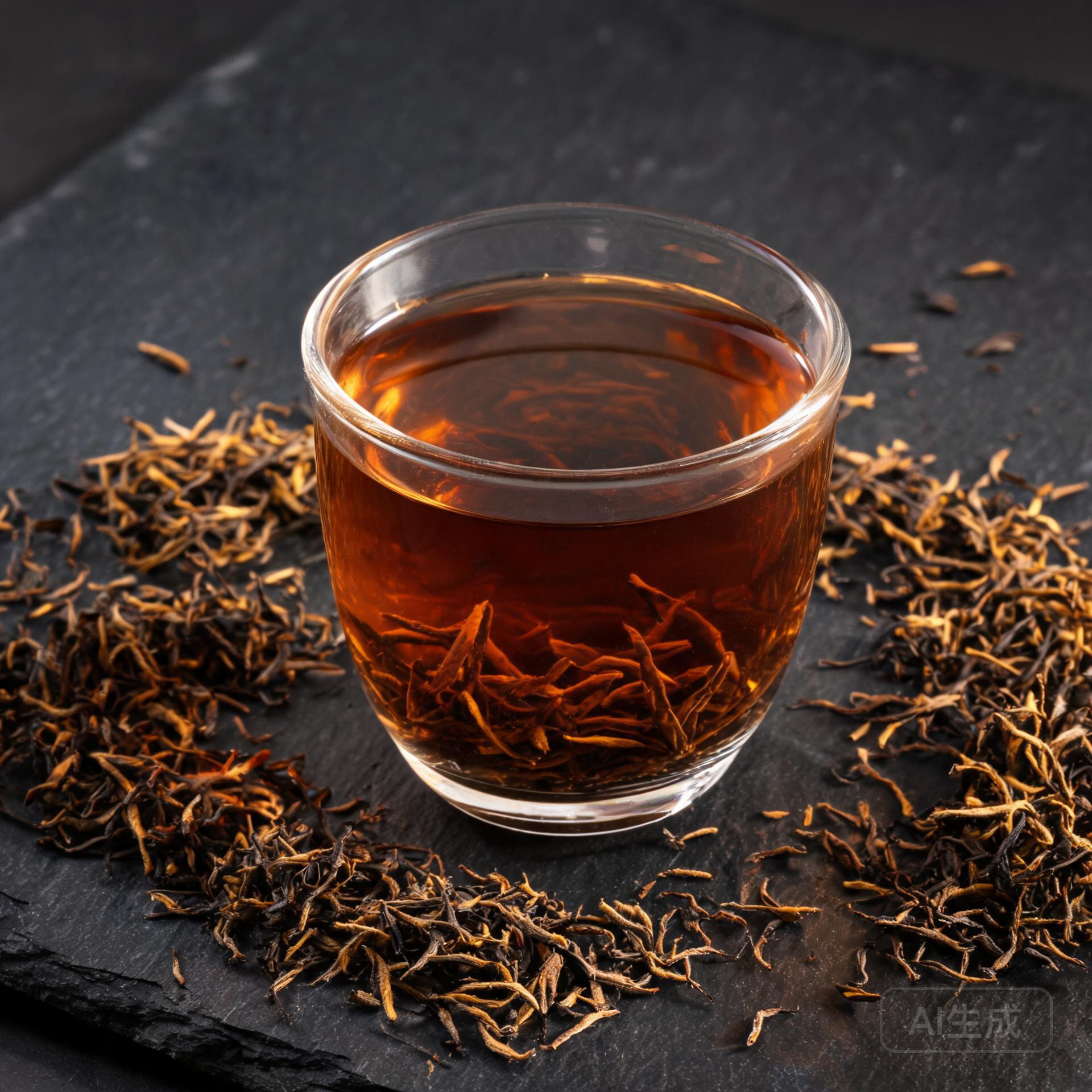
Chinese medicine classes red tea as warm in nature, sweet in flavor, and entering the heart, spleen and stomach meridians. That is the opposite of green tea, and the difference comes entirely from processing: full oxidation converts the leaf from cold to warm. The same bush produces both, and the tradition treats them as different medicines for different constitutions.
The classical basis
The Bencao Gangmu describes tea as bitter and sweet, slightly cold and non-toxic. That description was written about the unoxidized leaf, which is what most people in Li Shizhen’s region were drinking. It does not describe red tea, and applying it to red tea is a misreading that appears constantly in English-language tea writing.
The tradition’s own logic supplies the correction. Tea nature tracks processing, and oxidation moves the leaf from cold toward warm. Red tea is fully oxidized, so it is classified as warm. The Bencao Gangmu also notes that tea is bitter and descending, which is why it clears heat; red tea retains the bitterness but loses much of the descending cold, and gains a warming, moving quality instead.
Modern Chinese tea medicine states the rule plainly: the higher the degree of fermentation, the warmer the tea. Green is cold, white is cool, yellow is cool, oolong is neutral and leans cool, red is warm, dark is warm. This is the core logic of the system, and red tea sits at the warm end of the oxidized spectrum.
| Attribute | Red tea | Contrast with green tea |
|---|---|---|
| Nature | Warm | Cold |
| Flavor | Sweet | Bitter and sweet |
| Meridians | Heart, spleen, stomach | Heart, lung, stomach |
| Direction | Warming, moving | Sinking, descending |
| Principal action | Warms the middle, aids digestion | Clears heat, drains fire |
| Typical use | Cold constitution, weak digestion | Heat constitution, summer |
What warm nature implies
A warm tea is indicated when the body runs cold. The classical signs are cold hands and feet, a preference for warm drinks, loose stools after cold food, a pale complexion and low energy. Red tea with its warming, spleen-supporting action is the traditional answer to that pattern.
The spleen and stomach meridians are the key attribution. In Chinese medicine the spleen governs transformation and transport, which includes digestion. A warm sweet tea that enters those meridians is understood to strengthen digestion and dispel cold from the middle burner. That is the theoretical basis for the familiar advice to drink red tea after a heavy meal, or when the stomach feels cold and unsettled.
The heart meridian attribution is less discussed in English sources but consistent across Chinese ones. Red tea’s color, its warming quality and its effect on circulation are all read as acting on the heart. The tradition associates it with moving blood and warming the channels, which is why it is often recommended in cold weather and for people who feel the cold in their limbs.
How it was used
The classical record on red tea is thinner than on green, for a simple historical reason: red tea is a later development. Fully oxidized tea emerged in the Ming and spread through export trade in the seventeenth and eighteenth centuries, well after the major materia medica were compiled. What the tradition says about red tea is largely derived from the general principle about processing rather than from dedicated classical entries.
That derivation is not arbitrary. The tradition had already established that processing changes nature, and that roasted, fermented and aged preparations tend to be warmer than fresh ones. Applying that rule to a newly developed fully oxidized tea was a straightforward extension, not an invention.
Practically, red tea appears in the tradition as a warming daily drink rather than as a prescription. It is given for cold-type digestive weakness, for cold weather, and as a vehicle for other warming herbs such as ginger. The combination of red tea and ginger is a common household remedy for the early stages of a cold, and it follows directly from the warm-nature logic.
Where the tradition cautions
The caution runs opposite to green tea’s. Where green tea is warned against for cold and deficient constitutions, red tea is warned against for heat patterns: a red face, thirst, a bitter taste in the mouth, constipation with heat signs, or a sore throat with redness. Drinking a warm tea in a heat pattern is understood to add fuel.
There is also a caution about strength. A strong red tea is warming and moving, but taken very concentrated and on an empty stomach it can irritate the stomach lining. The traditional advice is to drink it warm, moderate and after food, which is the same advice modern gastroenterology would give for a different reason.
And there is the caffeine point, which the tradition handles in its own vocabulary. Red tea is described as strongly lifting the spirit, which is the desired effect in the morning and an unwanted one at night. The classical texts that warn against evening tea are describing, in their own terms, the same phenomenon a modern sleep researcher measures with a half-life curve.
- Red tea is warm, sweet and enters heart, spleen and stomach.
- The warmth comes from full oxidation, not from the cultivar.
- It suits cold constitutions and cold weather; it aggravates heat patterns.
- The classical cold description of tea applies to green tea, not red.
- Traditional cautions are about heat patterns and strength, not about liver or iron.
The honest summary is that this framework describes what kind of drink red tea is in a system of correspondences, and gives a coherent account of who tends to feel well on it. It is not clinical evidence that red tea treats any condition. What it does offer is a vocabulary that matches a common experience: some people feel warmed and settled by red tea and unsettled by green, and the tradition explains why.
Red tea and ginger, and other pairings
The most common traditional pairing is red tea with ginger. Ginger is warm and pungent, red tea is warm and sweet, and the two together are the household remedy for the first sign of a cold: chills, a stiff neck, no fever yet. The combination is understood to drive out cold before it settles.
Other pairings follow the same logic. Red tea with brown sugar and a slice of dried orange peel is a warming winter drink. Red tea with milk is a later, Western addition, and while the tradition has no particular view of it, the milk does bind some of the theaflavins.
What the tradition avoids pairing with red tea is anything strongly cooling, such as chrysanthemum or mint, because the combination cancels the warming action. That is a rule of thumb rather than a prohibition, and plenty of people drink mint tea with red tea in summer without ill effect.
- Red tea plus ginger: warming, for the start of a cold.
- Red tea plus brown sugar: warming, winter drink.
- Red tea plus dried orange peel: aromatic, aids digestion.
- Red tea plus milk: Western habit, binds some theaflavins.
- Avoid pairing with strongly cooling herbs if the goal is warming.
Reading the color symbolism carefully
The Chinese name for red tea is literally red tea, and the English name is black tea, because each tradition named it after a different thing. The Chinese named it for the color of the liquor, the English for the color of the dry leaf. Neither is wrong, and neither carries medical meaning.
There is, however, a genuine correspondence in the tradition between color and organ. Red is the color associated with the heart in the five-phase system, and red tea is attributed to the heart meridian. That is not arbitrary color symbolism; it is the same logic that assigns green to the liver and yellow to the spleen.
A modern reader can take the correspondence as a coherent internal system without treating it as a physiological claim. What it produces is a set of drinking recommendations that many people find match their experience, which is a different kind of validity from a clinical trial but not nothing.
What the classification does and does not claim
The warm classification is not a comment on the drink’s temperature. A cup of red tea at room temperature is still classified as warm, and a cup of green tea served hot is still classified as cold. The word describes a direction of action inside the tradition’s system of correspondences, not a thermometer reading and not a measured effect on body heat.
This is not clinical trial evidence. Nothing in the classical literature establishes that red tea treats cold-type digestive weakness in the sense a modern trial would test, and no trial has been designed to test the classification itself. What the tradition offers is a coherent account of which drink suits which constitution, built from long observation and stated in its own vocabulary.
Holding both statements at once is the useful position. The framework is internally consistent and often matches experience, and it is not a substitute for medical evidence. A drinker can use it to decide what to order in winter without believing it has been validated as a treatment, and a writer can describe it accurately without either sneering at it or overclaiming for it.
Frequently asked questions
Why is red tea warm and green tea cold?
Because of oxidation. The tradition holds that processing determines nature, and full oxidation converts the leaf from cold to warm. The same bush produces both.
Which meridians does red tea enter?
Heart, spleen and stomach, according to the modern Chinese tea-medicine summary. The spleen and stomach attribution is the one most used in practice.
Does the Bencao Gangmu describe red tea?
No. Its description of tea as slightly cold refers to the unoxidized leaf. Red tea developed later and is classified by derivation from the processing principle.
Who should avoid red tea in this framework?
People with heat patterns: red face, thirst, bitter taste, constipation with heat, or sore throat with redness. A warm tea is understood to aggravate those.
Is red tea good for digestion?
The tradition says yes, through its action on the spleen and stomach meridians. The modern reason is different but the practical advice to drink it after a meal coincides.
Is any of this clinically proven?
No. It is a traditional classification describing tendencies, not evidence that red tea treats disease.