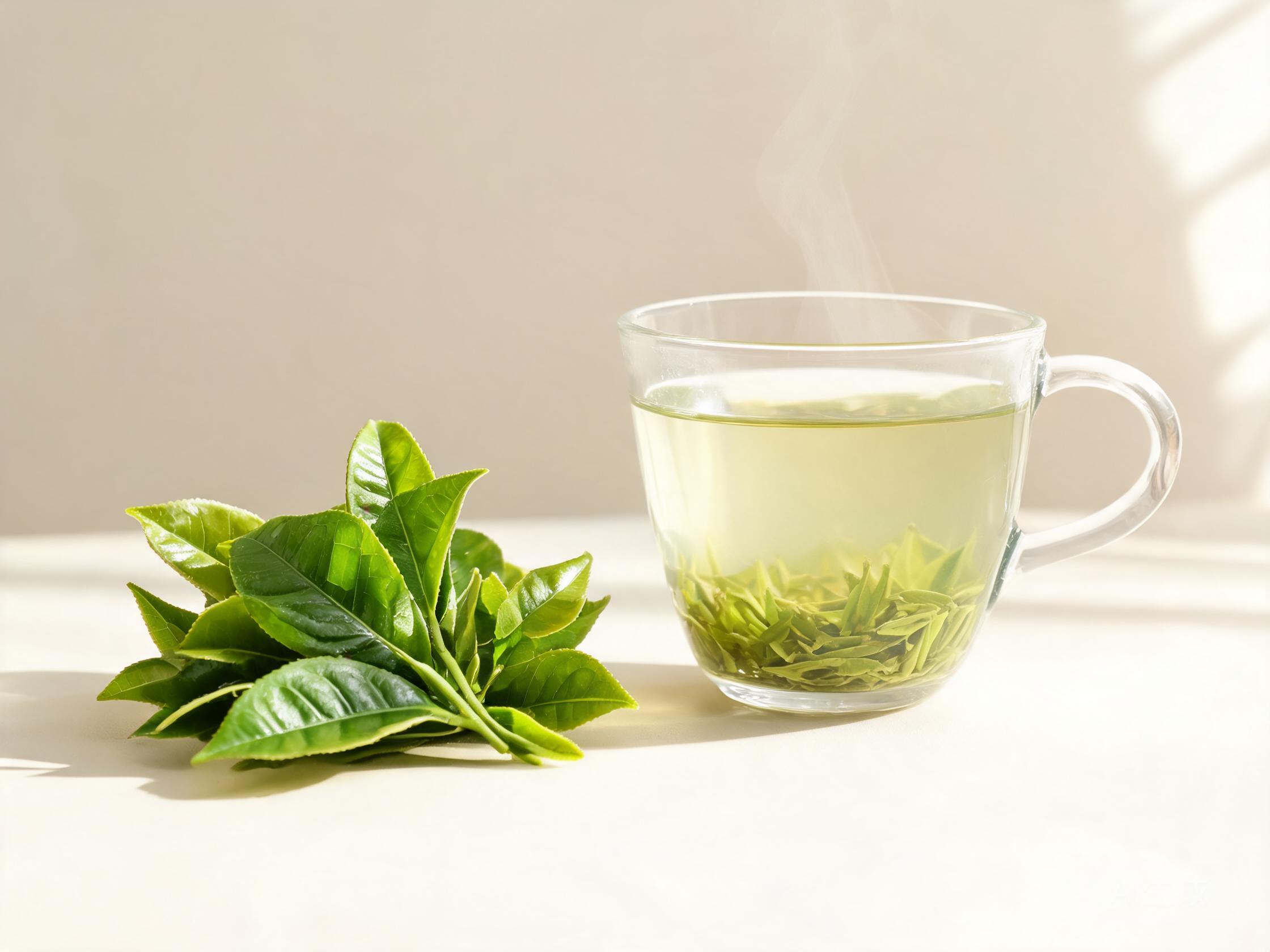
The pan-fired tradition centred on Zhejiang and Anhui
The most recognisable regional tradition is the pan-fired, hand-rolled style centred on Zhejiang and Anhui. Longjing from Hangzhou, Maofeng from Huangshan and Taiping Houkui from Anhui all share the same broad logic: hand wok fixation, hand rolling, two-stage drying.
Within that broad logic the differences are real. Longjing is pan-pressed flat and shaped in the wok. Houkui is tied by hand and pulled straight. Maofeng is shaped by light rolling and a single, long drying step of sixty to 90 minutes.
The Zhejiang style has its own logic. The wok temperature is slightly lower than in Anhui, around 180 to 200 °C versus 200 to 220 °C. The rolling is lighter, and the drying tends to keep more of the leaf’s green colour.
These are working categories. A tea labelled Longjing but pan-fired in the Anhui style will not taste like a Hangzhou Longjing, even if the leaf came from a similar cultivar.
The steaming tradition that runs through Japanese lines
The steaming tradition runs through Japanese lines and has Chinese cousins. Sencha is the most familiar example, with a short-blast steam fixation of thirty to sixty seconds that gives the leaf its recognisable bright green and a more vegetal cup.
Chinese steamed greens are less common but exist. They include Enshi Yulu from Hubei, which is steamed for sixty to 90 seconds and then pressed into small granules, and several smaller regional teas that use a thirty-second steaming step before drying.
Steam-fixed leaf unfurls differently in the cup. The cell walls are more thoroughly disrupted by the steam, so the first infusion is usually twenty to thirty percent stronger and the colour greener.
There is also a hybrid pattern where the leaf is lightly steamed for ten to twenty seconds first and then pan-fired, used for some Chinese green teas that want a touch of the steamed character without giving up the pan-fired finish.
The two traditions diverge most in the shape of the leaf and the colour of the brew. A Sencha is usually needle-shaped or slightly twisted and steeps a bright yellow-green. A pan-fired Longjing is flat and steeps a paler, more yellow cup. The same cultivar will look like different teas depending on which tradition it goes through.
Hand-rolled styles with a more fragile leaf
Hand-rolled styles with a more fragile leaf are mostly concentrated in Jiangsu and parts of Fujian. Biluochun from Dongting Mountain is the most famous: tiny hand-rolled spirals of bud and first leaf, often eight thousand to ten thousand buds per 500 g.
The Biluochun process is hard to mechanise. The leaf is too small and too tender for most rollers, and the shape depends on a press-and-roll motion of about five to eight seconds per leaf that the machine equivalents cannot replicate.
A close cousin is Xinyang Maojian from Henan, which uses a smaller bud set and a tight, slightly twisted shape. The processing has more in common with pan-fired Anhui teas than with Jiangsu traditions.
Hand rolling in these styles is partly aesthetic. The shape is part of how the tea is judged and how it presents in the glass. A well-rolled Biluochun will unfurl slowly through three or four infusions.
Where two or more traditions meet in a single tea
Where two or more traditions meet in a single tea, the result is often labelled with a regional name but follows a different process. Hunan and Hubei produce green teas that draw on both Anhui and Jiangsu traditions.
Anji white tea, despite the name, is a green tea from Zhejiang that uses a temperature-sensitive cultivar. The leaf is light and the cup is unusually sweet, with five to seven percent more amino acids than standard Longjing, and the processing is closer to a Longjing than to a Biluochun.
Some Yunnan green teas blend elements of Dian Hong red tea processing with green tea methods, including a brief withering step of thirty to sixty minutes that is rare in mainstream green tea production.
These boundary cases are useful to know because they show that the regional categories are traditions, not strict rules. A skilled processor will borrow from another region if it improves the cup, usually in one or two of the four main stages.