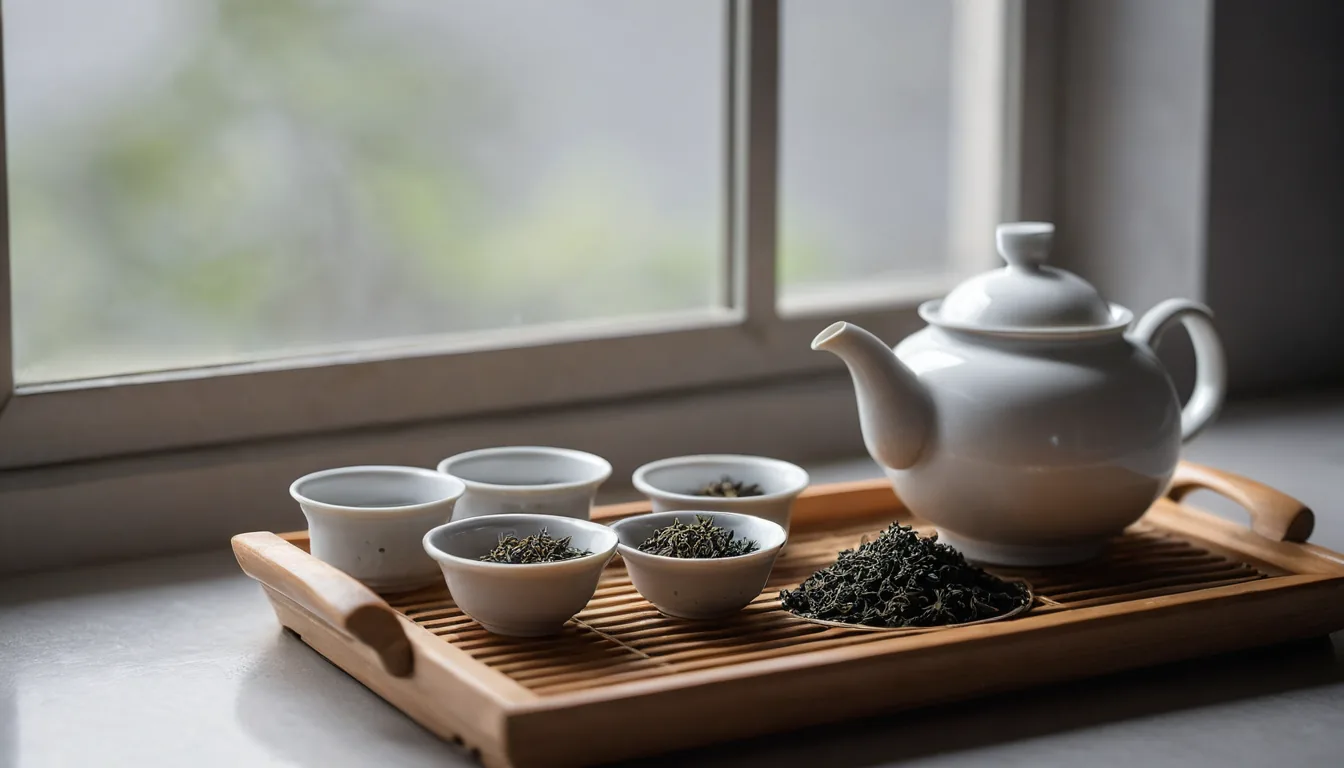
A strainer looks like a passive object. It is actually a flow controller. The size and number of openings decide how fast the liquor leaves the leaf, and that changes the cup.
The right strainer depends on the tea. A large-leaf oolong needs space; a fine broken leaf needs a mesh that catches particles without blocking the pour.
Mesh catches more, flows less
A fine mesh catches small particles and gives a cleaner cup. It also clogs faster. A mesh that is too fine for a broken leaf can stop the pour halfway, which leaves the tea sitting in water and over-extracting.
Mesh is best for teas with small pieces or for a final pour into a serving pitcher. It is less useful as the only strainer for a large rolled oolong, where the leaf needs room to open.
Punched holes flow faster
A strainer with punched holes passes liquor quickly and lets more small particles through. That can be acceptable in a rustic cup and undesirable in a competition tasting. The holes also scratch easily if cleaned with an abrasive pad.
Hole size matters more than the total open area. A few large holes can flow faster than many tiny ones, but they also let more leaf through. Look at the holes, not the marketing.
| Type | Flow | Particles | Best for |
|---|---|---|---|
| Fine mesh | Slow | Low | Broken leaf, final pour |
| Punched holes | Fast | Higher | Large leaf, quick pour |
| Basket | Medium | Medium | Gongfu sessions |
Leaf space is part of the design
A basket strainer that sits inside the cup gives the leaf room to expand. A small ball infuser does the opposite: it packs the leaf into a cage and restricts water flow. For a rolled oolong, the ball is the wrong shape.
If the leaf cannot expand, the center stays dry and the outside over-extracts. That is why a large basket often makes a better cup than a small mesh ball, even when the mesh is finer.
- Match the strainer to the leaf size, not the tea color.
- Leave at least half the basket empty for expansion.
- Rinse immediately after the pour.
- Use a soft brush; do not scrape mesh with metal.
Cleaning and taste
Old tea residue in a strainer can taste stale. Rinse it under warm water after every use and dry it fully. A mesh with trapped fibres needs a soft brush; a toothbrush works. Do not put delicate mesh in a dishwasher basket where it can be bent.
If the strainer smells sour, soak it in warm water with a little baking soda, then rinse. Do not use soap on a basket that will touch the tea unless you rinse it very thoroughly.
A simple flow test
Put 3 g of leaf in the strainer, pour 150 ml of water at your usual temperature, and time the pour. If the flow stops before the cup is full, the strainer is too fine or the leaf is too broken. If the liquor is full of bits, the openings are too large. The right strainer finishes the pour without a stall and leaves most of the leaf behind.
For the brewing side, see Tea Steeping Time; for cup shape and material, see Types of Teacups.
A 3 g sample of broken leaf in a fine mesh can stall a 150 ml pour in under 5 seconds. The same leaf in a basket with 1 mm openings finishes in about 3 seconds and leaves more particles in the cup. Neither result is automatically better; the question is whether the stall is over-extracting the leaf or the particles are spoiling the texture.
For gongfu brewing, a basket that leaves half the volume empty is usually a better tool than a ball infuser. The leaf needs room to open, and the basket lets you lift the leaf out between pours. A ball infuser is convenient for a mug, but it is a poor match for a rolled oolong that expands several times its dry size.
Clean a mesh strainer with a soft brush and warm water after every session. A brush removes the fine fibres that a rinse leaves behind. If the mesh is bent, replace it; a bent mesh creates a gap that lets leaf through and makes the flow uneven. Do not dry a fine mesh with a twisted towel.
The material matters less than the fit. Stainless steel is durable; ceramic is heavy; bamboo can absorb odour. A strainer that sits loosely over the cup can tip and spill. Choose one that rests stably, even when the cup is full. The best strainer is the one you can use without thinking.
A second strainer is not a sign of failure. Pouring through a coarse basket into a fine mesh gives fast flow and a clean cup. This two-stage method is common in tea service because it separates the leaf from the liquor quickly and still catches the fines before the guest drinks.
Test the strainer with the tea you actually drink, not with water. Water flows through everything. Leaf, especially broken leaf, is what reveals whether the design works. If the pour stalls, change the strainer before you change the tea.
The strainer is also a serving tool. A fine mesh that produces a clean cup can make a broken leaf look better than it is, while a coarse basket can let useful texture through. In a tasting, the same tea poured through two strainers can read differently: one cup looks clear and tastes narrower, the other looks cloudy and tastes fuller. Neither is the “true” cup; they are two views of the same brew. If you are comparing teas, use the same strainer for both. If you are serving guests, choose the one that finishes the pour without a stall. The tool should disappear into the routine, not become another variable that changes every time you brew.
A strainer that is hard to clean will eventually be used dirty. That is the practical argument for a simple basket with smooth edges and a brush that reaches the corners. A decorative strainer with a narrow spout looks elegant and traps leaf in the bend. Choose the one you can rinse in 10 seconds and dry in 10 minutes. The cup will be better because the tool is actually clean.
If you use a basket, check that it does not sit so deep that the leaf is fully submerged between pours. A basket that holds the leaf above the water line lets you stop extraction without lifting the whole lid, while a deep basket keeps the leaf in contact with the liquor. The difference is small in a 10 second pour and large in a 60 second one. Match the basket depth to the way you brew, not to the way it looks on a shelf.
The best test is a side-by-side pour with the same tea and the same cup. Put the basket in one cup and the mesh in another, pour at the same moment, and watch the flow. Then taste both after they cool for 30 seconds. If the mesh cup is sharper and the basket cup is rounder, the difference may be extraction rather than leaf. That is useful information: it tells you which tool matches the tea you are drinking, and which one is only convenient.
Choose the tool that lets the leaf leave the water when you decide, not when the mesh decides. That may be a coarse basket for a large oolong, a fine mesh for a broken leaf, or two strainers in series for a clean cup. The right answer depends on the tea in front of you, not on a rule about which strainer is “best”. A tool that stalls the pour is taking control away from the brewer.
A final test is to brew the same tea twice, once with the strainer and once without, pouring through a wide-mouth vessel. If the difference is small, the strainer is doing its job. If the difference is large, the strainer is changing the extraction, not just filtering it.
A strainer is easy to overbuy. The expensive version does not make better tea if the openings are the wrong size. Start with a cheap basket and a cheap mesh, use both for a month, and notice which one you reach for. That habit tells you more than a specification sheet. The goal is a repeatable pour, not a collection.
When you find the one that works, keep it clean and keep it in the same place. A tool that is always available gets used; a tool that is buried in a drawer gets replaced by a spoon. The best strainer is the one that is already on the tray when the water boils.
Finally, consider the cup you pour into. A wide cup loses heat quickly and makes a slow pour taste cooler; a narrow cup holds heat and concentrates aroma. The strainer and the cup are a pair. If you change one, change the other only after you have tasted the result. The same tea can feel thin in one cup and full in another without any change in leaf or water.
A good strainer also tells you when the leaf is done. If the flow slows in the middle of a pour, the leaf has begun to pack the openings; that is a cue to shorten the next steep or use a coarser basket. Watching the flow is more useful than watching a clock, because the leaf is changing while the water is moving.
The simplest rule is this: the strainer should finish the pour before the leaf finishes the steep. If the basket is too fine, the leaf keeps steeping while you wait; if it is too open, the cup fills with bits. Watch the flow, taste the result, and adjust the tool rather than the tea. That is the whole method, and it works with a cheap basket as well as an expensive one.