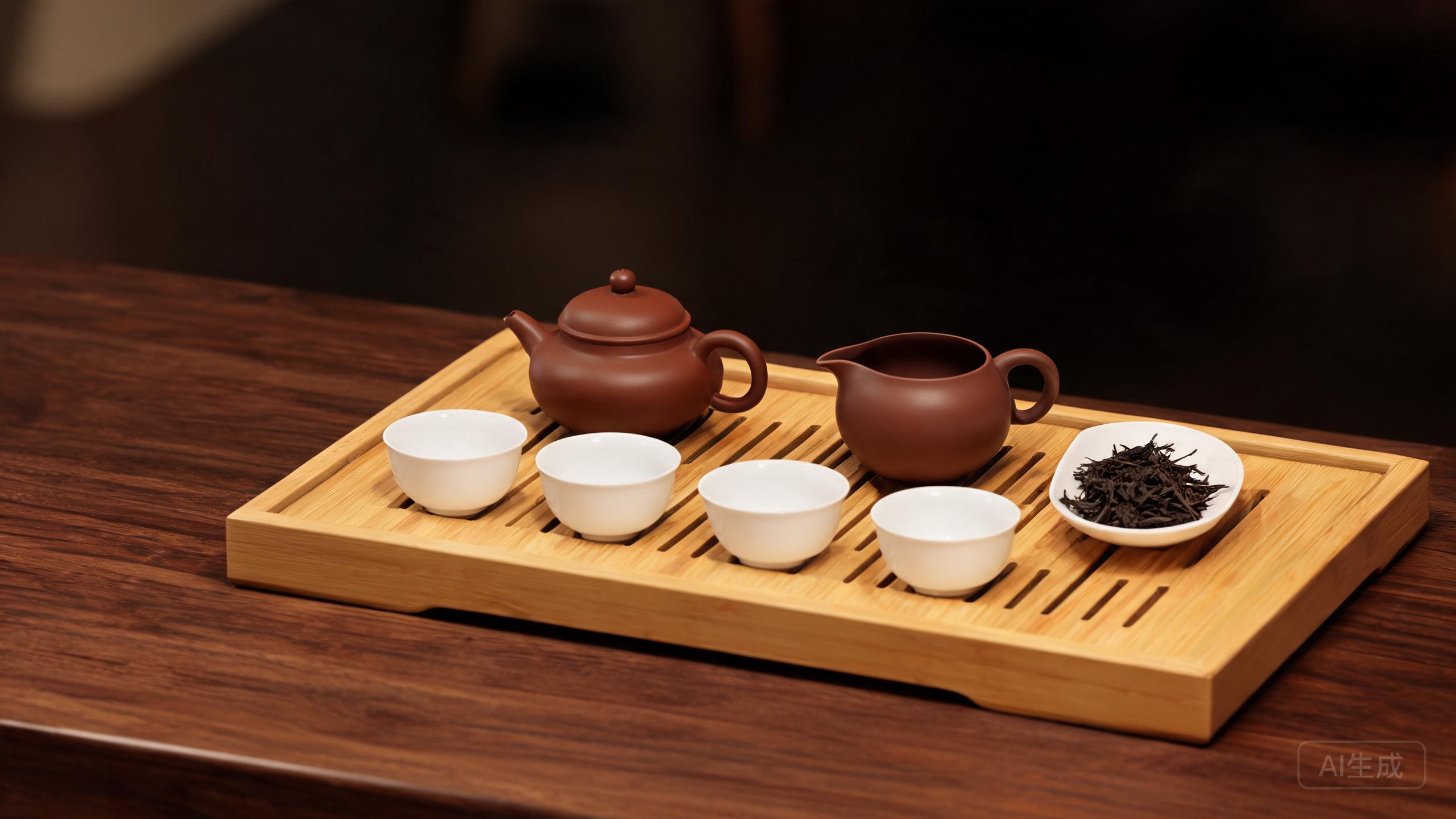
What a tray is actually for
A tea tray has one job, and it is not decoration.
It catches the water you pour away.
Gongfu brewing means rinsing the leaf, warming cups and overflowing the pot.
Without a tray, that water goes somewhere you did not choose.
A session can pour away 500 ml to 1 litre before anyone drinks anything.
The second job is to hold the session in one place.
Everything sits inside the same rectangle, and the table stays dry.
Most trays are 5 to 8 cm deep, which is enough for a rinse and a spill.
Some drain into a hose, and some hold the water in a drawer underneath.
Both work, and the difference is where you happen to be sitting.
A tray plumbed to a hose needs a bucket beside the chair.
One with a drawer needs emptying after every session.
Neither is better; choose the one that fits the room you actually use.
The tray is also the surface you pour over, so it gets hot and wet.
Anything that warps or stains badly is the wrong material for it.
The types, and what each costs you
Bamboo is the traditional choice and the cheapest.
It is light, it drains well through a slatted top, and it looks the part.
It also cracks if it is left wet or kept beside a radiator.
Wood is heavier and dearer, and it moves less with the seasons.
Root-carved trays, known as gen diao, come from a single piece of root.
They are expensive, heavy, and every one is a different shape.
Buy one for the look of it, not for any function it adds.
Stone trays are slab-cut and very heavy indeed.
A large one can weigh 10 kg, which is fine until you have to move it.
They do not crack and they do not warp, and they are a nuisance to carry.
Ceramic trays are glazed, easy to wipe, and they chip if dropped.
Stainless steel is the practical answer and the least attractive.
It drains, it survives, and it is what many tea rooms actually use.
Plastic versions exist, and they are a perfectly sensible first tray.
The material changes maintenance far more than it changes the tea.
Size, drainage and the details
Size is the decision people get wrong most often.
Measure the space you actually have before buying anything at all.
A tray that holds a pot, a pitcher and four cups needs real width.
One for a single drinker and a gaiwan(盖碗)needs far less than you think.
For one or two people, about 40 cm by 30 cm is usually enough.
The slatted top should lift out, or you will never clean underneath it.
Drainage holes need to pass leaf fragments, not just water.
A drawer that pulls out from the front is easier than one at the side.
Check that the tray sits flat, since a tray that rocks will spill.
Depth matters less than people expect, but a shallow one overflows fast.
A drawer holding 1 litre is plenty for a single session.
A mat or cloth under the pot keeps the surface from scratching.
Bamboo wants drying after use, and oiling once or twice a year.
Stone wants nothing at all, which is its one real advantage.
Whatever you buy, empty it the same day rather than the next morning.
Whether a beginner needs one
No, and that is the honest answer for most people starting out.
A bowl and a towel do the same job for the first few months.
What a tray buys you is tidiness and a fixed place to work.
That is worth something once the habit has actually formed.
Buy the cheap bamboo one first and see whether you use it.
If it is still out on the table after a month, upgrade.
If it has been put away, you have saved the money.
A tray does not change how the tea tastes, and nothing else about it does either.
Anyone brewing at a desk should use a small one plumbed to a hose.
Carrying waste water across a room is the fastest way to stop bothering.
A 25 cm tray is enough for a gaiwan and two cups at a desk.
Anyone short of space should skip the tray entirely.
A large towel is a legitimate substitute, and many people never change.
The ritual sits in the brewing, not in what catches the water.
Start without one, and add it when the habit has earned it.