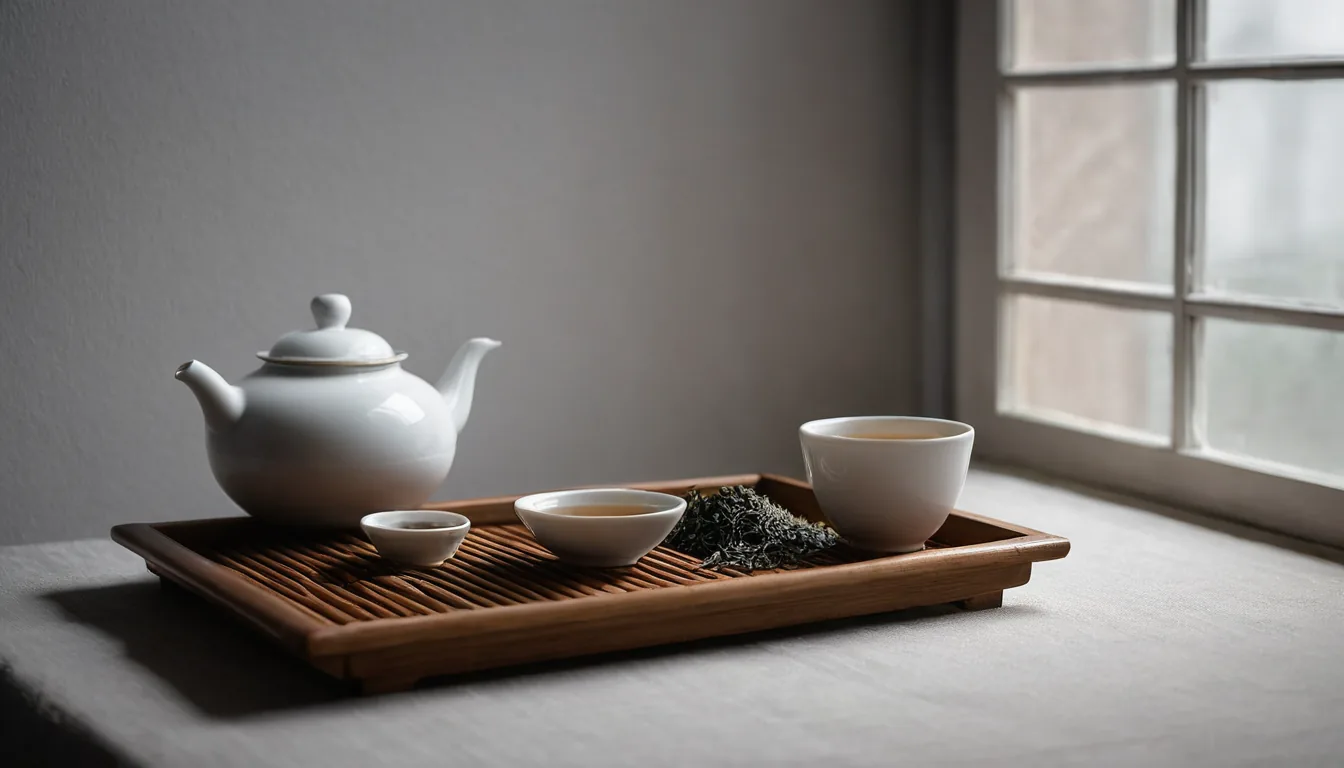
- Drying Tea: The Step That Decides Whether It Keeps
- The step that decides shelf life
- Why one drying step is not enough
- Six methods and what each does
- Withering is the opposite problem
- What goes wrong
- What a buyer can actually use
- Why does tea need drying?
- Is drying the same as firing?
- Why do oolong producers roast in several passes?
- Does drying temperature affect flavour?
- How dry is dry enough?
Drying Tea: The Step That Decides Whether It Keeps
The step that decides shelf life
Fresh tea leaf is roughly 78 per cent water. Left at that level it ferments, moulds and spoils within days, which is why every tea-making tradition ends with the same task: remove almost all of the water, and do it in a way that builds rather than destroys the flavour.
Finished tea carries 3 to 6 per cent moisture. Everything between those two figures is a sequence of decisions, and the sequence differs by tea type enough that it produces the categories themselves.
Why one drying step is not enough
Water does not leave leaf evenly. The surface dries first, and if the surface sets while the interior is still wet, the result is a leaf that looks finished and is not. That is the reason most traditions dry in stages, with a rest between them so that moisture can move from the middle of the leaf to the outside.
Oolong roasting shows the principle most clearly. The leaf is roasted at 100 to 110 °C, rested, roasted again at 80 to 90 °C, rested again, then finished at 60 to 70 °C. Each pass steps down in temperature, and each rest lets the interior catch up with the surface.
Six methods and what each does
The method chosen is not merely a matter of equipment. Heat applied one way builds one kind of aroma, and applied another way builds a different one from the same leaf.
| Method | Typical range | Used for |
|---|---|---|
| Pan drying | 100 to 120 °C | Flat and curled green teas |
| Hot air baking | 90 to 120 °C, in stages | Red tea and some yellow tea |
| Charcoal roasting | 60 to 110 °C, stepped down | Roasted oolong |
| Sun drying | Ambient | Raw material for pressed tea |
| Steam fixing | About 100 °C for 30 to 60 s | Steamed green tea |
| Withering | Ambient, 48 to 72 h | White tea, oolong |
Pan drying at 100 to 120 °C is what gives flat green tea its characteristic shape as well as its aroma, because the leaf is pressed against the hot surface while it dries. Hot air baking, by contrast, leaves the shape alone and works mostly on moisture and sweetness, which is why red teas are baked rather than panned.
The stages within a single method matter as much as the method itself. Red tea is usually baked in two passes, a first at 110 to 120 °C to take the bulk of the water out and a second at 90 to 100 °C to finish, with the lower second pass chosen because the aromatic compounds that carry the sweetness are volatile at the higher temperature. Running both passes hot produces tea that dries fast and tastes thin, which is the most common fault in machine-baked red tea.
Withering is the opposite problem
White tea and oolong begin with a stage that removes water very slowly, over 48 to 72 hours, with no heat at all. That is not drying in the sense above; it is a controlled loss of water that keeps the leaf alive long enough for its own chemistry to change.
The distinction matters because the two processes are often confused. Withering softens the leaf and starts transformations that heat would stop; drying ends the process and fixes what has been built. Reversing the order ruins the tea, and in practice the withering step and the drying step are separated by everything else in the method.
The water loss in withering is modest by design. Leaf typically drops from about 78 per cent to somewhere between 60 and 68 per cent over a day or two, and the target is a specific texture rather than a number: the leaf should be limp enough to roll without cracking. That is a narrow window, and it is why white tea production is so weather-dependent, since a humid day will not move the figure far enough in the time available.
What goes wrong
Two failures dominate. Under-drying leaves enough moisture for mould in storage, and the failure appears weeks later rather than at the factory. Over-drying drives off the aromatic compounds that were the point of the exercise, and the leaf arrives safe, stable and tasting of very little.
The second failure is harder to catch because it looks like success. A very dry tea keeps well and photographs nicely, and only the cup reveals that the drying went too far. That is why the grading systems that developed around Chinese tea include leaf appearance as a criterion: colour and lustre are readable proxies for how the final step was handled.
- Weigh a sample before and after drying if you want to know the real moisture; guessing is unreliable.
- Keep dried tea sealed and cool. At 12 per cent moisture it will mould; under 6 it will not.
- Expect roasted tea to change for weeks after purchase as moisture redistributes inside the leaf.
- Do not store different roast levels together; the lighter tea takes up the heavier aroma.
- Judge a green tea’s drying by its leaf colour, since over-dried leaf looks dull rather than green.
- Treat residual moisture as the main variable in shelf life, not the harvest date on the tin.
What a buyer can actually use
The moisture figure is never printed on a tin, but two of the consequences are testable. A green tea that looks dull rather than green was probably dried too hard. A roasted oolong that smells flat when opened and better a week later was probably still redistributing moisture when it was packed, which is normal and not a defect.
The practical conclusion is narrow. Moisture content, not harvest date, is the main determinant of how long a tea will keep, and it is the variable a buyer has least access to. Storing sealed and cool is the only lever available, and it compensates for a great deal.
There is one exception worth knowing, and it concerns pressed tea. A cake or brick that has been dried to 6 per cent and then stored at a steady humidity will slowly take up a little moisture from the air, which is part of how it ages. That is not a fault in the drying; it is the drying having been done correctly enough to leave room for the change. The failure to avoid is the opposite case, a cake that starts at 12 per cent and moulds before it ever has a chance to age.
Why does tea need drying?
Because fresh leaf is about 78 per cent water. At that level it ferments, moulds and spoils within days. Drying brings it to 3 to 6 per cent, which is stable.
Is drying the same as firing?
Not exactly. Firing fixes the leaf by heat early on; drying is the later removal of water to a target level. Many teas use heat for both, which is why the words get confused.
Why do oolong producers roast in several passes?
Because moisture has to redistribute inside the leaf between passes. One long roast at a high temperature dries the outside before the inside, which produces an uneven result.
Does drying temperature affect flavour?
Substantially. Higher temperatures push aroma toward roasted and nutty notes and away from fresh green ones, which is why the same leaf dried two ways tastes like two different teas.
How dry is dry enough?
Around 3 to 6 per cent moisture for finished tea. Below that the leaf becomes brittle and loses aroma; above roughly 8 per cent mould becomes a real risk in storage.